Public Works director recommends transit cuts as cost-saving measure
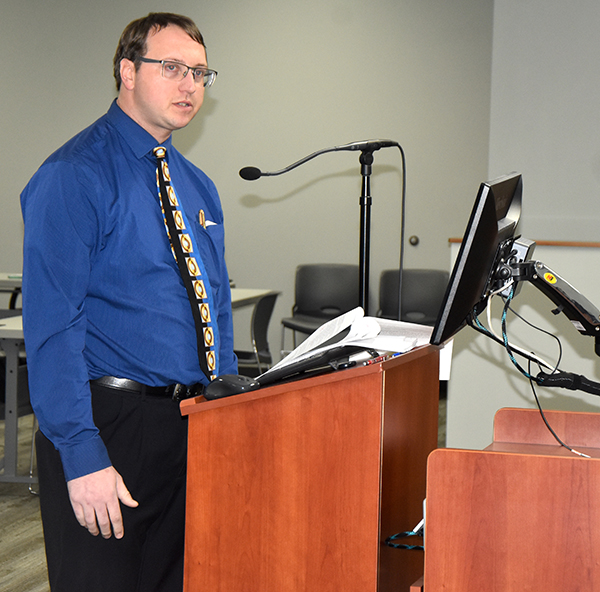
T-R PHOTO BY ROBERT MAHARRY Marshalltown Municipal Transit Director Kevin Pigors addresses the city council during Monday night’s city council meeting. Public Works Director Heather Thomas proposed both staffing and service reductions to address budget concerns with the transit fund.
Once the Marshalltown city council handled its first bit of business on hiring a search firm to search for a new city administrator during Monday night’s special meeting, it was back to the budget with a primary focus on the city’s enterprise funds — sewer utilities, transit, storm utility, compost and the parks and recreations concessions.
After spending about five minutes running through the sewer utility fund and not recommending any increases in rates for the time being — despite Councilor Gary Thompson joking that he was “trying to give her some more money” — Thomas then moved on to the topic of public transit, which has been in the news at least once over the last year due to prolonged staffing shortages.
She described the current state of public transit as “very challenging” not just in Marshalltown but across several cities in Iowa.
“As I go through this, I know it sounds kind of doom and gloom, but please realize that we are actually doing better than many of our comparable cities,” Thomas said.
From there, she told the council she was proposing a reduction in both staffing and services to address the situation and was seeking direction on where the tax levy should be set. Thomas credited Marshalltown Municipal Transit (MMT) Director Kevin Pigors and his staff for their efforts to continually increase ridership, but nonetheless, expenses have gone up at a higher rate than revenues.
“They are making the right efforts and connections in Marshalltown to increase ridership. In order for this to be a sustainable transit system, we are going to need to increase ridership,” Thomas said. “If we stay steady or we backtrack, we have two options. We either close or our transit levy is going to go up to the max of 95 percent.”
She also noted that the transit system serves the most vulnerable populations in the community — about 40 percent of ridership is elderly and disabled individuals — and that it helps reduce congestion in school areas as well. The school system does not transport students within two miles of an elementary or middle school or three miles from a high school, but those situations provide an opportunity for MMT to transport those students in what she called a “mutually beneficial” service.
Thomas then presented some proposed cost-saving measures including removing an $18,000 software purchase, delaying a $60,000 bus purchase and reducing staff. She acknowledged that the department hasn’t been fully staffed for a number of years and said they could go one of two routes — eliminating a full-time position to save about $64,000 or eliminating two part-time positions to save about $80,000.
“We’re realizing those budget reductions because we haven’t been full staffed, but looking at our budget, I think we’re probably confident right now that we would be able to do one or the other as a change, an effort change, to where the budget we present, we could eliminate one of those positions,” she said.
Ideally, she added, they would eliminate the full-time position and instead hire for the two part-time positions, and Thomas recommended that course of action to the council. Councilor Greg Nichols asked about the possibility for attrition through retirement, and Thomas said there is currently one full-time and two part-time positions open while she anticipates two other imminent full-time retirements.
Thomas also proposed a reduction in services by cutting the 5 to 6 p.m. ride and stopping an hour earlier than they currently do to save around $10,000 annually. She said the average was 5.2 rides per day during the final hour and that while it would have an impact regardless, it was the smallest impact possible.
A common suggestion over the years has been raising the fare from its current cost of $1, but Thomas explained that because of the state and federal funding the city receives based on ridership, efforts to increase the fare actually resulted in a loss in overall money after ridership declined. In her view, she didn’t feel the city could handle bringing paratransit routes as opposed to contracting them out to PeopleRides.
In examining the overall fund balance, Thomas projected it would drop from just over $1 million to about $500,000 if the council did not make any changes, but the number would climb back up to around $581,000 with the reductions she suggested. The current levy is just shy of $0.30 per $1,000 of valuation, and Thomas indicated that without any changes, it would still create major problems looking toward the future.
“We’ll be OK in Fiscal Year 25 and 26 but likely (end up) with a negative cash balance in Fiscal Year 27,” she said.
To balance the budget this year without any reductions, it would require more than doubling the current levy to $0.68 per $1,000, and balancing it with the reductions would require a levy of $0.61. Thomas did not recommend either of those actions but presented options for levy rates of $0.30, $0.35 and $0.40 instead before opening the floor up to questions.
In response to a question from Thompson on whether the bus lift would save on labor costs over time, Thomas invited Pigors to the stage, and he said they do currently have a bus lift and that they would simply be adding a second one. Thompson also asked if eliminating the later ride would help them in the morning (Thomas said the drivers were in favor of such a change) and whether the two main transfer locations — the courthouse and the Marshalltown Arts and Civic Center (MACC) — should be examined further.
According to Pigors, the MACC is the preferred transfer spot with its central location in town, and Thompson then said while he didn’t like to see the fund go down as much as was proposed, he supported the cuts Thomas presented.
After Mayor Pro Tem Mike Ladehoff asked what her recommendation was, Thomas said she was conflicted but definitely wanted to avoid a major levy increase to $0.61 or $0.68 while also not wanting to leave it at $0.30. A goal of hers is to increase student ridership by at least 100 in the coming years, and she said her ultimate suggestion would be to go with the $0.35 or $0.40 levy.
Nichols then made a motion to go with the $0.40 option, and before the roll call vote, Thompson asked Thomas if she felt comfortable that it would buy the city two fiscal years. The motion passed by a 6-0 vote with Councilor Jeff Schneider absent.
Todays News
Marshalltown Family Aquatic Center opens for season
Water Plaza temporarily closed for minor vandalism, maintenance work
Council awards HMA street rehabilitation contract to Manatt’s
America at 250: First Transcontinental Railroad had immediate impact on nation that continues to be felt today

Annual Black Dirt Days celebration starts Friday