
Marshalltown city council takes first step toward outright ban on data centers
Trending
(Editor's note: This is the fourth and final story in a series about last Monday night's city council meeting and the ongoing controversy surrounding data centers in the community.)
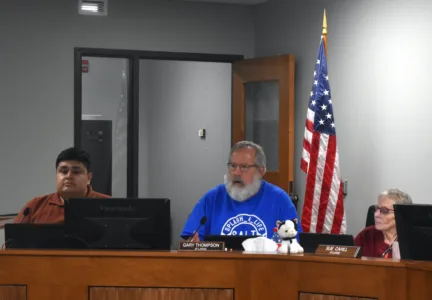
After spending approximately a half hour further discussing the future of the century-old city hall building at 24 N. Center St., the Marshalltown city council returned to the topic of the night -- data centers -- for the final hour-plus as Councilor Gary Thompson introduced the idea of an outright ban as a discussion item, citing overwhelming public feedback.
"This is probably a conversation we should've had a long time ago, and the reason I asked this to be on the agenda is the people that are... that I call the anti-data center group, that's the group that's been coming to all the council meetings," Thompson said. "And I can honestly tell you 90 percent of the calls and text messages and emails I get are from people that do not want a data center here."
His goal in putting it on the agenda, he added, was to see if those who favor data centers would show up to the meeting and weigh in with their perspective.
"I can count on both my hands the number of people that have approached me or contacted me that want data centers, and honestly, the only reason they can give me is the property tax revenue," Thompson said. "Don't get me wrong, we need the money. We do. We don't generate enough tax revenue to support everything that we do for you. But seeing the crowd tonight, (those in favor) are not showing up. We work for you, and we're listening to you. So I guess, let's have the discussion."
Thompson asked if there were other reasons besides tax revenue to allow data centers in town, and fellow Councilor Greg Nichols replied that the city needs new businesses, citing the prevalence of data centers within the Des Moines metro area and the lack of negative impacts -- including cheaper electrical rates -- often cited as arguments against them there.
"My concern is if we start selecting businesses we want and don't want, we're gonna have a closed (sign) on our door for businesses," Nichols said. "Can we select who's gonna come to Marshalltown? We can say we like all kinds of businesses, but we don't have a business coming into our town for quite a while. It's been mostly going out."
Mayor Mike Ladehoff described data centers as "new technology" and said young people entering the workforce no longer want to work in traditional factories, ultimately leaving for other opportunities as a result. He agreed with Thompson that the city needed the money but didn't feel like data centers constituted a "deal with the devil," instead insisting that with proper ordinances and regulation, such projects could become a win-win.
The mayor expressed frustration that common arguments against data centers, including water use, continued to be trotted out and lamented that people were not taking the time to inform themselves about closed-loop systems. He pointed to the potential positive impacts of construction workers spending money at local businesses as well.
"All of our quality of life in this town depends on economic development, whether you like to admit it or not, because if we do not move forward with economic development on our terms, services from the city of Marshalltown will be cut," he said. "There is no way around that."
He worried that a ban would throw a "wet blanket" over Marshalltown for future economic development efforts and resonate for decades. Councilor Jeff Schneider cited the need for diversification, property tax relief and an increase in artificial intelligence (AI) capabilities.
"We are in the middle of something bigger than the industrial revolution. We need the capacity. Trillions of dollars of capital are flowing into these projects, and we should take advantage of them," he said. "There is an unlimited wall of demand for these services. They are not going away... It would be like in the 1900s (saying) 'We don't want a power plant. We're fine with candlelight.' We really do need to embrace this."
Conversely, Councilor Mark Mitchell said a previous council 45 years ago "thought they were doing a good thing" by allowing the JBS meatpacking plant, which is Marshalltown's largest employer, to expand, but Mitchell argued that it had a negative long-term effect and felt that allowing a data center would constitute a similar mistake.
"Now look what we have sitting down there. It affects the whole city -- the drug problem, drug trafficking, you can smell it 30 blocks away. We don't need another situation like that. We can find other ways. That's why people aren't coming to town -- JBS," he said.
Councilor Sue Cahill commented that she has heard from community members who, while not necessarily rabidly pro-data center, are pro-business and pro-economic development, reading from a letter she had received before the meeting. The letter writer also claimed that people who shared their position were increasingly afraid to speak up due to the emotionally charged nature of the issue.
Fellow Councilor Melisa Fonseca took exception with the idea that those who would vote for a ban are anti-business or would discourage businesses from coming to town, but said it was an "ethical, emotional and environmental issue." She also asked how the third reading of the data center zoning ordinance scheduled for the next meeting on Dec. 7 could coincide with an outright ban.
City Administrator Carol Webb said such a ban would have to go back to the Planning and Zoning Commission and include a public hearing before a recommendation is made and returned to the council for three readings. City Attorney Steve Leidinger suggested rejecting the third reading at the next meeting if the council intends to move forward with a ban.
"The vote next (meeting) is going to come up. You can't stop it procedurally at this point with a discussion item," Leidinger said.
He added that the vote to eliminate the data center overlay district was "inconsistent" and didn't make a lot of sense to him. Thompson countered that if the zoning ordinance (129) is amended with the overlay removed, it would constitute a substantive enough change to restart the process with a first reading.
"So we have time to discuss this ban and possibly put it in place. So I don't think they're in conflict at all," Thompson said. "We should've had this conversation a long time ago, and I apologize for that... There's no harm in moving this forward because it's just a discussion."
The councilor, who has already indicated that he does not plan to seek re-election in 2027, said the ban would really only amount to a one-year moratorium as three council seats will be on the ballot in next year's election. A new council can reintroduce any issue.
From there, the council listened to nearly an hour's worth of public comment, starting with P&Z Chairman Jon Boston raising questions with Leidinger about the specifics of the data center overlay district and whether locations could still be added at a later date. Layne Pieri felt the ban should be given serious consideration, and Cody Brink questioned the job projections and encouraged city leaders to explore other manufacturing opportunities instead.
Marshalltown Area Chamber of Commerce President/CEO John Hall said, in no uncertain terms, that a ban would have "a chilling effect" on all types of businesses including restaurants and hotels. Over 4,000 Iowa jobs, he added, are directly tied to data center operations, and that number is projected to more than double by 2031 with projects underway. The average annual pay is over $125,000, he said, and the Meta facility in Altoona has 500 full-time employees.
A subsequent commenter raised concerns about the effect of a low-humming sound from a data center on schoolchildren, and recent Marshalltown Community College (MCC) graduate Amber Lawthers objected to being "spoken for" as to her preferences and said people like her would leave the community if data centers are allowed, referencing climate change, Flock cameras and AI "shredding up our childhood dreams." She would likely never get her dream job as an artist, she said, because of AI eliminating so many jobs in the industry.
"Building a data center in Marshalltown to everything that my generation has struggled with and will have to continue to struggle with for the rest of our lives at no fault of our own," she said.
An exasperated April Long wondered whether the council had listened to the public opposition to data centers, calling the situation "crystal clear" and asking them to "put a stop to this madness," and others agreed that the city should work to attract other forms of economic development. Kathy Larson warned that the ultimate goal of AI was to eliminate white-collar jobs and steal intellectual property.
"AI and the big companies are highly speculative. Most have not made a profit yet. They rely heavily on federal subsidies. They have overbuilt data centers, and they are very close to a bubble. Do we remember the dotcom bubble?" she asked. "Some companies survive. Some don't. We don't know which will. Do we want to buy the last guy who buys into a pyramid scheme? I don't think so."
Kiley Miller of Alliant Energy told the audience that base rates for customers would not increase for at least six years thanks in part to growth from large load customers like data centers.
"It is Alliant's commitment that new large load customers pay the infrastructure costs to serve their loads. One-hundred percent, emphatically, we are committed to that principle," he said. "Reliability comes first. It will not be compromised."
Leigh Bauder decried the "shroud of secrecy" surrounding initial data center conversations and non-disclosure agreements between developers and city staff, arguing that trust had not been rebuilt with the public and subsequently necessitated a ban for at least one year. Daleen Michel asked why environmental considerations had not played a larger role in the discussion and urged a pause until new federal and state regulations are enacted, especially given that the proposed overlay district in the Edgewood Industrial Park butts up against a residential area.
As a business owner himself, Jim Palmer said he approached the issue from a financial perspective and worried that banning data centers could put the city in a precarious financial position over the long term. Citing the looming vote on a franchise fee, which has already failed once at the polls previously, he contended that the council had nothing to replace the revenue a data center would generate.
MARSHALLTOWN Company President/CEO Joe Carter felt the environmental aspects had been considered throughout P&Z's process of drafting regulations, and he reiterated the argument that a ban would send a bad message to businesses that "foot the load" and already pay higher property tax rates. Carter also took Thompson, who said he had been swayed by strong public feedback from those who opposed data centers, to task and told him that he doesn't respond to his emails.
Jimmy Landt wondered if the data centers in the Des Moines area were close to residential areas, and he contended that the safety of the community should take a higher priority than money. Gina Tomlinson, who lives on North 5th Avenue near the Edgewood Industrial Park, asked how residents like herself and her neighbors would be protected from the noise and emissions of a data center. Stephanie Lizarde questioned why immigrants in the community who speak languages other than English were not part of the conversation on data centers.
"I don't think it's fair for them. I don't think it's fair for my mom to only just find out about this a month ago, and she lives by the area.. I don't think it's fair for the people who live by Woodbury to just be finding out about this. It's just not fair, and a ban would be a good thing. It would let people catch up," she said.
Larry Ginter of rural Rhodes recounted his long history of activism and compared the data center/AI debate to the rise of Concentrated Animal Feeding Operations (CAFOs) in the 1990s and its negative impact on family farming and smaller agricultural suppliers.
"What we're talking about here is humanity itself. You better understand that because I've been reading all sorts of horror stories about artificial intelligence and what it's doing to the human mind, the human psyche," he said.
Finally, Maggie Valentine noted that 16 states have proposed bans on data centers with more potentially being added to the list and a list of local municipalities passing long-term moratoriums or outright bans.
"Banning data centers is no longer able to be construed as an extreme action. It's happening all over the country, and it's happening because citizens are demanding it," she said.
Part of the reason, she added, is because proposed amendments to protect citizens have been rejected by the city council. City Clerk Alicia Hunter then read a trio of written comments, two in support of a ban and one from the president of Alliant's Iowa energy company reiterating the company's commitment to preventing rate increases for residential customers and opposing a ban or extended moratorium.
Thompson motioned to call for a vote to move the outright ban forward, send it to P&Z and then bring it back to the council for three readings through the ordinance process. It passed 4-3 with Thompson, Mitchell, Fonseca and Marco Yepez-Gomez in favor and Cahill, Schneider and Nichols opposed.
Contact Robert Maharry at (641) 753-6611 ext. 255 or rmaharry@timesrepublican.com.