
China opens Olympics, with lockdown and boycotts
Trending
BEIJING -- Chinese President Xi Jinping declared the Winter Olympics open Friday night, inviting the world back -- sort of -- for the pandemic era's second Games, this time as an emboldened and more powerful nation whose government's authoritarian turn provoked some countries' leaders to stay home.
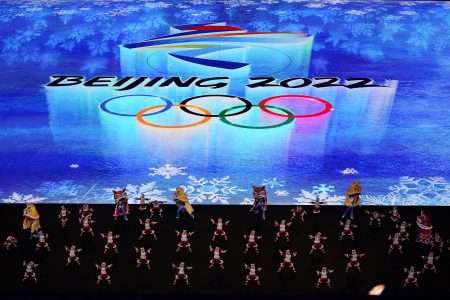
China used its first Olympics in 2008 to amplify its international aspirations. This time, in a ceremony held in the same lattice-encased Bird's Nest stadium that hosted the inaugural event of that year's summer Games, it presented a more confident, and defiant, face to the world.
Athletes Zhao Jiawen and Dinigeer Yilamujiang delivered the Olympic flame. The choice of Yilamujiang, a member of the country's Uyghur Muslim minority, was steeped in symbolism: Western governments and human rights groups say the Beijing government has oppressed Uyghurs on a massive scale.
With the flame lit, Beijing became the first city to host both winter and summer Games. And while some are staying away from the second pandemic Olympics in six months, many other world leaders attended the opening ceremony. Most notable: Russian President Vladimir Putin, who met privately with Xi earlier in the day as a dangerous standoff unfolded at Russia's border with Ukraine.
International Olympic Committee President Thomas Bach addressed assembled athletes: "Dear fellow Olympians: Your Olympic stage is set."
The pandemic also weighs heavily on this year's Games, just as it did last summer in Tokyo. More than two years after the first COVID-19 cases were identified in China's Hubei province, some 700 miles south of Beijing, nearly 6 million human beings have died and hundreds of millions more around the world have been sickened.
The host country itself claims some of the lowest rates of death and illness from the virus, in part because of strict lockdowns imposed by the government aimed at quickly stamping out outbreaks. Such measures instantly greeted anyone arriving to compete in or attend the Winter Games.
An Olympic opening ceremony typically provides the host nation a chance to showcase its culture, define its place in the world, flaunt its best side. That's something China in particular has been consumed with for decades. But at this year's Beijing Games, the gulf between performance and reality is shaping up to be particularly jarring.
Fourteen years ago, a Beijing opening ceremony that featured massive pyrotechnic displays and thousands of card-flipping performers set a new standard of extravagance to start an Olympics that no host since has matched. It was a fitting start to an event often billed as China's "coming out."
Now, no matter how you view it, China has arrived -- but the hope for a more open country that accompanied those first Games has faded.
For Beijing, these Olympics are a confirmation of its status as world player and power. Yet for many outside China, particularly in the West, they have become a confirmation of the country's embrace of more oppressive policies.
Chinese authorities are crushing pro-democracy activism and tightening their control over Hong Kong, becoming more confrontational with Taiwan, and interning Uyghurs in the far west -- a crackdown the U.S. government and others have called genocide.
In protest of those actions, leaders of the United States, Britain, Australia and Canada, among others, imposed a diplomatic boycott on these Games, shunning appearances alongside Chinese leadership while still allowing their athletes to compete. But China came back with its own symbolic finger in the eye Friday, putting Yilamujiang in the opening night's most anticipated role.
In the runup to the Olympics, China's suppression of dissent was also on display in the controversy surrounding Chinese tennis star Peng Shuai. She disappeared from public view last year after accusing a former Communist Party official of sexual assault. Her accusation was quickly scrubbed from the internet, and discussion of it remains heavily censored.
In the shadow of those political issues, China put on its show. As Xi took his seat, the performers turned toward him and repeatedly bowed. A simultaneous cheer went up as they raised their pom poms toward their president -- China's most powerful leader since Mao Zedong, who established the People's Republic in 1949. A barrage of fireworks, including some that spelled out "Spring," announced that the festivities were at hand.
A line of people dressed in costumes representing China's varied ethnicities passed the national flag to the pole where it was raised -- a show of unity the country often puts on as part of its narrative that its wide range of ethnic groups live together in peace and prosperity.
But politics still elbowed its way into the proceedings. The parade of athletes from Taiwan -- the island democracy that China says belongs to it but that competes separately as "Chinese Taipei" -- was greeted with a cheer from the crowd, as were the Russian competitors. An overcoated Putin stood and waved at the delegation, nodding crisply as they marched.
The stadium was relatively full, though by no means at capacity, after authorities decided to allow a select group to attend events.
As with any Olympics, attention will shift Saturday -- at least partially -- from the geopolitical issues of the day to the athletes themselves.