
COVID bill to deliver big health insurance savings for many
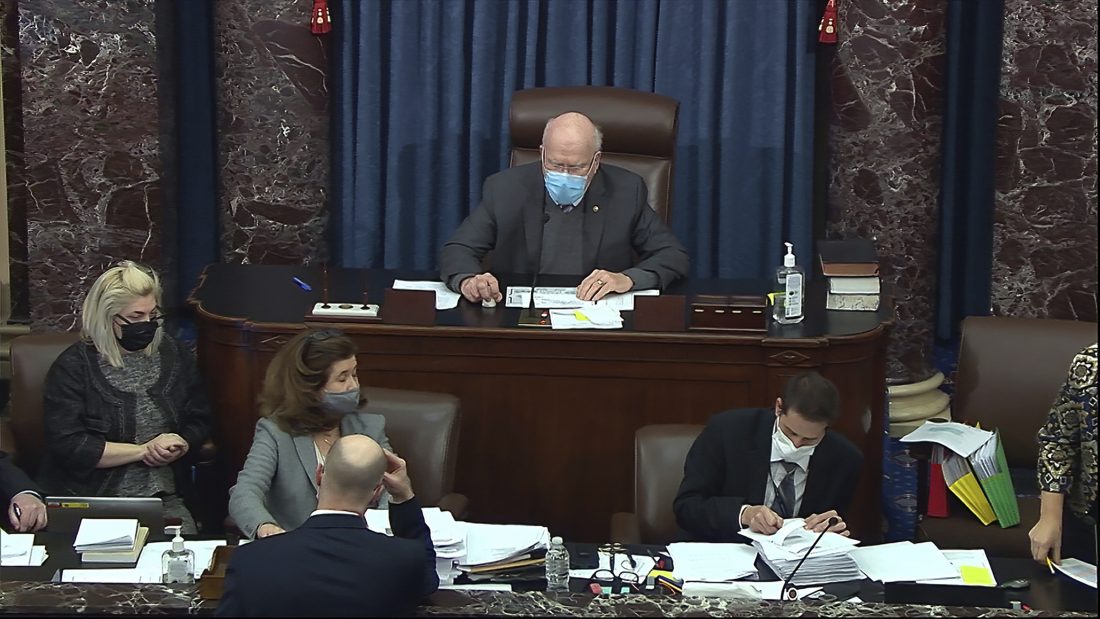
ap photo In this image from video, Sen. Patrick Leahy, D-Vt., the president pro tempore of the Senate, announces passage of Senate version of the COVID-19 relief bill by a vote of 50-49 in the Senate at the U.S. Capitol in Washington, Saturday.
WASHINGTON — Several million people stand to save hundreds of dollars in health insurance costs, or more, under the Democratic coronavirus relief legislation on track to pass Congress.
Winners include those covered by “Obamacare” or just now signing up, self-employed people who buy their own insurance and don’t currently get federal help, laid-off workers struggling to retain employer coverage, and most anyone collecting unemployment. Also, potentially many more could benefit if about a dozen states accept a Medicaid deal in the legislation.
Taken together, the components of the coronavirus bill represent the biggest expansion of federal help for health insurance since the Obama-era Affordable Care Act more than 10 years ago. “Obamacare” not only survived former President Donald Trump’s repeated attempts to tear it down but will now get a shot of new life.
Consider a couple of examples: A hypothetical 45-year-old making $58,000 now gets no aid under the ACA. With the bill, they’d be entitled to a $1,250 tax credit, or 20% off their premiums, according to the Congressional Budget Office. A 64-year-old making $19,300 already gets generous subsidies that reduce premiums to $800 a year. But with the bill, that person would pay no premiums for a standard plan.
Because health insurance is so complicated, consumers are going to have to do their homework to figure out if there’s something in the bill for them. And health care benefits are not like stimulus checks that can be blasted out. There will be a lag as government agencies, insurers and employers unpack the bill’s provisions.
There’s also a political twist. Since most of the health care aid is keyed to the pandemic and expires by the end of 2022, that will let Democrats set up election-year votes to make new benefits permanent, or build them out even more.
“There was always a hope that we were going to be able to return and build on where we started in 2009-2010, and we finally got to a place where it was possible,” said Judy Solomon of the Center on Budget and Policy Priorities. Her organization advocates on behalf of low-income people and was an early supporter of the health care law.
“We had this massive fight that went on for 10 years,” said blogger Robert Laszewski, who followed “Obamacare” for an industry audience. “Over the weekend, it’s like it’s been erased.”
Money & Markets
Gas prices eclipse $4 a gallon in the US, the highest since 2022
NEW YORK — U.S. gas prices jumped past an average of $4 a gallon for the first time since 2022 on Tuesday, as the ...

War with Iran delivers another shock to the global economy
Democrats, White House strike spending deal that would avert government shutdown
WASHINGTON — Democrats and the White House struck a deal to avert a partial government shutdown and temporarily ...
Wall Street sinks as Trump threatens 8 European countries with tariffs
NEW YORK — Stocks slumped on Wall Street Tuesday after President Donald Trump threatened to hit eight European ...
China buys several shiploads of U.S. soybeans ahead of Trump trade meeting
U.S. soybean farmers and lawmakers said the Chinese purchase of several shiploads of U.S. soybeans indicated a ...
Wall Street hits records following an encouraging update on inflation
NEW YORK — U.S. stocks hit records on Friday after an update on inflation came in a bit less painful than ...