Bluebirds and bluebells brighten up our lives
Bluebirds (Sialia sialis) are welcome spring and summertime birds that may well be offering us great viewing opportunities at nest box sites. Many folks have built and placed bluebird boxes in backyards or along open spaces in hopes of attracting bluebird pairs. If that happens, bluebirds who take up residential duties in a nest box will provide many hours of nature study to people with binoculars and/or spotting scopes. Hopefully you will be one of the lucky people to accomplish just that.
Today’s image of the bluebird pair was made during early April 2016. I was in the right place at the right time parked in a friend’s private driveway when I happened to glance out my window at the bluebird house the landowner had put up years previously. All of a sudden, a bluebird pair flew to the rooftop.
I slowly and carefully placed my long lens camera out the window and proceeded to make many clear, well lighted, well focused images of the pair. Sometimes one gets lucky to have an opportunity like this happen.
That same birdhouse has seen and met the test of time. Bluebirds always check it out, and if a male determines it will make a good home, he will try to persuade a mate it will be good by showing off for her. He does that by carrying grasses in and out of the bird box entrance then fluttering his wings to draw attention of the female.
If the female accepts his offers, she will join him in gathering nest materials. However, nest building is her thing inside the tree cavity of either an old woodpecker hole or man-made nest box. She selects grasses, pine needles and other soft thread-like particles to weave the final nest shape.
When satisfied, the pair will adopt that house as home, defend it vigorously, and raise the first brood of the year. It is possible they will raise another brood or even a third brood during the year.
Pale blue colored eggs numbering from two to seven will be laid. Each egg is about ¾ of an inch long and about â…� of an inch wide. Incubation takes 11 to 19 days, and the young bluebirds will be ready to venture out 17 to 21 days later as they explore and learn from the parent bluebirds how to survive in the real world.
Bluebird diet items are varied to include insects spotted on the open ground around their pasture or backyard site. Caterpillars, beetles, crickets, grasshoppers and spiders had better be careful. All are fair game.
Small critters eaten by bluebirds have been documented to include salamanders, shrews, small snakes, lizards and tree frogs. In the fall, small berries of juniper trees will work as food. So will hackberry fruits, honeysuckle, pokeweed, and many others.
In case you are wondering how many bluebirds live in North America, the American Breeding Bird Survey Partners in Flight organization estimates the population at around 22 million. This number is adequate to not place the bluebird on any watch list of concern. It goes without question, however, that all bird species the survey monitors have some of great concern due to population declines, and others with population growth patterns that continue to grow very well.
——
Bluebell flowers (Mertensia virginica) will grace the forest floors of many woodlands come mid May. Prior to tree full leaf out, sunlight can penetrate to the forest floor quite well. Virginia bluebell flowers respond to the sunlight, sending up stems as tall as 24 inches, but typically about 6 to 12 inches.
Each stem will have a cluster of flowers form in a hanging down position. Those tiny blue bell shaped blossoms will greet each morning dawn with dew drops suspended on them, and awaiting any insects probing the flower for nectar. In some forest areas, the entire forest floor will be one virtual carpet of blue as these plants dominate for a brief period of time.
Bluebells can be found in almost every forest, private or public. Look for them at Timmons Grove, Arney Bend, Grammer Grove, Three Bridges or other county park areas.
The Latin name for bluebells derives from a German botanist named Franz Karl Mertens who lived from 1764 to 1831. We still admire the dedication of naturalists of the long ago past and even of today who have a passion for understanding and improving our human knowledge of all plant and animal life forms. May that dedication never diminish.
——
April has arrived. This springtime month will bring new rains that will soak into the soil, nourish new plant life and help transform wetlands, forests and grasslands into a new productive year. From a natural history point of view, April will bring warmer air, more moisture and rebirth to all living plant species.
It will be a welcome wake-up for a new year. We look forward to all that April will provide, good and bad (as humans may define it), for which our options are to adapt just as we always have done.
Day length was 12 hours and 41 minutes on April 1. That will increase to 13 hours and 59 minutes on April 30, a very big step increase in solar insolation for our northern hemisphere. The power of sunlight will transform the sleeping soils of the landscape, awaken plant life and welcome new bird and mammal births.
On the weather side of the ledger, April can have Mother Nature show us extremes periodically. Examples from history tell us of the first 100 degree day on April 22, 1980, when Fort Dodge and Waterloo hit the thermometer setting of the century mark.
Not to be outdone, Mom Nature did an about face on April 6, 1982 at Manchester, IA with the latest record of below zero temps of -9 degrees. Ouch!
April 9, 1973 was the beginning of a three day long intense blizzard. High winds of 65 miles per hour and snowfall of 20 plus inches hit eastern Iowa in a big big way. Traffic was at a complete standstill until the storm finally broke. This storm, when details emerged from huge snowbanks, found suffocated cattle numbers in excess of 100,000, and over 200,000 farm turkeys also died in that storm.
In Marshalltown, no cars or trucks drove any roadways due to too much snow, and wind created large drifts. Emergency services were accomplished by volunteers on snow machines taking police and firefighters to and from work. Nurses and doctors rode snow machines to get from home to the hospital.
My wife, a nurse, was already at the hospital working in the OB/GYN department, unable to get home, so she stayed safe and worked extra shifts. I, meanwhile, was “trapped” at home in Albion with two little sons, who by the way were blissfully unaware of the dangers outside our warm home. It does not pay to make Mother Nature mad.
April will be overall a warming month. American toads will begin singing mating songs to their kind on or about April 10. Mid month shorebird migrations will see a significant increase of these avian critters as they filter northward.
Mid April will also see the emergence of garter snakes from hibernation. In southern Iowa by April 18, morel mushrooms may be poking their stems out of the forest floor. April 23 and close by dates will have pheasant hens on nests. So too will quail be on nests and wild turkey hens will be sitting on eggs. Wild turkey hunting season begins April 10 for bearded turkeys as our Eastern Wild Turkey species struts his full fantail and puffed out body plumage.
Lastly, April 29 is Arbor Day, a time to celebrate trees. Planting trees is a good thing to do during April. Make sure those trees are the right trees, in the right soil types, and in the right locations so that as a full grown tree, its crown of branches and leaves will be correctly placed for the safety of other trees or dwellings.
Brighten up the world by planting a tree of two or three, knowing full well you may never live long enough to sit under the shade of that tree. It has been said that the height of optimism is a 90-year-old person planting an oak tree seedling. He or she will never see that tree in its full glory, but knowing it will be there for the future is enough to inspire planting that little tree. Let it be so.
——
Garry Brandenburg is the retired director of the Marshall County Conservation Board. He is a graduate of Iowa State University with a BS degree in Fish & Wildlife Biology.
-
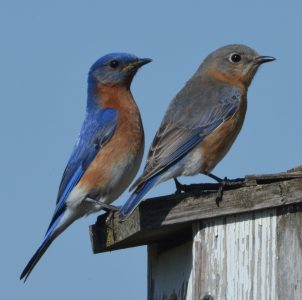
- PHOTOS BY GARRY BRANDENBURG — Bluebirds and bluebell flowers, when viewed against a clear blue sky, will surely brighten up your day. Bluebirds may have already arrived from wintering grounds as they search out territories and nest sites. Bluebell flowers of the deciduous forest floor will wait until mid May to carpet the land with their pale blue blossoms. In either case, this bird and this flower are harbingers of spring. Nature delights our senses and helps renew our souls.