Happy trails to you: Closing out OUTDOORS TODAY
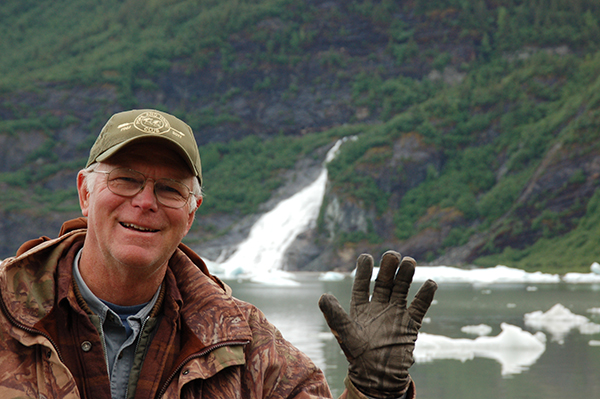
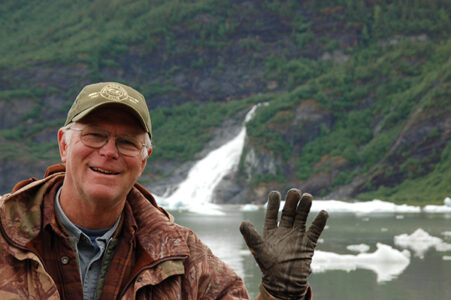
PHOTO BY BOBBI BRANDENBURG It has been a long time coming, an inevitable choice that lasted way longer than I had ever thought possible. After 34 years and two months of writing stories about all kinds of outdoor adventures, it is time for me to step aside. Perhaps the baton will be picked up by a new person or team of people to explore the wonders of Mother Nature's grand creations, adventures and explorations into the sciences of natural history. My decision to retire (a second time) is one I have contemplated for several years. The how, why and when were unknown factors at that time. It was my decision alone to make this ending of an era of writing effective with this installment for the Times-Republican newspaper. It is story number 1,763. My goodbye wave image was made in Alaska on June 4, 2011 at the toe of the Mendenhall Glacier near Juneau while on a cruise vacation. Thank you to everyone for your inspiration and following of my weekly TR Outdoors Today editions. I trust I have brought you along on many of those outdoor adventures through my written words. Better yet, if my places for adventure made you incentivized to explore on your own, that is great. Happy Trails to you until we meet again.
RETIREMENT, for a second time, is a somewhat bittersweet moment. As many of you already know, my professional working career as the Director of the Marshall County Conservation Board began a long time ago, specifically on June 1, 1972.
It was an excellent fit for who I am, my choice of studies at Iowa State University (1968-1971), and what my passion for conservation would entail as I worked to enhance natural areas and programs in Marshall County, Iowa. I retired the first time on June 30, 2004 with 32 years and one month of service.
There was an overlap of my contributions to the Times-Republican with my beginning Outdoor Today stories in October of 1991. I was still working at that time when the late John Garwood offered the baton to me.
Garwood had written his byline stories titled Sighting Upstream for about 40 years. His work inspired me as I read his words. Later on, when Garwood was in his early 90s, he desired an exit strategy. His dedication was a terrific example to follow. Garwood’s words of mentoring were taken to heart as I pursued my own pathways. The rest is now history.
After my first retirement in 2004, I continued to write for the T-R with my weekend edition about some aspect of natural history. Doing so meant that my “new job” was to continue to instill insight, wonder, fascination and scientific knowledge about our place in this Universe, our galaxy, our Earth and to highlight numerous local activities by people enjoying hiking, canoeing, bird watching, hunting, fishing, camping, wildlife photography, just to name a few. My stories were just one more method of continuing a never ending need for conservation education.
How did I find a topic to inspire me to write a story and make it interesting to you? I let the seasons of the year, and what people seemed interested in be my clues. Most of my subject matter could start with my passion for natural history and wildlife photography.
If I captured any image of good to great quality, those images would begin the search for more detailed information. And then, an exploration into more research would inevitably offer facts about the life of those critters, their habitats, and the cycles of life those episodes illustrated.
An assortment of local happenings could fill out that week’s edition, and then there were always, in season of course, someone’s big fish, big deer, or bag full of mushrooms or wildflowers at the Sand Prairie. Add in a timely new bison calf at Green Castle, new fawn deer in the spring, migrating waterfowl, canoeing or kayak adventures, great sunsets highlighting cloud bases, and many aerial images from an airplane to depict landscape features only offered from a high vantage point.
Many great tips would be provided to me about things to photograph. I would take diligent notes and make the journey to see what I could make of those natural moments. This was fun, and yes hard work, and maybe if I was persistent, I could obtain great photos.
A list of examples would be long, so here are just a few. A birder friend called to say that Ruby-throated Hummingbirds had a nest on the porch. I traveled there and made my long lenses do the work of recording a mother Hummingbird on her nest.
Later, when the young birds were about to fledge, I was there in the morning to record three bird heads poking out of a very tiny nest. Later that afternoon, those young birds flew away. Timing was everything, and I was lucky.
Other lucky opportunities were fox pups playing outside the den while the adult mother fox monitored her young’s escapades. As the pups played hide and seek with each other, I recorded digital images with a long 400mm lens.
After an hour or more of watching and making images, I backed out slowly to allow the foxes to continue to do their thing. I had the record of intimate interactions of young fox pups learning the skills they would need to survive. More than once, I was able to share those images with you, the readers.
Over time, I have collected several thousand images, all digital now, of wildlife, wild flowers and plants, weather events, and of course one of my special topics of interest, namely geology and Earth history. I find it amazing to be able to grasp the intensity of long ago geological ages when the Earth was much more unfriendly to life as intense volcanism took place around the globe.
I am still fascinated by Earth’s landscape sized glacial ice advances and retreats that come and go over time spans that humans have a hard time wrapping our minds around. But these natural events happened in Earth’s past. Given enough time, they will repeat their cycles again. Bringing these stories to you periodically helps us understand how precious our brief human life times are compared to the eternity of time that has passed and the eternity of time that is the future.
In closing, I offer these words of wisdom from another conservationist. His name was Aldo Leopold, and although he has passed, this college professor proved to be an inspirational educator and author.
In his book Round River, he noted this about the complexities of the land organism. He stated “Only those who know the most about it can appreciate how little we know about it. The last word in ignorance is the man who says of an animal or plant: What good is it? If the land mechanism as a whole is good, then every part is good, whether we understand it or not. If the biota, in the course of aeons, has built something we like but do not understand, then who but a fool would discard seemingly useless parts? To keep every cog and wheel is the first precaution of intelligent tinkering.”
May your truth detecting antennae always be ready to learn, to read, to investigate and to search for the truth. Facts matter.
So with these thoughts in mind, I offer my heartfelt, giant THANK YOU to everyone who has helped make my time as author of Outdoors Today a success. Happy Trails until we meet again.
———
Garry Brandenburg is the retired director of the Marshall County Conservation Board. He is a graduate of Iowa State University with a BS degree in Fish & Wildlife Biology.