Woodpeckers: small, medium and large
WOODPECKERS have unique habits that place them into a category of avian critters who conduct their life and food gathering abilities in similar fashion. Scientists place them in the family named Picidae. All have strong claws, short legs, strong stiff tail feathers to help them climb trees and brace themselves well for wood probing action of their beaks.
A sharp bill is used to chisel out insect foods. Chisel bills assist in excavating nest cavity holes, and bills tapping (drumming) on woody tree trunks help communicate to other woodpeckers territorial limits.
In the world, there are 217 species of woodpeckers. In North America, there are 25 species. The Midwest count is closer to seven.
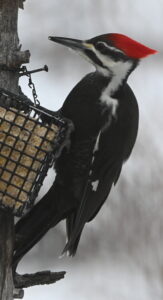
My big surprise this past week was to see and be able to photograph a female Pileated WP at the suet feeder of our Albion home. Last spring, I was offered the same opportunity to capture images of the same species at the same suet feeder.
Whether or not it was the same bird is just a guess, nobody knows. In any event, it happened.
I had a Nikon camera with its 400mm lens attached ready to go. I made many images and then selected the best ones to preserve. That is how I am able to share with you the excitement of seeing and recording this crow-sized woodpecker.
Pileated woodpeckers have a body length of 16.5 inches. It is the largest living woodpecker north of Mexico. It has an overall black coloration, with white underwing and wing patches visible in flight. A distinct white strip leads from its head down the sides of its neck.
Males have a large red top crest and a red chin line. Females do not have the red chin line of feathers, and the top crest does not extend all the way to its beak base.
Habitats for Pileateds include mature deciduous-coniferous woodlands. One common need is that the forests have a mix of scattered, large, dead trees or a ready supply of decaying down wood. It is within these forests that standing dead trees may offer the right mix for chiseling out nesting cavities, or finding foods.
A favorite food type are carpenter ants, but any ant species will work. Woodboring beetle larvae, termites and insects, caterpillars, cockroaches and grasshoppers are also on the menu.
Plants do not get a pass. Wild fruits and nuts will be taken from greenbrier, hackberry, poison ivy, holly, dogwood, persimmon and elderberry. Add suet at backyard bird feeding stations.
Nests in standing dead trees are a common site for their rectangular chiseled out entry holes. A male will begin the excavation process for entry and nest cavity depth up to 24 inches.
The female will contribute and keep chiseling away at half-rotted wood to make her roomy nest chamber just right. Wood chips are the only nesting material, no grasses or feathers needed to line the nest. It may take 3 to 6 weeks to excavate a nest.
Three to five eggs will be laid, each about 1.25 inches long. Incubation takes 15 to 18 days. Nesting takes another 24 to 31 days.
Both parents will be kept busy securing insects or insect larvae to feed the young. Catching the bugs is helped by a tongue that has tiny barbs to reach into tube-like cavities and retract the food item.
As a nature observer whenever I am outside, especially during bow hunting season awaiting deer passing by, pileated woodpeckers are a welcome and uncommon sighting. It is nice to hear and see this big bird of the woodpecker world.
———-
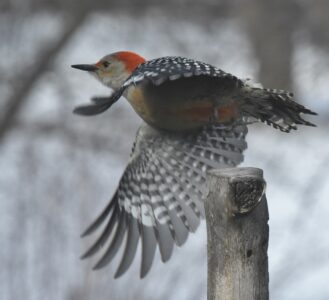
For mid-sized woodpeckers, the Red-bellied fits this category. Its body is about the size of a robin.
Its name is somewhat a mistake since the belly has only a hint of pale reddish tints to those feathers. Its head has lots of red, more red on males and less on females, but still a red head dominates.
This is not to be confused with the true Red-headed Woodpecker Midwesterners will also see each year. A better name for Red-bellies could be Bar-backed or Red-napped Woodpecker. Today’s image is of a Red-bellied taking off from a perch so that its undersides of its wings show alternating patterns of black and white.
Red-bellies eat ants, spiders, lizards and other arthropods. Plant matter includes acorns, nuts, pine cone seeds, grapes and other berry fruits.
When nesting in a new tree cavity each year, wood chips are enough of a nest lining. Two to six eggs may be laid, each of which is about one inch long.
Incubation takes 12 days and nesting another 24 to 27 days. This is a common species with a population expanding slowly at about 0.8 percent per year, according to the North American Breeding Bird Survey.
———-
The smallest of woodpeckers is the Downy. It has a body about the size of a sparrow, or about six inches long.
It has a black and white spotted appearance on its wings. A mostly white belly is noted.
Like other woodpeckers, its stiff tailfeathers are used to help form a base brace on trees so that the head, eyes and beak can be utilized to peck deep into tree bark of insect tunnels to find foods. Other foods are corn earworm, tent caterpillars, bark beetles and apple borers. Plant types on the menu are berries, acorns, grains and feeder station foods like sunflower seeds and suet.
Nesting sites are dead branches of living trees or in already dead trees. If a dead tree is infected with fungus that soften the wood, excavation may be easier.
Males and females work together to make a nest cavity that can take one to three weeks. Ultimately, the cavity will be six to 12 inches deep and widened at the bottom for more space.
Again, in typical woodpecker fashion, only wood chips line the nest bowl. Eggs laid count from three to eight and are about ¾” long.
Incubation takes 12 days. Nesting takes another 18-21 days.
So there you have it, a short and sweet summary of common backyard woodpeckers, although the Pileated is far less common than its family origins suggest. It is always interesting to take care in observations of nature, in this case unique birds of the same family, from small to medium to large.
Woodpeckers are neat.
———-
DEER HUNTERS continue to hunt. That is a good thing as keeping Iowa’s overall deer number in check is important. Hunters enjoy the time together with family or friends.
This tradition is a major factor in securing some wild grown venison meats. It is estimated that Iowa deer and deer hunting generate about $200 million in annual economic activities.
All things related to deer hunting include travel, hotel stays, meals, fuel, gear and supplies. Then add on venison processing services for many of those deer taken and the total adds up.
The time deer hunters spend at their sport is huge. There are mental and physical benefits to these times spent outdoors.
Hunting takes people back to an age-old instinct to provide food sources, to share that bounty and build stories and memories of another deer hunting season. Sometimes it is like fishing — “You should have seen the big one that got away.”
I’m sure that scenario will be replayed many times before Iowa’s gun season number two ends on Dec. 21, and of course there will be stories of the big ones that made a mistake in favor of the hunter. Another record book buck deer will tell its story for a long time into the future.
Statewide deer hunter registration numbers are approaching 60,000 by this weekend. By Dec. 21, it will be well into the 90,000 bracket of history of Iowa deer hunting statistics hold true.
Stay tuned for updates.
———-
HUNTING LICENSES for 2026 go on sale on Monday, Dec. 15. This is a general type license that covers small game and game birds like quail and pheasants. There are special combo licenses available if a person chooses to take that option.
Page five of the Iowa Hunting, trapping and Migratory Game bird regulations has a big list of license types to study. Perhaps this stocking stuffer will be a good Christmas present.
———-
Garry Brandenburg is the retired
director of the Marshall County
Conservation Board. He is a graduate of Iowa State University with a BS degree in Fish & Wildlife Biology.
Contact him at:
P.O. Box 96
Albion, IA 50005
-
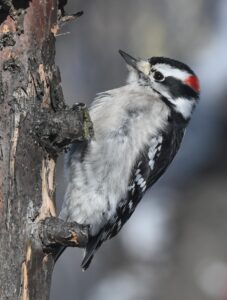
- PHOTOS BY GARRY BRANDENBURG — Woodpecker birds for us central Iowa folks to watch for still offers a good variety of species. For today’s outdoor adventure, I have picked just three — from the smallest to the largest, and one in the middle sized range. They are the small sparrow-sized Downy (Picoides pubescens), the Red-bellied (Melanerpes crolinus) in a mid-range size, and the largest crow-sized being a Pileated (Dryocopus pileatus). All of these are year-round residents. Woodpeckers tend to get that name moniker from the primary foods they eat, namely bugs from the bark of trees or acorns from oak trees. Their foods are much more diverse, still it remains that to gather some of these foods, they use their beaks to dig away woody material to expose the morsels they want to eat.