Round River: Winter Woods
The most difficult lesson which Iowans are learning is that fence-rows, grown up to prairie plants, shrubs, and some trees are beautiful rather than unsightly and that the protection thus afforded wildlife, especially song and game birds, is much worthwhile.”
–J.M. Aikman and Ada Hayden, 1938. Trees in Winter.
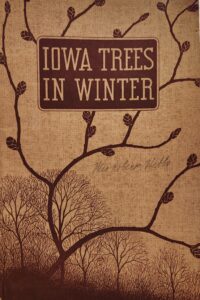
Bob Hibbs, retired Forester and long-time Marshalltown resident, gifted me this original Iowa State College Extension Circular a few years ago. The pamphlet had been his mother’s, a 1906 graduate of Grinnell College who was born two years apart from the renowned Botanist Ada Hayden. Inside the cover, Bob quipped, “I wonder if Ada Hayden (known for her love of wildflowers and herbaceous plants) had more interest in trees than prairies!”
For lovers of both the natural world and Iowa’s conservation origins, the book is a fascinating document. The Introduction gives thorough context to Iowa’s natural history in relation to its pre-settlement biomes, as well as the habits of early settlers who may have actually planted more trees than they cut.
“As valuable as trees were for occasional logs or a few boards, they were even more valuable in the form of a grove for protection and shade around the new home. As one early prairie settler said, ‘A tree meant more to us than the number of board-feet which it contained.’ They seemed more anxious to establish and care for adequate shelterbelts around their homes than are some few of their descendants among the present-day inhabitants. Many trees were set out around the new house from planting stock brought from the east, and many long journeys were made to the nearest forested streams to bring back cuttings and saplings for home planting.”
These early trailblazers’ affinity for trees was both a practical matter and at times something more abstract.
“For the pioneer, the light of the prairie was so strong that it blinded his eyes. He could face the prairie only with the woodland at his back. Woodland meant water; it meant food; it meant shelter. Occasionally, someone more adventurous than the rest had launched boldly out from the shore…into the open ocean prairie and had fixed his home where the storms of summer and the wintry winds might approach him on all sides, and in defiance also of the distance whence the materials of fire and shelter and fences were to be procured.”
“Few of the early settlers were content to live for any length of time on a homesite which was not protected by a grove of trees.”
“There seemed to be something of kinship, something of welcoming protection about the woods to those who came pouring out of the forests of the East. There was companionship in the woods — even in their deep mystery. In any event the forest comer would snuggle up to them.”
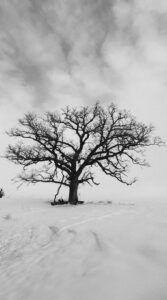
I totally get it. There’s just something about being in the woods — even in the winter.
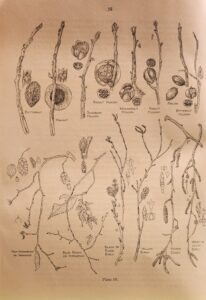
The book goes on to provide Dr. Hayden’s extraordinary hand-drawn illustrations of dozens of different species’ winter twigs, buds, leaf scars, and bark, along with identification tips, keys, and descriptions. Like any botany textbook, it gets a bit dry for my taste, reminding me of the Walt Whitman poem When I heard the Learn’d Astronomer; that is to say, it’s a lot more fun to just head out to the woods and ponder the mystery and magic of that wild place than it is to read the scientific descriptions in a book.
To many people, February is a bleak month of cold, gray, and darkness – but the winter woods are slowly awakening. Barred owls and great horned owls begin their courtships and nesting, offering peak opportunities to hear them calling. Many furbearing mammals also begin their mating seasons right now, including coyotes, red fox, squirrels, rabbits, raccoons, and bobcats. We tapped maple trees on Wednesday this week. By the end of the month, we’ll have a full extra hour of daylight and we’ll be able to look up at silver maples and see their tiny reddish-yellow flowers beginning to bloom at the tops already. To me, February is actually a little bittersweet; although I’m excited for each lengthening day and the prospect of spring warmth, I’ll miss the slower pace of the winter months, hanging out by the fireplace with my kids, and the austere beauty of the woods in winter.
A quick note about Windbreaks and Shelterbelts: If you are one of the wise rural Iowans who, like the early pioneers, planted a thick windbreak of shrubs and evergreen trees around your home years ago, congratulations! You may have saved up to 40% on your winter heating bill during last month’s lengthy arctic experience. For the rest of you, if you weren’t aware: Iowa’s Soil and Water Conservation Districts offer a Windbreak Assistance program with both financial and technical assistance to help establish or replace farmstead windbreaks. Contact the county USDA office for information.
Upcoming events to know about:
— Woodland Management and Water Quality Workshop, Grundy Center, Feb. 17th. RSVP by calling 515-294-5429 by 2/13
— Tri-State Forest Stewardship Conference, Dubuque, March 3. https://naturalresources.extension.iastate.edu/events/forestry.
——-
Joe Herring is the District 3 Forester with the
Iowa Department of Natural Resources.