Round River: CRP: It’s not love (but it’s not bad)
None of us who are alive today will ever know, nor feel, what it must have been like to gaze across Iowa’s endless sea of prairie grasses in the early 1800’s. “There was only the enormous, empty prairie, with grasses blowing in waves of light and shadow across it, and the great blue sky above it, and birds flying up from it and singing with joy because the sun was rising.” -Laura Ingalls Wilder
The closest surrogates we have today are large-scale restoration projects such as the Neal Smith Wildlife Refuge (a mostly artificial habitat reconstruction on retired agricultural lands), or the sharp-ridged grasslands of western Iowa’s Loess Hills region. Actual unplowed, virgin prairies exist only on fragmented, postage stamp-sized remnants hidden away in the margins of pioneer cemeteries, wet corners of old pastures, steep bluffs, and other slivers of land unsuitable to farm or build on. The 17-acre Marietta Sand Prairie State Preserve in Marshall County is a rare local gem.
Caught somewhere between our modern day intensive rowcrop matrix and the wrinkled, unfarmable “wastelands” as they used to be called, is the Conservation Reserve Program (CRP). To give context to the article title, if pre-settlement prairies had been Merle Haggard’s first love, then CRP habitat would have been the newer, but less desirable replacement mistress that he crooned about back in 1975: “We still don’t have what you and I once had…no, it’s not love, but it’s not bad.”
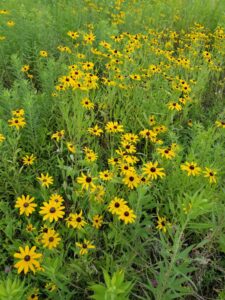
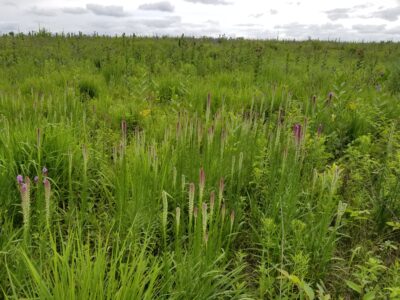
For those who may not be familiar, CRP is a federal Farm Bill program dating back to 1985 which offers rental payments to farmers willing to voluntarily and temporarily “retire” certain portions of their ground. Instead of growing corn or soybeans, the landowner signs a 10- or 15-year contract and seeds the ground down to perennial vegetation such as native prairie grasses and wildflowers, letting it “rest” while providing wildlife habitat and soil erosion benefits. In return for not farming it, and for doing periodic maintenance to ensure the success and functionality of the conservation practice, the landowner receives a payment on par with local cash rents based on their soils. Most CRP habitat mixes contain at most 30-40 different species of grasses or forbs, a far cry from the 300+ species represented in native remnants.
But protecting sensitive, Highly Erodible Lands (HEL) and providing wildlife habitat were not the only reasons for the 1985 Farm Bill CRP. Like its ancestors, the Soil Bank program of the 1950’s and the Agricultural Adjustment Act of 1933, CRP was deliberately intended to take marginal ag lands out of production specifically to help alleviate the problems of overproduction. Farming fewer acres would reduce grain surpluses and help raise marginal commodity prices, which was important to farmers if you remember the 1980’s. A common nickname among older farmers for CRP is “set-aside.”
Fast-forward to today and talk to any farmer or rural Iowa landowner, and you’ll receive mixed emotions when discussing CRP. To some who use the program, it’s a hot mess of acronyms, rules, confusing policies, or even government overreach. But to many, myself included, it’s widely considered to be one of the most successful voluntary private lands conservation programs ever conceived. In a state like Iowa, where public lands for hunting and outdoor recreation are scarce, private landowners have either the responsibility or the opportunity (you decide) to provide habitat for both game and non-game wildlife species. CRP has done that to the tune of millions of acres nationwide since its inception. Keeping soil in place, filtering water, and building soil health are added benefits reaped by the owner.
Last month, the USDA announced it would begin accepting offers from farmers & landowners for both a Continuous and General CRP signup. The modern CRP has an array of vegetation types to choose from and configurations to fit any farm, including field borders, buffer strips, Highly Erodible Land on steep slopes/erosive soil types, wetlands, grassed waterways, and more. Some special initiatives, like the Clean Lakes, Estuaries, And Rivers (CLEAR) 30, offer bonus incentives and 30-year contracts for practices that focus on water quality. And, unbeknownst to many Iowa landowners, not all CRP needs to be planted to grasses and wildflowers. You can elect to plant hardwood trees, conifers, and shrubs using forest-based CRP practices such as hardwood tree planting, field windbreaks, riparian forest buffers, living snowfences, bottomland hardwoods on 100-year floodplains, and more. Interested landowners should visit their local USDA office immediately for information and to apply.
However, one major issue looms: “the program is currently limited by an arbitrary 27-million acreage enrollment cap and is likely at or very near that limit,” says Jonathan Coppess of the Department of Agricultural and Consumer Economics, University of Illinois. Coppess goes on to make a compelling case for congress to act swiftly to raise that cap in his article, “Now Would Seem Like A Good Time To Think Seriously About The CRP” published February 26, 2026 on the Illinois Farmdoc Daily website (16):32.
There is much in the news lately about massive uncertainty facing Iowa’s farmers, from the costs of production to a lack of markets, both exports and domestic. During times of thin profit margins, stress, and unpredictability, CRP has historically provided a solid alternative to the yearly market fluctuations and uncertainty that farmers face.
CRP isn’t perfect, and it’s certainly not for every farm operation. Like any political topic these days, opinions will vary dramatically. Urban taxpayers may find some solace in swapping their costs for crop insurance subsidies to that of improving soil health, protecting water quality, and creating habitat for pollinators. Sportsmen and women who like chasing pointers and flushing dogs in November already know that they have reaped the benefits of CRP. An old couple who watch their young grandchild reel in a fat bluegill from their farm pond might conclude that enrolling the grassed waterways or buffers upslope was well worth the hassle. On my Grandpa’s farm where my brothers and I used to spray Velvetleaf with glyphosate while riding the “bean bar,” my kids and their cousins now run around with butterfly nets catching and tagging Monarchs.
No, it may not be true love; it is just a government program, after all; but it sure ain’t bad.
———–
CRP has also been a boon to waterfowl populations. The Iowa River Valley Ducks Unlimited chapter will host their 52nd Annual Membership Banquet on Saturday, March 14th at the Midnight Center, 1501 South 17th Ave, Marshalltown. Doors open at 5:00 PM with dinner at 7:00. Advance tickets including meal and membership are $60, or $75 at the door. Visit ducks.org/iowa#events.
———–
Joe Herring is the District 3 Forester with the Iowa Department of Natural Resources.
-
- CONTRIBUTED PHOTOS