
Not my words
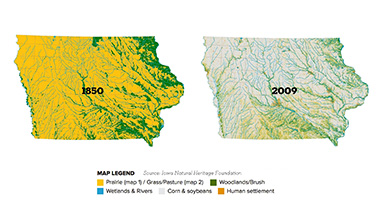
CONTRIBUTED PHOTOS — These maps compare historic and modern land cover in Iowa. Maps by INHF.
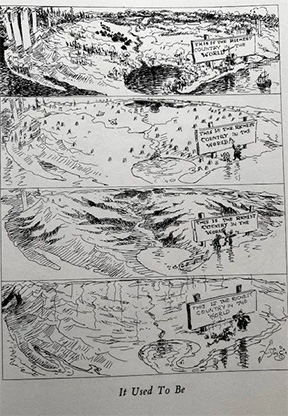
CONTRIBUTED PHOTOS — These maps compare historic and modern land cover in Iowa. Maps by INHF.
Trending
One piece of advice Garry Brandenberg gave me before retiring from his column was, "Don't make it political." I replied, "Everything is political nowadays." I do not know why it needs to be, but we have interjected politics into every part of our daily lives, from the font we use to the radio station we listen to, the cars we drive, and the places we eat. Politics has wound its way into almost every part of everyday life.
So here is my disclaimer: When I talk about conservation in Iowa, I am not taking political sides; I'm taking conservation's side. Like The Lorax, "I speak for the trees, for the trees have no tongues." To be honest, I do not understand why caring for the land has to be political. Caring for the future health of our waters, soils, and animals and plants should not be just one party's concern; it should be everyone's. Water, soil, and the creatures that live on Earth directly impact humans. "When nature suffers, we suffer. And when nature flourishes, we all flourish," Jane Goodall.
That said, I will talk about how conservation is being affected by both sides of the political aisle, because I think it is important to know what is happening under the golden dome. I want to cover the good, the bad, and sometimes the ugly, because what we don't know, we cannot change. As Nelson Mandela said, "Education is the most powerful weapon which you can use to change the world." And as Mo Ibrahim said, "I am not a politician. I am not in politics. I'm just a citizen."
For me, problems that are so big often feel beyond my control and like there is nothing I can do about them. But that is an easy excuse not to try, as Desmond Tutu said, "There is only one way to eat an elephant: one bite at a time." There are many small steps you can take to improve conservation in Iowa. One of the first steps is to learn about the dynamics affecting conservation in your area or in the state.
If you do a quick Google search for conservation challenges in Iowa, the results are habitat loss, climate change, and agricultural pollution. Google's words, not mine! I know a lot of those things are political issues, but why? Because politicians have made them be. Because one side or the other has called them a hoax or used them as a soapbox. The fact of the matter is that our environment and the creatures inhabiting this land, including humans, are suffering due to this divisiveness. Humans are intelligent creatures; we need to step out of our Facebook Pages and tight-knit circle of people who tell us we are right and have honest problem-solving conversations with those who might not agree with us. Because, "We cannot solve our problems with the same level of thinking that created them," Albert Einstein.
So let's delve into this hornet's nest of so-called political issues. One significant issue conservation in Iowa faces is severe habitat loss. Iowa is the most altered state in the nation, meaning that it has changed more than any other state in the United States since European arrival. We have lost 99.9% of our prairies, 98% of our wetlands, and 75% of our forests. We are 49th in the nation in terms of public land. Less than 3% of the state is public land, and half of that is road right-of-ways. So, when I get an email about future infrastructure development that will negatively impact county parks and their wildlife or natural resources, I think of the quote, "Earth provides enough to satisfy every man's needs, but not every man's greed." Mahatma Gandhi
But these current metrics do not have to define us. We can make improvements for future generations. As the Native American Proverb says, "We do not inherit the earth from our ancestors; we borrow it from our children." Martin Luther King III adds, "Because no matter who we are or where we come from, we're all entitled to the basic human rights of clean air to breathe, clean water to drink, and healthy land to call home." We as humans need to start caring about the future of land health in Iowa. As Ice Cube says, "You better check yo self, before you wreck yo self."
Climate change is another one of those touchy subjects, and whether you choose to believe in it or not, it is hard to deny that days of gentle soaker rains have been commonly replaced with storms that roll into Iowa, accompanied by hail, derecho-force winds, monsoon rains, and a tornado here and there. The National Weather Service records billion-dollar disasters, which have been adjusted for inflation. In 40 years (1980 - 2019), there were 59 billion-dollar disasters. In four years (2020 - 2024), there have been 27. From 1980 - 2019, Iowa averaged 1.47 billion-dollar storms per year. From 2020 to 2024, we have an average of 5.4 billion-dollar storms per year.
Why does this matter? Severe storms and drought stress are damaging what little wildlife habitat remains in Iowa. Over the past few years, we have watched many hundred-year-old oak trees die across Iowa due to the stress of drought and storms. Trees that have been damaged by storms are more vulnerable to insects and fungi. This environmental stress is causing the corner posts in Iowa's forest ecosystems to lose a battle they had fought for hundreds of years. What has changed? "Ancient trees are precious. There is little else on Earth that plays host to such a rich community of life within a single living organism," Sir David Attenborough. Additionally, the large gully-washer rains are exactly that, gully washers, washing sediment that is not secured by plant roots into our waterways. Which leads us to the next conservation issue, water quality.
Water quality is a big buzzword for many politicians right now, and it affects every Iowan. When I was a senior, I spent my last summer of freedom volunteering with Marion County Conservation and, in my free time, floating away the hours on Lake Red Rock at Wallashuck Beach. Now, a couple of decades later, I do not let my children swim at public beaches in Iowa. There are only a few places I will let my children get into Iowa's waters. The only way to fix the poor water quality is conservation. Water quality is directly tied to agriculture, and for some reason, the two groups, conservation and agriculture, both of which care deeply about the land we live on, cannot see eye to eye on how to fix the erosion problem. Which is Iowa's number one pollutant in our waters. On average, slightly more than 6 tons of soil per acre per year erodes into Iowa's waterways, according to the Iowa Farm Bureau. That is 142.8 million tons of topsoil that erodes from Iowa's fertile farmlands annually. It carries with it forever chemicals, nitrates, phosphorus, viruses, and E. coli. As Franklin D. Roosevelt stated, "A nation that destroys its soil destroys itself." No one benefits from soil loss and dirty waters, no one.
As I began writing this article, a bunch of favorite quotes popped into my head. Quotes that I have memorized and used over and over again. Quotes from very different people that have become a motto of the person I am today. In the song Spring Winds, Greg Brown sings, "In a mucked up lovely river, I cast my little fly, I look at that river and smell it, and it makes me wanna cry, Oh to clean our dirty planet, Now there's a noble wish, And I'm puttin' my shoulder to the wheel, 'cause I wanna catch some fish." So, how are you going to help put your shoulder to the wheel? How can you make a difference in habitat loss, water quality, or climate change? How are you going to tackle these world-altering problems? Easy: educate yourself, have hard conversations, and take on the challenges one bite at a time. Because "The Earth is a fine place and worth fighting for." Ernest Hemingway
J.N. "Ding" Darling was a cartoonist for the Des Moines Register from 1900 to 1949. Even over 100 years ago, he was trying to warn about the effects of habitat loss in Iowa. Darling, Jay N. (Jay Norwood). "It used to be". Editorial cartoons. Editorial Cartoons of J.N. "Ding" Darling. Accessed June 11, 2026. https://digital.lib.uiowa.edu/node/83259.
-------
Emily Herring is the director of the
Marshall County Conservation Board.