Labor Day a national tribute to workers
Editor’s Note: Sept. 1 marks the 120th anniversary of Labor Day’s official designation by Congress as a legal holiday. The day is synonymous with organized labor’s victories and defeats.
Staff and features reporter Mike Donahey researched the history of the United Auto Workers in Marshalltown, and interviewed other union leaders about their current priorities and how they view the future.
First in a series of two.
On Monday, many central Iowans will celebrate Labor Day.
For some workers, it will be a welcome respite from a day of work, and to spend time with family and friends.
For those in the armed forces, law enforcement, health, the hospitality and service industries, among others, it will be a day of work as usual.
Labor Day, fittingly, was a creation of the labor movement and is dedicated to the social and economic achievements of American workers.
It constitutes a yearly national tribute to the contributions workers have made to the strength, prosperity, and well-being of our country, according to the Department of Labor.
Through the years the nation gave increasing emphasis to Labor Day.
A huge parade honoring workers was held in New York City Sept. 5, 1882.
The first governmental recognition came through municipal ordinances passed during 1885 and 1886. From these, a movement developed to secure state legislation. The first state bill was introduced into the New York legislature, but the first to become law was passed by Oregon on Feb. 21, 1887.
By the end of the decade 14 states had followed suit. By 1894, 23 other states had adopted the holiday in honor of workers, and on June 28 of that year, Congress passed an act making the first Monday in September of each year a legal holiday in the District of Columbia and the territories.
“Personally, Labor Day honors the American worker acknowledges the value and dignity of work and its role in modern American life,” said Matt Nevins of Marshalltown. “It is such an honor to be able to spend time with friends and family on this day. My grandfather, Clifford Wayne Olmstead, worked 45 years for Bill Fisher (the late president of Fisher Controls). Each year we would spend time with family and use grandfather’s RV.”
Nevins is an educator at Anson Elementary School, and president of the Marshalltown Education Association, which advocates for more than 300 MEA members in the Marshalltown Community School District.
He has been an active MEA member since he became an educator seven years ago.
“We value quality public education, professionalism, teamwork, advocacy, strong public engagement, and a proactive organization in education,” reads the organization’s mission statement.
Meg Sponseller, also an educator at Anson, is a member and past president of MEA.
“I’ve been employed with the MCSD for 33 years and have been a MEA member the entire time,” she said. “I come from a long line of educators (grandparents, and parents were teachers) so when I was asked to join MEA I didn’t hesitate. MEA, the Iowa State Education Association, and the National Education Association is my professional organization. I am proud to belong to an organization that represented teachers all over America. While MEA deals mostly with contractual issues, ISEA and NEA offer a multitude of resources for educators. These resources are in the form of in-service training, classes for continuing education credit, strategies to use in your classroom, legal advice, and a network of teachers all over the nation in which to share, and get ideas for lessons and your classroom.”
While the MEA and other unions – especially those affiliated with several railroads – have been active in Marshalltown for years – the community was considered a “non-union town” in the early 1960s, according to the late J.L. Jack Tompkins, and former historian of Local 893 of the United Auto Workers.
Then, Fisher Controls, Lennox, Swift’s (now JBS) and several railroad companies who once served Marshalltown, were the “Big 4” and considered “good places to work.”
However, a desire for better wages motivated some employees at Fisher to request union representation.
“After ever increasing company profits, with less than desirable wage increases, some Fisher employees said it was time to unionize,” wrote Tompkins.
It was a long, hard road, with seven unsuccessful votes to unionize.
But April 12, 1964 will always be a historic date for Local 893, because it was then workers at Fisher Controls in Marshalltown voted 453 to 435 – a slim 18-vote margin – to be represented by the UAW.
The 1,200 employee Fisher Controls would be the first factory in Marshalltown represented by the UAW.
William “Bill” Fisher, president of the company, was quoted in the Local 893 history book as to why the family business “went union.”
“Everybody has his own ideas as to why and how the UAW organized the plant,” Fisher said. “My opinion is that the UAW came in with the changing times. Life became more complex, things got bigger and there was a tendency of personal relationships to break down, although I tried to prevent that. The employees voted for a union because they thought they needed one. Since that time we have lived together, arguing a lot, but never getting a divorce.”
On Aug. 1, 1964, the first contract between Unit 1 at Fisher was ratified.
Unit One’s first bargaining committee included James Dillon, Robert Jacobson, Keith Kerr, William Kettles, David “Max” Randall and Willard “Ham” Miller.
Next was KIOWA.
Efforts to unionize KIOWA had been made but failed, by organizers affiliated with the AFL-CIO in the 1940s.
Central to failure was a 59-day strike in 1946 which ended in workers returning to work with five cents per hour less than the original offer which had been declined, soured some workers on unionism.
A second organization effort in the 1950s resulted in an independent union.
Workers were disappointed again when it was alleged that officials at union headquarters were negotiating behind closed doors with management.
Workers left the independent union in June 1964, and shortly thereafter, voted to join the UAW.
The first contract with KIOWA was signed Nov. 9, 1964, by members of Local 893 Unit 5.
Unit 5 stayed active with KIOWA until the company became Ace Precision Casting.
Workers with Marshalltown Trowel, now Marshalltown Co., became the third group to vote for UAW representation.
On July 24, 1964 workers voted in the UAW.
The first contract became effective April 15, 1965, for a term of three years.
Workers at Cooper Manufacturing were the fourth group of laborers to align themselves with the UAW.
The first vote to unionize failed in September 1964, 57 against and 43 for.
On Oct. 5, 1965 pro-union workers won out by a narrow margin, and the first contract for one year for the Local 893 Unit 4, was ratified January 1965.
The early years were challenging for the UAW in Marshalltown.
There were a number of failed campaigns to unionize workers, but the union persisted.
Sometimes strikes were used as a way of forcing management’s hand after contract’s had expired.
That tactic was successful and unsuccessful.
Dunham-Bush, Fire Apparatus, Marshalltown Manufacturing (formerly Marshalltown Instruments) UAW retirees, Midwest Springs, RAMCO, Ritchie Industries in Conrad and the Marshall County Care Facility eventually came under the Local 893 umbrella.
Joining them was the former Community Care of Toledo.
Lennox Industries workers first contract with the UAW/Local 893 came in April 1977.
They had been previously represented by the United Furnace Workers beginning in March 1964.
Over the years, Dunham-Bush, Fire Apparatus, Midwest Springs, the Marshall County Care Facility and RAMCO closed.
Marshalltown Manufacturing was sold, and moved to Nebraska.
Currently, Local 893 represents American Healthcare Associates, the city of Marshalltown’s Parks and Recreation employees, Emerson Process Management/Fisher Controls, Interface Sealing Solutions, (formerly Cooper Manufacturing), Lennox Manufacturing, the Lennox Warehouse, Marshalltown Co. (formerly Marshalltown Trowel) Ritchie Industries in Conrad, and Ryerson-Tull Coil Processing.
Currently, UAW/Local 893 has approximately 1,200 members, according to a spokesperson with UAW Region 4 in Lincolnshire, Ill.
President of Local 893 is Dennis Stewart, who was first elected in 2004.
“Labor Day, along with its sister holiday International Labor Day (celebrated everywhere else on May 1), is the most important holiday in the world,” said Robert Silver of Marshalltown, a Lennox employee and member of Local 893. “For thousands of years, workers have been regarded as the lowest form of the human race. From ancient times as slaves, servants, and serfs – to more recent days as free labor (and for a few centuries when slavery was brought back), the workers were not allowed to live and work in peace. Labor Day coincides with the dawn of the era of union labor and, in a sense, commemorates it.”
Todays News
Remembering Mary Beth Hurt’s time in Marshalltown
Progress 2026: Prop 12, tariffs and more challenge Iowa pork producers
Marshalltown veteran Steven Hyde details journey from enlistment to Vietnam in ‘Blood Sweat and Mothballs’
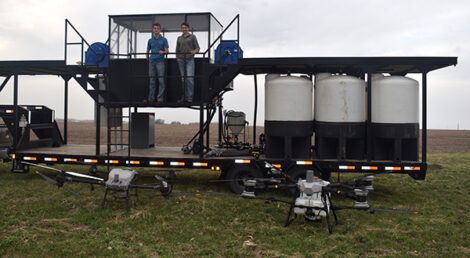
Progress 2026: Lifelong friends Lincoln Stover and Paul Murty launch MURST LLC with focus on drone spraying

Reserve Development confirms three tenants for Shops at Marshalltown