‘Dedicated to the service of humanity’: Religious orders pioneered local hospitals
Editor’s note: This is part one of a three-part series on the local hospital. The three parts focus on the history, the present and future. Part two and part three will run on Nov. 24 and Dec. 1 respectively.
-
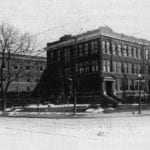
- CONTRIBUTED PHOTO – The Evangelical Deaconess Hospital complex circa 1928.
-
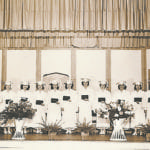
- CONTRIBUTED PHOTO – The class of 1946 from St. Thomas Mercy hospital school of nursing received diplomas during a June 3, 1946 commencement exercise at St. Mary school auditorium in Marshalltown. Shown from left are: Rt. Rev. Msgr. A.P. Meyer, Rev. W. Zeigler, Marcella Benda, Adeline Ward, Helene Townsend, Evelyn Sevcik, Mary Ellen Kjormos, Lois McCormack, Netha Mae Green, Irene Staebler, Betty Grabenbauer, Alice Newby, Ina Mae Claude, Dolores Jaeger, Nola Benson, Marjorie Colby, Tomiko Sutow and Rev. Pius Leabel.
Two religious orders — one Roman Catholic and the other Protestant — would take a leadership role in establishing two Marshalltown hospitals over a 11-year period.
The hospitals were critically needed.
Local newspapers in 1899 reported there were no hospitals or nurses in the growing community, according to T-R archives. That would change five years later.
In 1904, the St. Thomas Mercy Hospital and nursing school opened for business as a result of efforts by the Sisters of Mercy from Dubuque, a Roman Catholic order of nuns.
Marshalltown was now a player in the health care business, an endeavor which continues 104 years and several name changes later.
Times-Republican archives reported the order’s efforts began Jan. 14, 1902, when they announced plans to conduct a fund drive for the construction of a hospital at the intersection of West State Street and North 13th Street — now the site of Embers Retirement Community.
On April 10 that year, it was reported the hospital would be built that summer at a cost of $25,000 and on July 23, announced it would be constructed.
Ground was broken Sept. 1, 1902 and the cornerstone laid Oct. 22. It was completed Oct. 29, 1903.
Nearly 11 years later, the Evangelical Deaconess Hospital and its nursing school opened. For the second time a religious order — the German Evangelical Friends Church — would be instrumental in providing critical health care services.
The Rev. Karl Rest founded the Evangelical Deaconess Society In Marshalltown on March 30, 1913. The Deaconess system of service, which originated in Germany, was adopted in America by German Evangelical institutions in 1849. When consecrated, deaconesses promised a lifetime of religious service, melded with professions such as nursing.
The society selected a lot at 2 S. Third Ave., which stood the Wood Sanitarium, formerly the home of H.E.J. Boardman, a prominent attorney. It constructed a new hospital building on the south side of the Boardman house, beginning on July 25, 1913, and the cornerstone laid Aug. 25.
Within a month, plans were made to expand it for a cost of $14,000, followed by efforts to build a new hospital. Residents promised to raise $15,000 of the $26,000.
On the first Sunday in January 1914, the Evangelical Deaconess Home & Hospital was “dedicated to the service of humanity” and patients were admitted.
Due to the constant increase in the number of patients, a new $34,000 addition was built in 1916. The east wing was built in 1926 and cost more than $200,000. This addition almost doubled the bed capacity. It also contained the surgical department, clinical laboratory, the hydrotherapy department and the isolation ward.
The Evangelical Deaconess Hospital was not-for-profit, as was St. Thomas.
Forty years later, Mercy Hospital and the Evangelical Deaconess Hospital consolidated and became Marshalltown Area Community Hospital. The hospital remained not-for-profit, a tradition which remains through the present organization UnityPoint Health – Marshalltown.
In 1976, a $7 million east wing was added, bringing the total number of beds to 220.
Marshalltown Area Community Hospital became Marshalltown Medical & Surgical Center in 1985. In 2007, a new $6.7 million addition housing the Cardiovascular Catheterization Lab and the MMSC Clinic-Marshalltown was completed.
Two Nursing Schools
For 82 years the St. Thomas Mercy Nursing School and the Evangelical Deaconess Nursing School endeavored to educate women, and later, men in a burgeoning health care field, all within the walls of their respective hospitals.
Without the hospitals, the schools could not have existed.
First to end was Mercy’s nursing school in 1948. Next was Mercy Hospital in the 1960s (its name had been changed from St. Thomas Mercy previously) when it merged with the Marshalltown Area Community Hospital, which had changed its name from Evangelical Deaconess.
And in 1986, after 72 years of educating nursing students and sending them out worldwide, the Evangelical/Marshalltown Community School of Nursing graduated its last class.
Saint Thomas Mercy Nursing School
Saint Thomas Mercy Hospital School for Nurses offered a three-year course. Its graduates were eligible to take the state examination, which upon receiving passing grades, entitled them the Registered Nurse designation.
A spacious, well furnished apartment was provided for students in the hospital building for awhile.
Later, students would live in a rooming house near the hospital.
Students were instructed to provide two pairs of white oxfords with white heel, four white slips, (12 inches from the floor) toilette articles and a watch with a second hand among other items.
Anatomy and Physiology, Chemistry, Nursing Arts I and Microbiology, among others, were part of the first semester course work.
“When the student has acquired sufficient knowledge and skill in practice, she spends two hours a day on the floors under skilled supervision applying what she has learned,” according to the student handbook.
Evangelical & Community School of Nursing
On May 3, 2014, a group of nurses — some retired and others active — from the Alumni Association of Evangelical & Community School of Nursing, held its annual spring banquet at the Best Western Regency Inn in Marshalltown.
President Pat Thompson, class of 1984, presided.
The association announced it had raised money and awarded three $1,000 scholarships so that Marshalltown Community College nursing students could continue their education.
The ECNS graduated 1,230 nurses, with its first class in 1917 and last in 1986.
Like its Catholic counterpart, the ECNS started when a church — the German Evangelical Friends Church — founded a hospital and jointly opened a school of nursing.
The local society initially consecrated 12 deaconesses, the last in 1940.
The 1914 school handbook requested the students to bring a Bible, three gingham dresses, six large aprons of thoroughly bleached Indian-head cotton, a good supply of clothing (all marked) and shoes with rubber or quiet soles. Teeth were to be “fixed” before coming to school. Deaconesses directed the school from 1914 to 1955. MMSC staff nurses or others served as directors until it closed in 1986. The decision to close the school was made in 1984. Administrators cited the increased cost to the hospital for maintenance and management.
The former dorm is now jointly owned by Center Associates and Substance Abuse and Treatment Unit of Central Iowa (SATUCI). It may be the only physical reminder today the school existed, and the alumni banquet proved there are shared memories of helping others and saving countless lives.
“We are very proud of the school and felt we received an excellent education,” Thompson said.
Thompson is still active, serving as the long-tenured Marshall County Public Health Nurse.
The late Ester Helfer, class of 1933, told the T-R she considered herself a nurse “even though I have not practiced in many years. I keep a happy, positive outlook on life and try to help people to see the bright side.”
Nurse Charlotte Applegate, class of 1940, had been featured in the T-R a number of years ago. She told of her experience as a World War II army nurse stateside and England. She said she was grateful for the education she received.
While stationed in England, Applegate helped Allied troops prepare for the historic D-Day invasion.
The late Eva Shipman, a Marshalltown native, wrote a pledge and creed upon graduating from the Evangelical school in 1929:”Reverently do I pledge myself to the whole-hearted service of those whose care is entrusted to this hospital.
“To that end, I will ever strive for skill in the fulfillment of my duties holding secret whatsoever I may learn touching upon the lives of the sick.
“I acknowledge the dignity of the cure of disease and the safeguarding of health, in which no act is menial or inglorious.
“I will walk in upright faithfulness and obedience to those under whose quittance I am to work, and I pray for patience, kindliness and understanding in the holy ministry to broken bodies.”
Eighty-nine years later, nurses, doctors and staff at UnityPoint Health-Marshalltown endeavor continue Shipman’s pledge in a dramatically-changing health care environment which has tested the mettle and skills of several hospital administrators.
——
Contact Mike Donahey at 641-753-6611 or mdonahey@timesrepublican.com
Todays News

Iowa DOT starts construction on Toledo roundabout Monday
OneroRx Inc. completes acquisition of NuCara pharmacy locations
AI can do ‘a lot of different stuff’ in the workplace

Gubernatorial candidate Rob Sand calls for term, age limits on elected officials

Speed limit on 2-lane highways could increase under bill passed by House