
Council plays the long game with strategic planning session
Members of the Marshalltown City Council spent five hours with consultant Susan Parker of Sparker Solutions discussing long-term goals and eventually voting on top priorities during the annual strategic planning session at city hall on Tuesday morning and into the afternoon.
All of the councilors but Mike Ladehoff were present in the chambers, along with Mayor Joel Greer, City Administrator Jessica Kinser, Housing and Community Development Director Michelle Sponheimer and a few members of the public who sat in on the session.
Parker started the conversation with a slide showing the city’s current and proposed values, and one of the values — inclusion — prompted a discussion about providing equal access to all community members, especially those who don’t speak English.
“Equal means different things to different people,” Councilor Jeff Schneider said.
With over 50 languages now spoken in Marshalltown, Councilor Gary Thompson asked if more interpreters would be hired to help ensure equity for all.
A list of strengths and weaknesses also sparked further discourse about issues like employee burnout, city employees living outside of Marshalltown (according to the numbers provided, just over half — 102 of 195 total city employees — live within city limits) and recent turnover among frontline employees, especially in the police department.
Thompson said it was “his understanding” that most of the officers who have left the MPD are staying in law enforcement, which he believed may be due to an issue other than burnout or the across the board decline in applicants who want to enter the field.
“From what I’m hearing from other law enforcement agencies, they’re as understaffed as we are, so you can’t say our people are being burnt out here and going to another job to be burnt out there,” Thompson said. “So it makes you wonder what is the root cause of why we’re losing police officers to the sheriff’s department and other agencies. Is it pay, or is it our management style at the police department?”
Another area of particular interest was how the city marketed itself and pushed back against negative conceptions some people may have about Marshalltown. Greer said he was tired of hearing that “the sky is falling” from a small group at every city council meeting, but both he and Thompson agreed it was important to listen to those with dissenting opinions regardless of how they felt about them.
“We should be listening to the negative, whether it’s 15 percent or one percent. For me, the idea is to have the promotion and the positive feedback outweigh the negative,” Greer said. “It should, but we need to have the negative to keep us sharp to know what we’re doing.” Conversely, councilors expressed pride in the fact that four major international corporations — Emerson/Fisher, Lennox, Swift (now known as JBS) and MARSHALLTOWN Company — all had their origins here, and Schneider called Marshalltown, with a population of around 27,500, an ideal cross between a small town and a city with amenities and attractions.
“I think we need to celebrate what we still are and what we’ve always been, and that’s a town with good jobs, innovative companies, innovative people and kind of a hybrid between small town and little city quality of life, and I think that’s something you really can’t find (elsewhere),” Schneider said. “We always talk about the towns 45 minutes away from us, and that’s something you can’t find in any of those communities that you do find here — short commutes, get to know your neighbor, participate in the community and make your life matter in the community… Anybody can come here and make an impact.”
Kinser and the council later weighed in on how to more effectively promote Marshalltown around the state and the country — as Greer put it, the city doesn’t “toot its own horn” enough — and the possibility of hiring a communications or public relations director was mentioned without any official consensus on whether it should be pursued going forward.
“Is hiring a communications director one way to get to that vision? It certainly is, but is it the only way?” Kinser asked. “So that’s where we were thinking ‘How do you keep it at that super high level where some of those actions of how you do it still gets us to there.'”
Councilor Barry Kell argued that enhancing Marshalltown’s public image had to be more than just lip service.
“Everything we talked about, the celebrating and promoting, how do we make that core to who we are?” he asked. “I think we have to do more than just celebrate and promote it. I mean, we have to believe it and make it central to what we do. That is what separates us from other communities. I feel, and maybe I’m wrong, that we’ve resisted that for a while, and it didn’t really get us anywhere.”
The councilors and Greer then broke into two groups and contemplated several vision strategies with goals for increased housing, downtown restoration, celebrating cultural diversity, partnerships with other organizations focused on quality of life issues, and improving the city’s organization, services and infrastructure.
Before breaking for lunch, they then began to get down to brass tacks with specific projects and conversed about what the top priorities should be heading into 2023, including several street extension and repair projects, incentives for developments at the Marshalltown Mall, the future of the former downtown hospital campus, public art, the water plaza or splash pad and public safety traffic cameras, to name a few.
After lunch, Greer, Kinser, Parker and the council dove further into the goals and ultimately had a chance to vote on which items should receive the most immediate attention. Homelessness in Marshalltown was a topic that everyone in attendance agreed would need to be tackled in the future. Currently, there is no homeless shelter in the community.
Greer recalled a recent conversation with the mayor of Austin, Texas, and discussed the House of Compassion’s potential efforts to purchase a building that could serve as a shelter.
“It’s something that we’ll be addressing in five or 10 or 15 years, especially if we grow our population. We’re lucky that we’re cold,” he said.
Councilor Dex Walker suggested that city leaders should take time to learn more about the issue before pursuing any official course of action. Before the council wrapped up, Thompson also noted that although Marshalltown currently owns more than 20 city parks, the population would only need about 10 to 12 according to national data, and he wondered if affordable housing could be created on some of those properties while also reducing the Parks and Recreation budget. Isom and Greer said they fully agreed with the idea.
“I know if you’re taking away a park from someone, someone’s gonna complain, but at the same time, we could increase housing on some pretty good property that’s got some mature trees on it, and we could also help Parks and Rec with their budget,” Thompson said. “Even though we may disagree on the future population of Marshalltown, we want nice things in town. So if we can’t afford to keep up the 20 parks, and then on top of that we’re not getting what we thought we were getting with this $100,000 revamp of Elks Park and then now this bridge issue. We’re gonna Band-Aid that rather than going back and saying, go back and fix this… When do we stop accepting things that are subpar or doing things that are subpar? When do we start stepping up to the table to make some hard decisions?”
Overall, the most popular individual projects among those in attendance were the extension of West Merle Hibbs to 12th Street, the mall development incentive, the sale of downtown lots and buildings, the West Southridge Road extension, Iowa Avenue West, city-owned spaces, green spaces and welcome signs, building out a public safety camera network, a property maintenance grant program, city-owned public art, the possible purchase of an electric city vehicle, comprehensive street and city maintenance plans, the arts and culture master plan and an adult soccer field.
At the end of the five-hour session, the councilors, Greer and Kinser shared their feedback on how they felt it went, and the group agreed the experience was a positive one.
——
Contact Robert Maharry at 641-753-6611 ext. 255 or
rmaharry@timesrepublican.com.
-
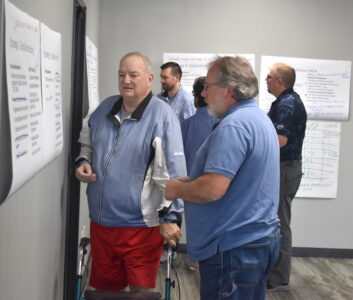
- T-R PHOTOS BY ROBERT MAHARRY — Marshalltown City Councilors including Al Hoop, front left, and Gary Thompson, front right, review long-term goals and strategies during a planning session held at city hall on Tuesday.
-
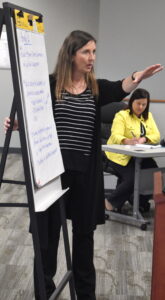
- Consultant Susan Parker of Sparker Solutions discusses ideas with the Marshalltown City Council during a work session held Tuesday at city hall.
-
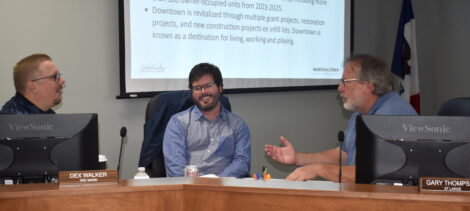
- From left to right, Marshalltown City Councilors Jeff Schneider, Dex Walker and Gary Thompson engage in a discussion during a strategic planning session held Tuesday.
Todays News
From band to podcast: Host seeking songwriters, other ‘creatives’ for channel

Marshalltown DMV moving to May Street location on June 29

Marshalltown man sentenced to over 8 years in federal prison for conspiring to distribute meth

Midsummer carnival coming to Laurel on June 27
Public works director explains event plaza construction delay