
MHS student, teacher visit Hawaii, eulogize local soldier who perished in WWII
Trending
The journey that led MHS senior Leticia Herrera and her Extended Learning Program (XLP) Instructor, Susan Fritzell, to spend a week in Honolulu last summer to learn all about the Pacific Theater of World War II and eulogize a Marshalltown soldier who perished in the Marshall Islands shortly before the war's end started with something completely unrelated.
For National History Day (NHD) last year, Herrera and her partner Yessenia Alvarez Zamora completed a project on La Huelga, the uprising of mostly Hispanic farmworkers in the western U.S. led by Cesar Chavez and Dolores Huerta that resulted in improved labor conditions and pay and the creation of the United Farmworkers Association.
After she and Alvarez Zamora had completed the project, Fritzell sent Herrera an email about another program offered through NHD called "Sacrifice for Freedom," which allows students and teachers to apply for a trip to Hawaii -- specifically, the area around Pearl Harbor in Honolulu -- and research a soldier who is memorialized there before delivering their eulogy. Surprisingly, Herrera originally thought it was more up Alvarez Zamora's alley.
"I decided 'You know what? This seems (like) something for her.' She likes to go out of the box, (and) I'm kind of a little bit more shy," Herrera said. "And Mrs. Fritzell and my parents, they decided, 'Well, why don't you give it a shot at least?' At least just a shot. I'm like 'OK,' and somehow, God only knows how, we made it in."
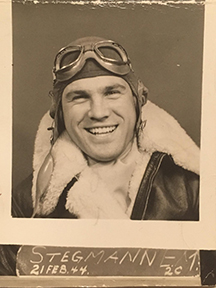
When they were accepted and began to research soldiers who were memorialized in Honolulu, they tracked down two from Marshalltown, but when Herrera went to look through old MHS yearbooks, she struggled to find anything on one of them because he had stopped attending school in eighth grade. The other happened to be Eugene Stegmann, the brother of the late former Mayor Howard Stegmann and uncle of recently retired Marshall County Conservation Director Mike Stegmann.
"I remember I was going through the 1939 yearbook, and I was looking and I found his photo. And I remember I was so shocked like 'That's him!' And since I found more information on Eugene, I decided to go with him," she said.
Ensign Eugene Stegmann, a Naval pilot, died on July 28, 1945, just under two weeks before the U.S. dropped atomic bombs on the Japanese cities of Hiroshima and Nagasaki -- on Aug. 6 and Aug. 9, respectively -- and the leaders of the country announced their intentions to surrender on Aug. 10. He was stationed on the Marshall Islands flying strafing runs in a Helldiver plane over Maleolap and the Wotje Atoll off the coast of Alu Island, and shortly after noon that day, he told his wingman he would complete one last pass.
About 300 feet in the air, they made a left turn, and the plane began to spin out -- Herrera said the reason has never been fully confirmed. The plane fell upside down in the water about 100 feet away from the island and sank immediately. Ensign Stegmann was awarded the Purple Heart and the Navy Air Medal.
Because so many American soldiers died in WWII and have been all but forgotten over time, Herrera and Fritzell worried it might be difficult to dig up information. Luckily, they found a great resource in the Stegmann family. Mike Stegmann jumped at the opportunity to assist.
"It was immediate. What can we do to help?" he asked.
Unfortunately, Howard Stegmann passed away March 23 of last year, so he did not get to travel to Hawaii and hear the eulogy himself. But as Mike, his son, reported, he was aware of the project, and he recalled the conversations he had with his father as a youngster.
"When I asked questions, he would answer them, both about growing up, what my dad and his brother would do, hunting and fishing, the lifestyle, working," Mike Stegmann said. "He didn't hold anything back, or if he did, obviously, I didn't know about it. He spoke about it, not just when prodded... But it was very hard on him. I could tell it tormented him through his life because it was his older brother, and they were very close."
Both Howard and Eugene dreamed of becoming commercial airline pilots someday, but that dissipated quickly after the latter's death. Howard was also in Naval Air Corp training when an accident while he was home on leave caused blindness in one eye and abruptly ended his military career.
The teacher-student duo spent a week in Hawaii -- from July 24 to July 31 -- and had a chance to explore both the natural beauty of the lush scenery and several important warships and other sites full of war history.
"At first, honestly, we were probably most excited (that) 'Oh, we get to go to Hawaii!' But it became so much more meaningful because one, we had already learned a lot about the war and these soldiers," Fritzell said. "And then being there made it all come alive, really."
And on top of that, all five of Eugene's nieces and nephews were able to attend the eulogy, which Mike said provided "a sense of closure" and "completed the story" for the family -- they were even able to track down a letter written by a fellow soldier shedding more light about the circumstances surrounding his death. It was the first time any of the siblings had been to Hawaii.
"We grew up not having, you know, we were all born well after the war, and I don't want to say it was a curiosity, but it was. It was a curiosity of having a relative in direct contact with that era of time," he said. "So it just answered a lot of questions, I think. It was a pleasure having Leticia go out, and she snapped a picture of the memorial where Eugene's name is inscribed. That was beautiful."
There were too many memorable moments to count, but Herrera will always remember a teacher named Mr. Yamamoto, who told her "Don't forget what you learn here. Don't forget what you see here and tell its story."
"That's such a simple quote, and he said it towards the end (of the trip). But now that I'm here I keep on thinking 'You know what? There's so many things that get covered up so easily and that we forget so easily,'" Herrera said. "We should open back up. We should see. We should hear. We should know. We should tell its story. Just by telling something to other people, they get to learn about it too... The history should be shared so that it doesn't repeat itself."
Herrera and Fritzell will present on their trip at the Grimes Farm Conservation Center during the next Marshall County Historical Society function on May 9, which will be open to the public. They also hope to launch a smaller program locally at the Veterans Cemetery in Marshalltown to learn more about the deceased and, in Herrera's words, tell their stories.
------
Contact Robert Maharry at 641-753-6611 ext. 255 or rmaharry@timesrepublican.com.