
Automated traffic cameras go up on Lincoln Way, S. 12th Ave.
MPD details road ahead for new systems
Trending
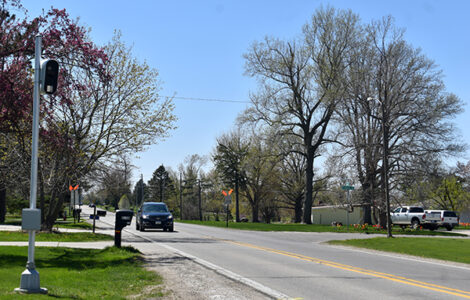
Motorists in Marshalltown may have noticed a pair of new structures adorning the edges of two roadways in town as the city, in conjunction with the Marshalltown Police Department (MPD), recently erected fixed automated traffic cameras near the intersection of Lincoln Way and Orchard Drive and on South 12th Avenue/Governor Road.
Discussed at length during a series of city council meetings in recent months, the automated traffic cameras are part of the city and department's efforts to curb speeding and speeding complaints in areas where traditional traffic enforcement proved ineffective or unrealistic.
"We had come to a consensus, in looking for (ways to) reduce speeds, to put up fixed locations in areas where we receive a large amount of complaints that were difficult for police officers to do traffic enforcement for a variety of reasons," MPD Capt. Chris Jones said.
The two areas in particular, Lincoln Way and South 12th Avenue/Governor Road, have thin shoulders on each road, and coupled with the high volume of traffic and congestion, the department found difficulties even placing its speed trailer on the roads, let alone a uniformed officer.
So, the department and city council set about contracting with the Sensys Gatso Group, a Sweden-based company that develops traffic safety systems for police and highway authorities, for two fixed cameras and one mobile traffic camera system. The move follows several other municipalities in Iowa like Waterloo, Cedar Rapids, and Des Moines, which have undertaken similar measures to reduce speeding.
As Jones explained, the new traffic cameras would take a video and photograph of the license plate of the vehicle speeding 11 mph or over the posted speed limit on each road, which would be sent to Sensys Gatso. The company would then create a document with the video, photograph, and registration information for the registered owner of the vehicle.
From there, the document is sent back to the police department, where an officer would review the compiled evidence by Sensys Gatso for accuracy and approve whether or not the ticket was in violation of the speed limit.
Finally, the confirmation would then be sent back electronically to Sensys Gatso, who would then send a civil citation in the mail to the registered owner of the vehicle.
"It will not go on anyone's driving record. Insurance companies won't be notified of that citation," Jones said. "It will give them directions on how to pay that either online, (or) they can mail a check or make other arrangements to pay that fine."
If the driver of a cited vehicle is not the owner, the owner would have 30 days to identify the driver, and if the driver is willing to come forward, he or she will be held responsible. If the owner cannot identify the driver, he or she will then be responsible for the ticket.
While the cameras are not live as of yet, MPD is hoping to get the word out about their existence early in order to prepare drivers to slow down in these areas, which will be well-marked with signage and widely publicized.
"We're developing signage for both locations. We want to make sure that everybody's aware of where the cameras are, (and) what exactly is going to happen," Jones said. "Once we get those signs installed, we're going to start a 30-day warning period on both locations... that 30-day warning period is just going to do the same thing as it would if you get a ticket, it's going to send you a notice in the mail that you were speeding. It's going to be very, very similar to what a ticket would look like. It's just going to say that there's no fine, it's just a warning."
Once the warning period is over, citations will start to be sent out and issued, and speeding fines will be as follows:
11-20 mph over: $100
21-25 mph over: $150
26-30 mph over $250
30+ mph over: $400
Drivers will also be able to appeal their fines through the court system if they believe they were ticketed unfairly, with the process to do so detailed on the ticket received.
Jones added that the mobile automated traffic camera system will be placed in areas where complaints of speeding are also found, but the speed trailer will first be placed on the street in advance to notify residents of the posted speed limit. The department will also be sending out press releases and communicating on social media and other avenues to alert drivers where the camera will be for a set amount of time.
Though questions about the legality and constitutionality of the automated traffic enforcement cameras always swirl when they are installed, Jones reaffirmed that the city and department are not stepping out of line with previously established rules pertaining to the cameras.
"We are not reinventing the wheel here. We are using programs that have been up for dozens of years, and with a company that's been in the business for dozens of years. We're simulating programs that happen in other communities, and they have proven that speeds have dropped in those areas where auto enforcement is in place," he said.
As such, Jones reiterated their main objective was to decrease the rates of speed for motorists in these areas.
"We're hoping to be able to get the same results as some of the other communities," Jones said. "If we don't make any money from civil fines in this case, and everybody is obeying the law, or at least under 11 mph over the posted speed limit, I would be more than happy with those results."
------
Contact Nick Baur at 641-753-6611 or nbaur@timesrepublican.com.