
MPD training provides lesson on responding to violent incidents
Trending
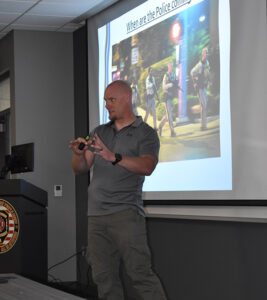
Fifteen Marshalltown residents learned valuable lessons during the Civilian Response to Violent Incidents training Monday night at the Marshalltown Police and Fire headquarters.
Sgt. Chad Hillers gave the instruction and used some well-known infamous school shootings -- 1999 at Columbine High School, 2007 at Virginia Tech and 2012 at Sandy Hook Elementary -- to highlight his points.
Hillers told the class no one ever believes they or their loved ones could be caught in a mass shooting, which extend beyond schools, such as the 2017 Route 91 Harvest Music Festival in Las Vegas -- the deadliest mass shooting ever, resulting in 60 people killed and 413 wounded.
"Only 20 percent of these [violent incidents] happen at schools," he said. "Businesses open to pedestrian traffic -- Walmart, a bank. That is the most common place for these things to happen."
Hillers said the definition of "violent incident" is any time a group of people are gathered, and someone has the intention of causing mass casualties. A violent incident is not limited to a shooting, and Hillers spoke about the 2013 Boston Marathon bombing, and the 2017 Charlottesville protest car attack. Although, he added, incidents with guns tend to have a higher body count.
The frequency of violent incidents have increased in the last 19 years, averaging 41 per year.
"A little over 1,000 people killed and close to 2,000 people wounded," Hillers said. "These things are brutal."
Something he stressed is that everyone must always be aware of their surroundings. It can make it easier to see if something bad is going to happen. The next thing Hillers suggested people in those situations should do is find a way out, especially in the event of a shooter -- 98 percent of the time, the shooter is acting alone. One way to get out is through a window, in which case, people should break the window at a corner and make sure to get rid of the broken glass to prevent injury.
A common action taken until recently when an incident occurred was a lockdown. Hillers told the class a lockdown gives people a 50/50 chance of leaving uninjured.
"Does anyone like 50/50 odds?" he asked. "I don't like a coin flip, especially when there's other things we can do to greatly increase our chance of survival."
Hillers asked, in the event of a fire, if everyone would lockdown.
"No. The danger's in this room -- same thing with these sorts of incidents," Hillers said. "There is a time and place for a lockdown, but if we're going to do it, we should be doing other things to prepare for something bad to enter this room."
If locking down is the best course of action, Hillers said the door needs to be barricaded to prevent or delay the shooter from gaining entry. Also, he said people should throw things at the shooter if entry is gained, which is a distraction technique.
"If I'm a bad guy coming in here, that's going to distract me from my intent," Hillers said. "It's going to buy you time to make some decisions and try to increase your chance of survival."
Once the bad guy is distracted, he said people can try to take control by grabbing his arms or legs and pulling him to the ground. If the bad guy has a firearm, Hillers said it should be placed in something like a trash can. The last thing anyone should do, he said, is kick it across the floor as the weapon is more likely cheaply made.
Another factor Hillers highlighted is stages people go through in response to a violent incident. People first respond with denial, not believing the incident is actually occurring.
"It's very important to not be in denial," he said. "Pay attention to what is going on and respond with some sort of action."
The next stage is deliberation, in which the circumstances are identified and people start thinking about how to deal with it. The last stage is making that decision.
"The quicker you can move through this, the better your chances are," Hillers said.
He stressed a lot of damage can occur before law enforcement responds. It would take the Marshalltown Police Department about five minutes to respond, and many casualties occur in less than five minutes.
"When we show up, our first priority is to stop the killing," Hillers said. "That means we're going to bypass the people who are hurt, bypass people locked in rooms. We will come back for you, but our goal is to find who is doing this. If I take time to put a Band-Aid on someone, there could be a bunch more dead."
The second thing law enforcement will do is provide aid to injured people and escort them to medical personnel. Then, they conduct a detailed search, which takes time because people are hiding.
"How should you guys react to law enforcement when we show up?" Hillers asked. "Leave your stuff behind. Follow our instructions. We don't have the time to answer questions or argue. Do what we say or we will make you do what we say. Show your hands."
Hillers said the more Marshalltown residents take the training, the better.
"I definitely recommend it," he said. "People don't think this can happen to them. It's good to get out there and think about what might happen if you're involved in something like this."
IOWA SCHOOL SHOOTINGS
There have been seven intentional school shootings in Iowa resulting in casualty or injury:
• Jan. 23 at the Starts Right Here charter school in Des Moines in which two students were killed and the program director injured
• March 2022 at East High School in Des Moines in which a drive-by occurred, one student killed and two wounded;
• January 2014 in the North High School parking lot in Des Moines, one student injured;
• July 1994 at Ottumwa High School, one student killed;
• November 1991 at the University of Iowa in Iowa City, six students killed and one wounded;
• March 1984 at Southeast Polk High School in Pleasant Hill, two students killed and;
• November 1963 at Jefferson High School in Cedar Rapids, one student injured.
------
Contact Lana Bradstream at 641-753-6611 ext. 210 or lbradstream@timesrepublican.com.