
Franchise fee debate continues as city council moves forward with ordinance change
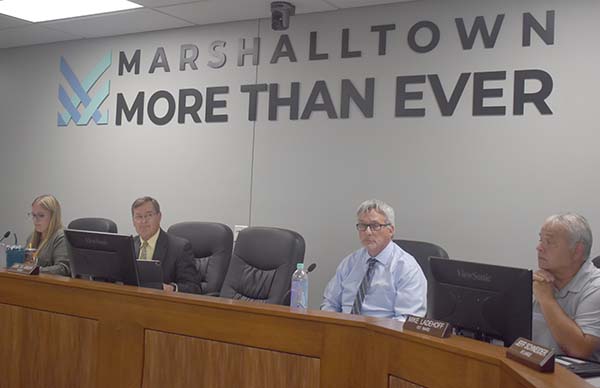
T-R PHOTOS BY ROBERT MAHARRY — From left to right, City Clerk Alicia Hunter, Mayor Joel Greer, Interim City Administrator Bob Fagen and City Councilor Mike Ladehoff are pictured during Monday night’s meeting.
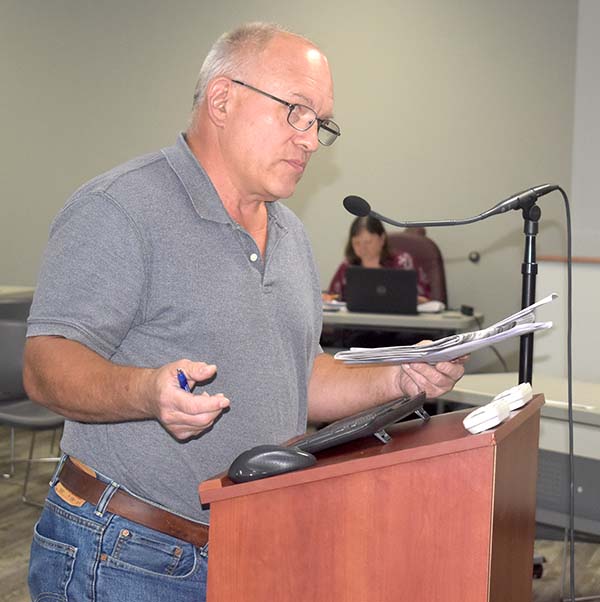
Mark Eaton, pictured, spoke out against the proposed franchise fees on multiple occasions during Monday night’s city council meeting.
T-R PHOTOS BY ROBERT MAHARRY — From left to right, City Clerk Alicia Hunter, Mayor Joel Greer, Interim City Administrator Bob Fagen and City Councilor Mike Ladehoff are pictured during Monday night’s meeting.
Mark Eaton, pictured, spoke out against the proposed franchise fees on multiple occasions during Monday night’s city council meeting.
Trending
Discussions over the plan to implement a five percent franchise fee on gas and electric bills in Marshalltown resumed at Monday night's city council meeting as councilors on either side of the issue and members of the public -- all of whom were opposed to the fees -- weighed in on the controversial issue.
Since the council opted not to put the item on the November ballot at a previous meeting, they can now legally move forward with implementing the fees unless a special election is called, which would require approximately 250 signatures. On Monday's agenda, they voted on a second reading of three ordinance changes that would establish electric franchises with Interstate Power and Light Co. (Alliant Energy) and Consumers Energy Cooperative and a gas franchise with Alliant as well.
Interim City Administrator Robert Fagen sought to clarify some of the most frequently asked questions surrounding the fees, including the 25-year sunset clause. Because the city already has a franchise agreement with Alliant without a fee, it would sunset in 2032, but the agreement with Consumers Energy would be brand new. He also clarified that changing the ordinance without an election -- if a valid petition is not presented by July 16 -- is legal.
As the podium was opened up to the public, Mark Eaton was the first to step forward, and he lamented that the council had "forced the voters' hands" into spending $20,000 on a special election in September.
"The council had the power, by its own vote, to put this on a citywide election (in November). Neglecting to do so and voting no to do so forced, well, technically, didn't force you to, but forced a special election by the voters unless the voters really want this and then don't sign the petition," Eaton said.
He then referenced an online Times-Republican poll showing widespread disapproval of the fees as evidence that the people of Marshalltown do not want them. Harley Murra said he believed the public should get to vote on the fees without spending money on a special election and expressed skepticism about plans for a water plaza or splash pad due to potential liability issues.
Councilor Mike Ladehoff responded to Murra by clarifying that the city would only be spending $500,000 on the water plaza with the remainder coming from private donations and state grants. Doris Kinnick told the council she was "tired" of attending meetings but felt she had to keep showing up because of the franchise fees, which she worried many families would not be able to afford.
"I talk to a lot of people, and they're behind me in this. I guess one thing you guys have to realize is you are representing us, the voter, not a special interest, not I don't know, whoever, but every single one of you was voted in because we want you here," she said. "So I know it's real easy to say 'Yes, we'll vote for this,' and 'Yes, we'll vote for that,' but boy, it'd be nice to once in a while hear no."
Linda Clark sought clarification on the matter of an election, and Fagen said the council could move forward without one. Lyle Hineman wondered why the council was still trying to pass the fees if no one was willing to speak up in favor of them during meetings.
Isom then took an opportunity to respond to the public comments, citing inflation and the state legislature changing the way local governmental entities can collect taxes and worrying about the potential for drastic spending reductions in the future without an additional revenue source to fund street repairs.
"I hear people talking about what they can afford from a budget perspective. That's a key piece of some of the discussion happening here today. I think budget cuts are so easy to say yet hard to sit there and dive into the weeds," he said. "And yet, what we're talking about, what this enables from a street perspective alone is somewhere in excess of an additional $5 million from a street repair and replacement perspective. I guess I'm just kind of curious on solutions rather than complaints on where you're gonna go generate $5 to $7 million in budget cuts on an annual basis to get what this is trying to enable and progress from a community perspective."
He added that because utility bills already include a one percent fee, the five percent fee would only be a net four percent increase. The first motion to establish a gas utility franchise with Alliant was carried by a 5-2 vote, with Al Hoop and Gary Thompson opposing.
As the next agenda item to establish an electric utility franchise with Alliant came up, the discussion continued, and Eaton again stepped forward first to clarify how the Iowa Code applies to the matter at hand. He also wondered why 22 percent of Local Option Sales Tax (LOST) dollars were being placed in a "slush fund" and being used for special projects and contributions to private nonprofit organizations.
"There's all kinds of ways to fix the roads with the money, and baiting everybody with the roads is like Lucy and holding the football for Charlie Brown. He never can kick it. She always pulls it out. We always know that's gonna happen," Eaton said. "That's what's gonna happen with the road money and the property tax relief money."
The next motion passed by the same 5-2 tally before the council moved to the third and final franchise fee related agenda item, the second reading of an ordinance amendment to establish a franchise agreement with Consumers Energy Cooperative. Thompson referred to a weekend T-R OpEd piece by Isom, Barry Kell and Jeff Schneider arguing in favor of the franchise fee and said while it was true that 216 Iowa cities utilize it in some form, only 18 percent of them charge the maximum five percent allowed by Iowa law.
"Maybe I could've supported this, and I probably could've at one or two percent but not to go for the whole five percent," he said.
Isom clarified that the average is 4.35 percent and said Marshalltown was not out of line with other similar communities in demographic and makeup. Kinnick asked for additional clarification on whether the five percent on gas and five percent on electric would constitute a 10 percent total increase -- to which Isom responded it would still be a net five percent increase on total utility bills -- and Eaton surmised that after the current Alliant franchise agreement expires in seven years, it would be renewed and/or extended.
The third and final motion passed by the same vote.
In other business, the council:
• Approved the consent agenda as listed with the exception of an item regarding the reappointment of two library board members, which was pulled for further discussion and later approved by a 5-2 vote.
• Recognized Katie Fink for 10 years of service to the library.
• Heard a quarterly update on MPACT from YSS of Marshall County Director David Hicks.
• Approved the second reading of an ordinance change regarding the sale of alcoholic beverages in city parks.
• Approved the second reading of an ordinance change regarding offenses against peace and safety reinstating language on vehicle and tire noise.
• Approved the first reading of an ordinance change regarding storm water billing by a 6-1 vote with Thompson opposed, and voted to waive second and third readings and enact the ordinance by the same margin.
• Approved a five-day liquor license for Midnight Ballroom at the Central Iowa Fairgrounds Arena on July 29 for a rodeo with outdoor service by a 6-1 vote, with Hoop opposed.
------
Contact Robert Maharry at 641-753-6611 ext. 255 or
rmaharry@timesrepublican.com.