
Albion farmer hosts Field Day, showcases CRP land
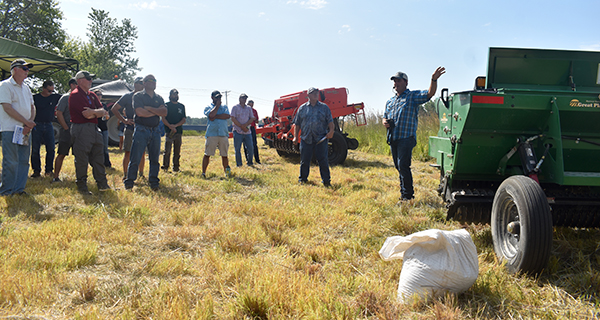
T-R PHOTOS BY ROBERT MAHARRY — Farmer Wade Dooley of rural Albion, right, hosted an Iowa Learning Farms Field Day and showcased his Conservation Reserve Program (CRP) land near the Iowa River on Thursday morning. The event drew farmers from around the state.
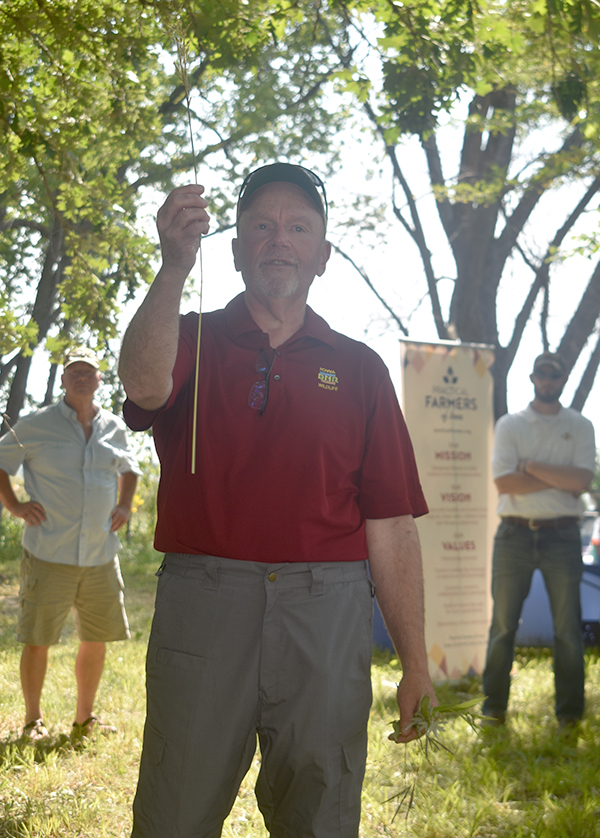
Iowa DNR Private Lands Biologist Kevin Andersen, front, holds a blade of Indiangrass during a discussion on native and noxious weeds as part of Thursday morning’s field day.
T-R PHOTOS BY ROBERT MAHARRY — Farmer Wade Dooley of rural Albion, right, hosted an Iowa Learning Farms Field Day and showcased his Conservation Reserve Program (CRP) land near the Iowa River on Thursday morning. The event drew farmers from around the state.
Iowa DNR Private Lands Biologist Kevin Andersen, front, holds a blade of Indiangrass during a discussion on native and noxious weeds as part of Thursday morning’s field day.
Trending
ALBION -- While Iowa will always be best known for its expansive fields with rows of corn and soybeans, in recent years, many farmers have chosen to enroll their land in the Conservation Reserve Program (CRP) as a way to promote water and soil health, allow for the restoration of native prairie grasses and guarantee income on plots where planting might otherwise be a risky endeavor.
Wade Dooley of rural Albion is one of those farmers, and he showcased what he's been up to in one of his fields near the Iowa River and just north of Timmons Grove County Park during an Iowa Learning Farms Field Day held in conjunction with the Iowa State Extension Offices, the Iowa Department of Natural Resources (DNR), Marshall County Soil and Water Conservation and Practical Farmers of Iowa on Thursday morning.
Despite the continued scorching temperatures, the event drew close to 50 people in all between interested farmers and employees of the organizations listed above. Once Liz Ripley of Iowa Learning Farms and the ISU Extension kicked off the morning with a brief introduction, she turned it over to Dooley to explain some of the lessons he's learned over the last five years with CRP, planting a diverse mix of seeds that has created a visually impressive portfolio of prairie grasses.
He described the land in question as "an easy fit" for the program due to its proximity to the Iowa River and the high flood risk associated with it.
"This ground, in row crops, would be profitable three out of 10 years. It would break even two out of 10 years," he said. "The other years it would either not break even or definitely lose money, so it was a perfect candidate for CRP. It's not the best land. It's the rest of the land."
Dooley, who serves as a Marshall County Soil and Water commissioner, went on to explain the no-till techniques he has employed and admitted he burned his field too early the first year he planted the prairie grasses, characterizing it as "a weedy mess." Nonetheless, he learned from the experience and has had much better luck in the years since.
He also joked that farmers should avoid discing their CRP "unless you really hate whoever's gonna come in after you" and offered advice on dealing with Canadian thistles.
"Persistence. You've gotta outlast it," he said. "Or you go in with an excavator, and you just dig a big hole... Mow, spray, burn. Those are your options, and you mix and match as to whatever's gonna fit your operation. But it's persistence."
Iowa DNR Private Lands Biologist Kevin Andersen spoke next and provided a rundown of various weeds, some native and some noxious, that anyone planting on CRP should be aware of when they get started. He then offered his "Three Ps of planting" -- patience in year one, patience in year two and patience in year three -- and commended Dooley for how quickly his grasses have taken root.
"What this looks like is amazing after three years, so you did a good job. No, seriously, pat yourself on the back because that looks amazing," Andersen said to applause from the crowd.
He shared his appreciation for the fact that enrolling in CRP, which typically involves a 10-year contract, is completely voluntary, and landowners ultimately make the decision themselves. Dooley then noted the importance of variety in his grasses.
"I'm a very big fan of diversity because I've seen in our pastures, which are just above here, so it's slightly higher ground so when it floods it doesn't get as bad usually. So diversity is everything," he said. "Because one flood kills off this species, but these other species are here and it's OK. The next flood kills off another species, and these guys are all OK. And so the more diversity I have out here, the higher the odds are I'm gonna have something that survives an eight-day flood. Because we've had floods that last eight, 10, 14 days, and we had things that survived. They shouldn't have."
Despite the obvious challenges associated with owning farmland next to a major river, Dooley added that one upside to having tallgrass prairie was his ability to collect the topsoil his neighbors "throw away," and he hoped to have another six inches of topsoil within the next decade.
The crowd then moved to a shadier area to ask Andersen and fellow DNR employee Jason Gritsch questions about their CRP land, and Tyler Kelley of Story County Conservation, who gave a rundown of some of the best equipment to use, also presented before a catered lunch from Hy-Vee was served. Andersen told the audience that CRP is hard work, and he warned of the presence of Lespedeza cuneata, commonly known as Chinese bushclover, a noxious weed considered an invasive species.
"It's a bad actor, and you don't want it," Andersen said.
After the event had wrapped up, Dooley spoke to the T-R about his conservation journey and why he has become passionate about the topic. Between his own land and nearby ground owned by his parents and relatives, the family now has about 250 total acres enrolled in CRP.
Becoming a soil and water conservation commissioner opened his eyes to some of the opportunities available, and the grim realities of the commodities markets at the time forced Dooley to strongly consider alternative options.
"It made a lot more sense to put this into CRP where I'm guaranteed the same paycheck for 10 years straight as opposed to rolling the dice on the floods," he said. "In a drought, river bottom actually does pretty good because it's not that far from water, but there's sandy spots out here that right now, they'd be burning up."
He also reflected on the ways conservation practices have changed his outlook on agriculture, noting the diversity of his CRP land as opposed to a row crop field with either nothing but corn or nothing but soybeans.
"I've been doing custom seeding and stuff now (for) enough years that I've learned to calm down, slow down and manage expectations because everyone wants it to look beautiful that first or second year, and that's not how this works," he said.
Ripley was glad those who were able to attend -- some of whom traveled from across the state -- braved the heat and stressed the importance of continuing to provide education about the benefits of conservation practices and the CRP program while also allowing farmers to learn from each other and network with each other.
"I definitely learned something today as well when it came to identifying those different native thistles, and the benefit of working with some of these organizations is they're also not out there to sell you anything. They're simply free resources to give you the best technical advice available today," Ripley said. "They're just there to help you make the best decisions for your piece of land."
To learn more, visit www.iowalearningfarms.org. The site presents weekly webinars that are archived and able to be viewed at any time.
------
Contact Robert Maharry at 641-753-6611 ext. 255 or rmaharry@timesrepublican.com.