
Monarchs prepare to migrate through Marshall County
Trending
Every year in the middle of August, monarch butterflies begin their migration from Canada to Mexico. Many of those butterflies fly through Marshall County.
Monarchs, which are cold-blooded insects, do not thrive in cold temperatures. So when colder temperatures start to hit Canada, the pollinators begin the 2,500 mile flight south for overwintering. The monarch is the only butterfly that makes an annual two-way migration similar to birds, such as geese.
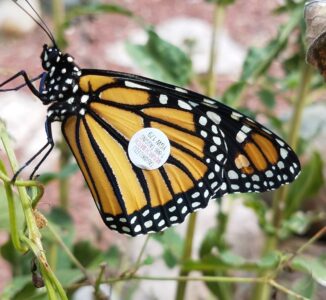
Marshall County Conservation Director Emily Herring said at the end of August, department staff and volunteers tag monarchs in collaboration with Monarch Watch at the University of Kansas. In the morning hours of the day Marshall County taggers make their rounds, hoping to catch sight of the iconic black and orange wings.
"These are monarchs that are fifth generation which have come up from Mexico, lived and died until the fifth generation and those are the ones we are tagging," Herring said. "Those are the ones that will fly and overwinter in Mexico where they will collect them. [Monarch Watch] can see where these monarchs are moving from and how many are surviving."
Unfortunately, the number of butterflies has dwindled -- so much so that the monarch is a candidate for the U.S. Endangered Species Act. Herring said they have a goal to tag 500 monarchs each year. That number makes it easier for Monarch Watch to determine the survival rate and what's happening with the population.
The goal to tag 500 was possible seven years ago when Herring started working at the county department. Now, she said they are lucky to tag 100. In 2021, the Conservation office only got 50 butterflies tagged.
Nicole Shimp, program specialist with Iowa State University Department of Ecology and Management, said last year's monarchs were found in less land across the state than previously.
"In the 2022-2023 winter, the monarch butterflies occupied under 5.5 acres and down from 7 acres during the 21-22 winter -- far less than the 15 acres scientists estimate are needed to sustain the eastern monarch population and its continental migration," Shimp said.
The decreased number of monarchs is sad and concerning to Herring.
"We've just seen a constant decrease in their numbers," she said. "It's not just monarchs we are losing. We're losing a lot of our pollinators which are a very important part of our ecosystem and the food supply for humans, as well."
Monarchs and other pollinators are responsible for pollinating a variety of produce humans enjoy, such as squash, watermelon, broccoli and apples. While the butterflies are not the most impactful pollinators on consumable crops -- bees make up 90 percent of the impact -- the continuing decline of monarchs will have negative effects on foods.
"If you sit down and look at your plate, you realize how much of your food is relied on by pollinators is quite impressive," she said. "If you think back to your cows and pigs and what they eat, that requires pollination. A lot of the food we consume relies on pollinators and the monarch is a poster child. We are obviously doing something that we need to be aware of. We need to get the insect population backup."
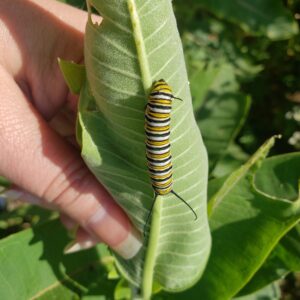
CONTRIBUTED PHOTO -- A Marshall County Conservation staff member finds a monarch caterpillar on the underside of a milkweed leaf. Milkweed is essential to the monarch butterfly life cycle, as it is the only food source for the caterpillar stage.
'Let us know'
Since it is harder for the Conservation department to tag the 500 butterflies, Herring asked Marshall County residents to notify them upon seeing monarchs.
"They get large groups migrating together and roost in a single tree in somebody's yard," she said. "We're always looking for monarchs to tag. If you have a ton of monarchs in your flower bed about the end of August, let us know. Those monarchs are not going to stick around long because they're migrating."
By the end of September, the number of monarchs in Marshall County will decrease. The few which may be spotted in the area right now are not the migratory butterflies. They are laying eggs on the sparse amount of milkweed since summer is monarch breeding season.
Food sources
Herring said she believes the loss of habitat to be the primary cause for the decline, and the decreasing amount of milkweed is an important aspect. Not many acres of land -- only 1,010 as of December 2020 -- in Marshall County contain native prairie anymore.
Shimp indicated the lack of habitat might be changing across the state. She said in September 2022, the Iowa consortium released a report which showed from 2018 through 2020, Iowans added 430,000 acres of habitat in the state.
The destruction of milkweed is a huge part of the habitat decline. Herring said the plant is vital to the monarch's life cycle. As the adult butterflies travel through Iowa, they lay their eggs on the milkweed, and the caterpillars eat the leaves. When they have had enough food, they begin the pupa stage on the underside of the leaves, emerging as the butterfly.
Herring urged residents to leave the plant alone. In fact, since milkweed is not invasive and so many crops are engineered, Herring said it can live in crop fields and not be a threat.
"Milkweed is not invasive," Herring said. "Just leave it in the road ditches – that's a great place for milkweed. I leave my milkweed in my garden as a food source for the butterflies. It's a plant that's really important to this species."
Due to the decreasing monarch numbers, many garden stores now sell milkweed seeds. Residents can also obtain milkweed seed for free through the Monarch Watch site, monarchwatch.org/conserve. People unfamiliar with milkweed should plant in the fall.
"The winter has a cooling, wet process which helps germinate those seeds," she said.
Herring said the adult butterflies rely on the consumption of nectar. Monarchs really love asters which bloom later in the year. They also like liatris, thistles and brown-eyed Susan.
"You can plant an area as native prairie or you can go to a garden store and they have tons of different plants which are great for butterflies," she said. "If they are good for butterflies, they are good for other pollinators, too."
MONARCH EDUCATION EVENT DETAILS
What: Nature Story Hour – Monarchs
Date: Thursday, Aug. 17
Time: 10 a.m.
Where: Grimes Farm Leonard Grimes Amphitheater, 2349 233rd St.
------
Contact Lana Bradstream at 641-753-6611 ext. 210 or lbradstream@timesrepublican.com.