
School board learns about student academic, behavior progress
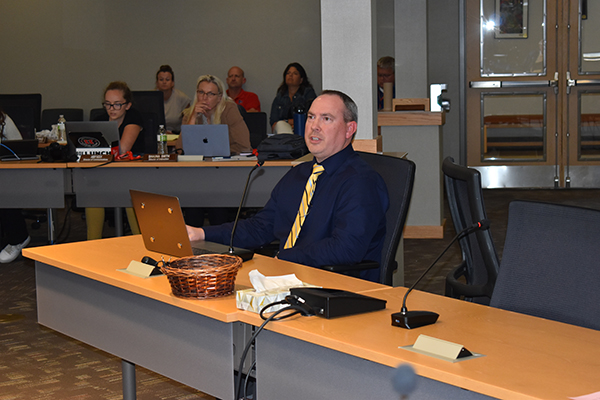
T-R PHOTOS BY LANA BRADSTREAM — Matt Cretsinger gives the Marshalltown Community School Board a social emotional learning update during a Monday work session. One of the updates revealed a maintaining of or increase of behavior incidents among students. Cretsinger is the district director of special services.
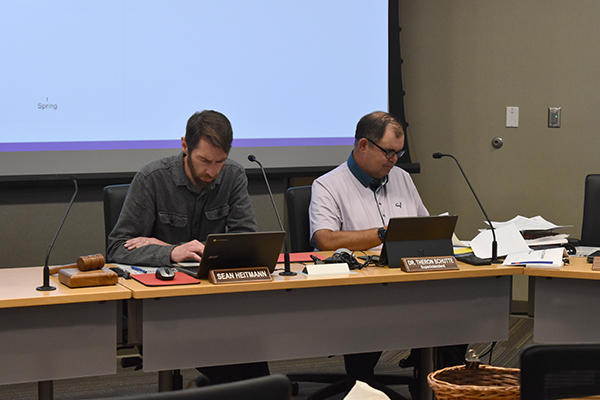
Sean Heitmann, president of the Marshalltown Community School Board, and Superintendent Theron Schutte review data about social emotional learning for last year’s students. The data accompanied a presentation about the subject during a board work session on Monday.
T-R PHOTOS BY LANA BRADSTREAM — Matt Cretsinger gives the Marshalltown Community School Board a social emotional learning update during a Monday work session. One of the updates revealed a maintaining of or increase of behavior incidents among students. Cretsinger is the district director of special services.
Sean Heitmann, president of the Marshalltown Community School Board, and Superintendent Theron Schutte review data about social emotional learning for last year’s students. The data accompanied a presentation about the subject during a board work session on Monday.
Trending
The academic progress and overall behavior of students were presented to the Marshalltown Community School Board on Monday during a work session.
Director of Instruction Shauna Smith presented last year's overall academic performance in literacy and math of the students. One thing she said the district should focus on is closing the gap between the scores of the Marshalltown grade levels and the state average. The data revealed students in grades kindergarten through sixth are behind in proficiency when compared to the state average.
Superintendent Theron Schutte pointed out the percentage of students in Marshalltown who are English learners is higher than the state average, which affects the results of the academic performance scores.
However, President Sean Heitmann noticed Marshalltown students were performing better in math than in literacy.
"Are there things we are doing well in math that translate well to the English Language Arts teaching?" Heitmann asked.
Smith said there was not, but elaborated. She said staff looked at the state average and broke down the grade levels at each building. Smith wanted to know if students were falling short in every building. Looking into whether or not there was any correlation, staff found some buildings were higher than the state average, and whether or not those same results could be transferred. She said it is possible what they find could be applied to Heitmann's question.
"Some buildings were excellent," Smith said. "There wasn't a true pattern. We're beginning that work. It's internal and important, but at the same time, I want to continue to push and be a part of the solution of how do we spread our knowledge from within."
"I think math results are encouraging," Schutte said. "I know that was an area the elementary principles really doubled down and tried to make gains."
Schutte added any given year, the district has a 14 to 20 percent turnover rate of students, which can also affect the overall scores of the school buildings.
"So it's not always the same students being measured year--in and year--out," he said.
Student behavior
Matt Cretsinger, director of special services, gave the board an update on progress of social emotional learning. He showed the board data from the 2022--23 school year and compared the results to the 2021--22 school year.
Cretsinger said the Conditions for Learning survey is given to students every year asking how they feel about:
• Physical safety
• Emotional safety
• Adult--student relationships
• Student--student relationships
• Expectations/boundaries
"We stayed mostly consistent when you look at the district data," Cretsinger said.
The biggest difference was a decline in emotional safety, which revolves around how safe students feel from being teased, verbal abuse and being excluded. Cretsinger said the strongest area where students feel most confident was student--student relationships, which focuses on how well students care for one another and get along.
A breakdown of how students responded in each building revealed Rogers Elementary and Woodbury Elementary had declines of positive responses in all areas. Board member Jan McGinnis asked why that is. Crestsinger told her it could be attributed to a variety of factors, such as a change in building leadership and a lack of staff in behavior management.
"Students who have bonded with teachers and staff and they change, it's going to affect them emotionally," McGinnis said.
Cretsinger's report also showed either a maintaining of or an increase of student behavior reports, which were divided into minor and major. Major behavior incidents are relatively serious and require the intervention of a principal to address. Minor behavior incidents can be managed by classroom teachers.
The percentage of major behavior incidents remained steady throughout the year, and minor incidents increased across the district. Cretsinger said some of the buildings need additional training to show staff how to handle minor incidents.
"Right now, we have ongoing professional learning in core approaches to our response in the classroom," he said. "We're working to further develop their understanding of trauma and how it changes things in the classroom."
Upon the mention of trauma, Cretsinger told the board students can sometimes be misdiagnosed with attention deficit hyperactivity disorder (ADHD), when they are actually struggling with trauma. Medication used for ADHD can make behavior worse.
Following the work session, the board held its regular meeting.
In other business during the regular meeting, the school board:
• Considered renaming a portion of the downtown Welcome Center the B.A. Niblock/MCSD Orpheum Welcome Center in honor of Bea Niblock. Niblock had a 49--year Iowa education career, including eight years serving on the Marshalltown Community School Board and 17 as the Anson Elementary principal. The board will vote on this at the Aug. 21 board meeting.
• Approved the district's legislative priorities -- student achievement, supplemental state aid, teacher recruitment and licensure and student mental health.
• Approved a $11.8 million budget and design of the Career and Technical Education (CTE) addition of the Marshalltown High School. Kevin Eipperle, FEH Design architect, presented the design and budget.
• Set Aug. 21 as the public hearing date for the $3 million tax revenue bond. The money will help pay for the high school CTE addition.
• Set Aug. 21 as the public hearing date for a lease agreement between the district and Alliant Energy to build a solar energy field.
------
Contact Lana Bradstream at 641--753--6611 ext. 210 or
bradstream@timesrepublican.com.