Piney Woods School leaders, students visit Marshalltown Friday
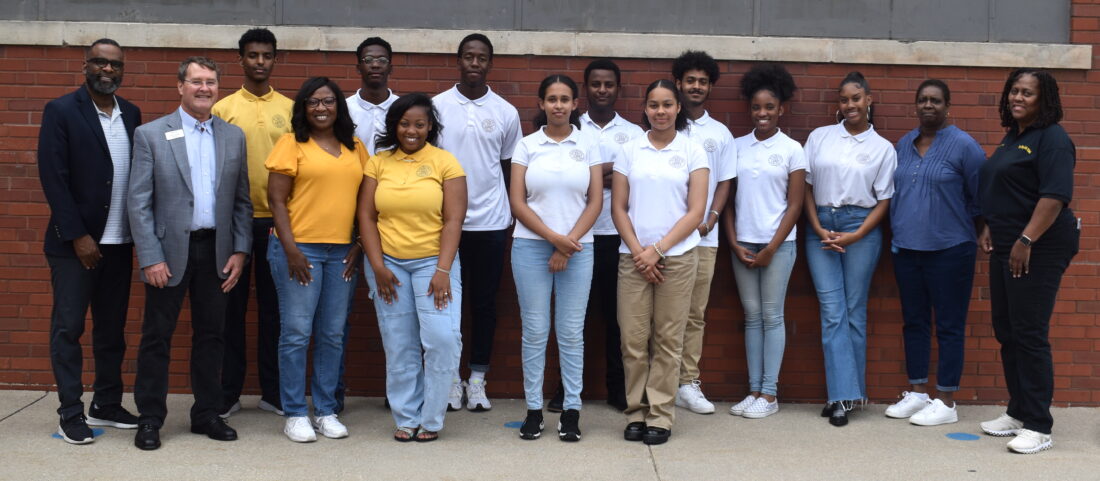
T-R PHOTO BY ROBERT MAHARRY — A group of 10 seniors from the Piney Woods School in rural Rankin County, Miss., who are pictured alongside School President Will Crossley, Dean of Faculty Monica Crossley, Chief of Staff Renee Tillman and Marshalltown Mayor Joel Greer, toured the community on Friday and posed for a photo outside of Franklin Elementary School. Laurence C. Jones, the founder of Piney Woods, was the first African-American to graduate from Marshalltown High School in 1903.
Laurence C. Jones made history as the first Black student to graduate from Marshalltown High School in 1903, and he went on to become a pioneer in the field of education, eventually founding the Piney Woods School in rural Rankin County, Miss. and, in a legendary story that still lives on today, not only talking Ku Klux Klan members out of lynching him in 1918 but in turn convincing them to contribute money to benefit the school, his passion project.
Piney Woods, an independent 9-12 boarding school serving primarily Black students from across the U.S. and Africa, continues in its mission to this day, and on Friday, a group of 10 seniors along with School President Will Crossley, his wife Monica, the dean of faculty, and Chief of Staff Renee Tillman visited Marshalltown and met Mayor Joel Greer, relishing the opportunity to tour their founder’s hometown — including the historic and recently reopened Marshall County Courthouse and Franklin Elementary School, which housed the high school when Jones graduated — and enjoy a meal at the Tremont Italian Grille.
“When (Will) first mentioned it and said we can go to Marshalltown, I got excited just because of knowing that that is how Piney Woods got started because the founder came from here,” Tillman said. “So for me, that was the whole purpose of this trip. I mean, I’m excited about all the other places that we got to go to, but being able to come here, it’s like a connection and a bond. I’ve been at Piney Woods for over 36 years now, and no one that I know of has been here. So you know, I was just excited and excited for the kids because it connects their present and their future with the past.”
Monica Crossley said she was grateful for the journey Jones took to the Deep South after he graduated from the University of Iowa in 1908 — instead of accepting a teaching position at the prestigious Tuskegee Institute in Alabama, he opted instead to work at the much smaller Utica Institute in Utica, Miss. and eventually setting out to reverse the 80 percent illiteracy rate in Rankin County, which is located just south of Jackson.
“He was on a train with little or nothing. Everything he learned, he took from here so we could make opportunities for young people. And just making all the connections. It’s almost like everything’s coming to life, and it’s just remarkable,” Monica Crossley said.
Perhaps due to their preconceived notions of Iowa, Crossley and Tillman were surprised to learn that Marshalltown isn’t a “small town” in the traditional sense of the word, with nearly 28,000 residents living here. They’ve also learned lessons about agriculture as both Iowa and Mississippi have rich traditions in the field, and they were headed off to Grinnell and Des Moines for a stop at Drake University to wrap up the trip in the Hawkeye State before heading back home.
The leaders were happy to report that the students — who hail from places as wide ranging as Indianapolis, Atlanta, Charlotte and South Africa — have been engaged throughout the trip and are asking questions about how they can make an impact in their communities in the future as some of them prepare to head off to college next year.
“Now, they know there are different aspects because you have kids who want to be engineers, and now they’re seeing that there’s actually engineering in farming,” Tillman said. “They think about the mule and a plow kind of thing, but now they’ve been exposed. And just bringing them to this part of the country, a lot of them would not come this way otherwise. And so now, in their brains, they’re thinking, ‘I might want to come here.'”
Will Crossley, the first alumni of the Piney Woods School to ever serve as its president, called the experience “empowering at its core,” and he felt that it strengthened the bond between the community where Jones received his education and the one where he helped to educate so many others.
“To be able to take students to see that, and the same person built the place that they live every day. And so (the goal is) for that to be an empowering lesson for them about what’s possible regardless of the obstacles and the challenges, I think this has been the most empowering thing we’ve done in a long time,” he said. “I think that’s what I’m taking from it… The really, really interesting thing is that you never know where relationships lie and where people connect. There were connections that we haven’t fully appreciated, and so just being here, even for these few days, has been an awesome, awesome time.”
Perhaps it’s fitting, then, that one of the largest buildings on the Piney Woods campus is called Iowa Hall, and the meaning behind it isn’t lost on Crossley, whose credentials include an appointment to a Department of Education post during the Obama administration and a stint as the chief legal counsel for the Democratic National Committee.
“We’ve always had this connection with Iowa, and it’s about time that we make good on our part of it. So here we are,” he said.
——
Contact Robert Maharry at 641-753-6611 ext. 255 or rmaharry@timesrepublican.com.
Todays News

Iowa DOT starts construction on Toledo roundabout Monday

OneroRx Inc. completes acquisition of NuCara pharmacy locations
AI can do ‘a lot of different stuff’ in the workplace

Gubernatorial candidate Rob Sand calls for term, age limits on elected officials
Speed limit on 2-lane highways could increase under bill passed by House