
Council discusses ideas on how to utilize traffic camera revenue
Trending
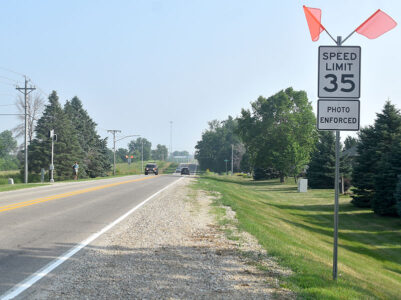
Since implementing two Automated Traffic Enforcement (ATE) cameras at fixed sites on Lincoln Way and South 12th Avenue/Governor Road over the summer, the city of Marshalltown has already generated almost $250,000 in revenue, and the question of how to spend those dollars came up for discussion during Monday night's council meeting.
City Administrator Joe Gaa said the purpose of the cameras was to force drivers to slow down in areas where complaints had been "constant" in the past, and he believed it had worked so far.
The flip side, he added, was that it had generated substantial revenue -- Gaa said it would not be unrealistic to expect $500,000 in a year -- and the third mobile camera has not even been installed yet.
Without council direction, the money will simply go into the city's general fund, but Gaa said it could be delegated for specific purposes.
"We want to use this in a way that enhances community safety and perhaps community improvement overall," he said.
Some suggestions included the Flock public safety cameras that Marshalltown Police Department Capt. Kiel Stevenson had just presented on to the council, which Gaa believed could be funded with about $125,000 annually, the implementation of the Arts+Culture Master Plan, increased community beautification projects such as park improvements and increased code enforcement.
Councilor Greg Nichols was the first to weigh in and said he would be for using the money for special projects like the public safety cameras as needed but wouldn't favor preemptively setting it aside for designated uses until a specific proposal came before the council.
"It can be earmarked for special projects, but I would prefer to see a project with an actual proposal and everything defined before we approve money for it," Nichols said.
Fellow Councilor Gary Thompson took a more cautious approach, worrying that as time went on, drivers would catch on to where the cameras are and revenues would decrease. Citing the current deficit in the general fund, he felt the money should be left there to offset it.
Councilor Barry Kell said that because ATE was sold to the public as a safety measure, using the money for "deficit filling" or "as things pop up through the year" would "go in the face" of that idea.
"These buckets or similar buckets, I think, directly make Marshalltown a better place to live, work and play. Learn, also. Sorry, I forgot that fourth one," he said of Gaa's suggested uses. "I think it follows the promise we made to the public that this wasn't a revenue generating process. It was public safety driven."
Councilor Gabe Isom was supportive of some of the money being put back into public safety as a "force multiplier" for the MPD, and he worried that without a consistent funding mechanism, the Arts+Culture Master Plan the council approved earlier this year wouldn't do the city much good if it was simply left on the shelf.
"I think what we've seen throughout the community as far as community pride and some of the projects that are before us and some that will continue to come forth, (we should be) making sure we have a fund that drives the very nature of some of the stuff that's going on for Main Street and that will probably come forth as an option to utilize some of that funding," he said.
He added that he felt parks and recreation projects were underfunded "like none other" in Marshalltown, and money set aside for that use could be put toward mowing, weed spraying and nuisance abatement to set a high standard of expectation for how the council would like the community as a whole to look. He said he would support the intent of how the memo was written up, which would delegate up to 25 percent toward police department technology, up to 25 percent toward the Arts+Culture Master Plan and up to 50 percent toward community beautification such as parks, maintenance of city entrances and thoroughfares and nuisance enforcement.
Councilor Mike Ladehoff expressed his support, specifically for nuisance enforcement in the First Ward, citing the need for a hand in that area, along with helping the police department and continuing to promote arts and culture initiatives.
"I would agree to this as it's written mainly because it's gonna increase the quality of life for people here in Marshalltown," he said.
The public then had a chance to share their thoughts, and Kathy Steinberg said she would like to see more street lights around the community so people will feel more comfortable being out and about later at night.
"For fun, I used to read Municipal Magazine, and it was always said that the most cost effective thing you could do to reduce crime is increase street lighting, so please don't forget that," she said.
Mark Eaton cited the socioeconomic transformation of Marshalltown from ninth wealthiest city in the state to the 17th poorest and said that while he enjoys arts and luxury and makes his living off of them, he didn't feel they were currently the city's most pressing needs.
"We don't have the luxury of spending on these things, and we have streets that are sorely underfunded. And the general fund can pay the salaries of the streets department instead of pirating $1.2 million of the $3.5 million we get from Road Use Tax, which should be going to streets but we're using to pay for people," he said. "So I think we need to rework the numbers some, and I think it's a little too early to put this in a resolution to give away like this."
Leigh Bauder related her experiences walking the streets of the Second Ward in support of city council challenger Mark Mitchell and said that in her interactions, the people they have spoken to would like to see money spent on streets, code enforcement and public safety. Doris Kinnick also said she would like to see the speed camera revenue be used for street repair and the aforementioned Flock police cameras.
A motion from Isom to bring back a resolution as presented -- up to 25 percent for public safety, up to 25 percent for the implementation of the Arts+Culture Master Plan and the remaining 50 percent for community beautification, parks, maintenance of city entries and thoroughfares and nuisance enforcement -- passed by a 5-2 tally with Thompson and Nichols opposed.
------
Contact Robert Maharry
at 641-753-6611 ext. 255 or
rmaharry@timesrepublican.com.