
Council revisits discussion on TIF agreements with Chamber, MCBD
Trending
The final item on the agenda during Monday night's nearly 2 ½ hour city council meeting was another discussion on the funding agreements for the Marshalltown Central Business District (MCBD) and the Marshalltown Area Chamber of Commerce as the Tax Increment Financing (TIF) certification deadline is fast approaching.
According to the current timeline, a public hearing will need to be set on the matter at the Oct. 23 meeting, and a final decision on how much funding to provide to each entity can be made after that hearing is held during the Nov. 13 meeting. With the floor opened to council comments, Councilor Gabe Isom wondered what remained to be discussed other than formally bringing back the items for a public hearing.
City Administrator Joe Gaa responded that of the three items included in the council packet -- the MCBD agreement, the Chamber agreement and facade and code incentive grants -- there seemed to be a consensus on continuing at the current level, but the first two came with some additional requests.
"I think continuing the facade and code incentive grants that we have downtown and the buildings that go along with that is a key piece of making sure we continue to revitalize and redevelop downtown," Isom said.
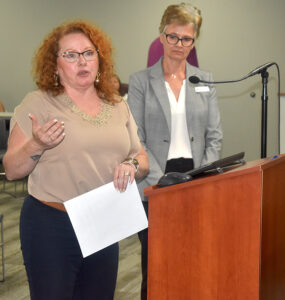
MCBD Board President Cindy Parks and Executive Director Deb Millizer then stepped forward to make their case again after Millizer spoke at the previous meeting, and Parks highlighted the fact that Marshalltown has been a Main Street Iowa community for 21 years. The goal of the MCBD, Parks said, is to "foster a safe, inviting and inclusive downtown so that people spend time and money there."
"We are an economic vitality engine. We are helping you support downtown and Marshalltown as a whole, and that's our whole mission," Parks said. "Our vision is to provide a greater sense of community by being a place that people want to be -- retail, restaurants and businesses."
She also mentioned the MCBD's participation as one of five communities selected for the Main Street Iowa Market Survey, which was presented in both English and Spanish and drew 604 responses, including 32 businesses. A key objective drawn from the findings, according to Parks, is to bring people downtown to eat dinner more than once or twice a month and do more shopping and walking around in the area -- respondents would also like to see more men's clothing stores, family entertainment and family-friendly restaurants.
A major point of excitement is the upcoming reconstruction of Main Street within the next few years, but it will also present challenges for businesses looking to survive and thrive during the process. Parks said Millizer would play a key role in promoting and supporting those establishments during that time.
Parks acknowledged the city's tight budget and fiscal constraints but felt that the MCBD contributed to the overall betterment of the community and deserved the investment it has received. Councilor Greg Nichols asked Parks how the MCBD would support downtown businesses during the Main Street reconstruction, and she said they would employ several strategies including promoting back entries and creating "bridges" across the construction area to help people navigate. According to Parks, they don't have all the details worked out yet, but she would be happy to return with them at a later date.
Councilor Gary Thompson noted that the council had given the MCBD more funding than usual -- $95,000 -- in fiscal year 2024 and asked how the $45,000 extra for economic vitality would be spent, which Parks said would go to hiring more help for Millizer and a rebranding effort. Thompson then asked what he called a "devil's advocate" question: what were some examples of things that had happened other than facade and code upgrade grants as a direct result of Marshalltown being designated a Main Street Iowa community?
She cited the Catalyst grant for the Hopkins/Willard buildings and handed the microphone to Millizer, who pointed to a $74,400 Main Street Iowa Challenge Grant that requires a match, along with $100,000 for the Hopkins building and substantial past grants for the Orpheum Theatre, the Blossom building at 105-107 W. Main St. and the Kibbey building at 125-131 E. Main St.
According to Millizer, the city also received $1.5 million from the Iowa Economic Development Authority (IEDA) after the tornado at least in part due to its status as a Main Street Iowa community.
"We're not as ugly downtown anymore. We have been pretty raw for a long time. Now that we have started to have our buildings addressed (and) have our buildings in hands that are going to do something with them, people feel that we are mostly recovered," she said. "We still have a lot of work to do. We now are in a position where we can do things like the Main Street Market Analysis Study... We have more and more opportunities that we can apply for."
She added that she feels they are finally starting to fight a sense of "apathy" about downtown and turn it into something that all residents can be proud of going forward. Thompson followed up with a few more questions, specifically wondering if downtown could enjoy the same vitality as the 13th Street District once the buildings are all updated.
"I would absolutely love to see more events downtown. One of the things that we need help with is doing those events," Millizer said. "It's not just that big event like Holiday Stroll or Bee Ridiculous Day, but it's ongoing events that we want to have in our downtown."
Third Thursday promotions were an example she cited, and Millizer hopes to add more food trucks in the area to encourage people to eat and shop in the area. Mayor Joel Greer recounted the reconstruction of 13th Street as a temporary inconvenience that has since led to a full-on revitalization in the area.
Nichols wanted to know how the rebranding would benefit local businesses, and Millizer sought to clarify that the goal was to avoid confusion between the organization and the location so that anyone visiting or interested in opening their own business would be able to distinguish.
Chamber President/CEO John Hall was the next speaker and presented the council with a substantial increase in the request for an economic development services contract. For the last 10 years, the city has paid the Chamber $50,000 annually, but, citing the scope of the work and the needs of business and industry, Hall asked that the number be more than doubled to $105,000.
"As I look at the economic development contract that we have been operating under, I would say it is probably woefully lacking from where the business community is asking us to be at and the items that we need to focus on," Hall said.
The seven key pillars of the Chamber's strategy, according to Hall, are industrial development, housing development, workforce development, downtown development, placemaking, retail and entrepreneurial growth/small business support. The current contract, he said, is strictly focused on industrial development.
"The reality is that we know workforce is the number one issue for most of our major employers, most communities across the entire nation, and if we are not focused on the items that allow us to continue to draw, retain and attract high-quality workforce, we are always going to be behind the curve and things will get more challenging and tougher," he said.
Hall said he and Gaa had discussed a survey tool that Gaa believed the city could handle internally, which would cut the overall contract down to $100,000 annually. He also discussed the ways the Chamber generates from other sources including direct investment from its member businesses.
Marshalltown Community School District Superintendent Theron Schutte, who also serves as an ex-officio member on the Chamber's board of directors, spoke up in support of the Chamber and its efforts as a proud member of the organization -- and, as of recently, the MCBD since the district acquired the Orpheum from the Iowa Valley Community College District. He expressed a desire to see Marshalltown become the best that it can be through amenities such as housing, restaurants, retail, entertainment and recreational spaces.
"One of the reasons that I chose to come back to Marshalltown after having grown up here and being educated and then being away for 30 years was the synergy around people like the John Halls or the other formal and informal leaders within the community that wanted to do everything possible collaboratively to try to make things better because all of us realize as Mark (Eaton, during a previous discussion item) pointed out, times have changed economically from where Marshalltown was back in the '60s, '70s and '80s when I was (first) living here to where we are today," Schutte said. "Many of the changes have been for the better. Socioeconomically, not so much, but as a result of that, we have to focus on 'How do we find solutions to the problems that we have at hand?' instead of dwelling in the negatives and in the problems."
He added that finding the aforementioned synergy and making the schools the best they can be from an educational standpoint "would not happen" without the collaboration of entities like the city and the Chamber, citing the creation of a workforce development director position and how it has benefited MCSD students who wish to stay in the community and start careers here.
"We have to help guide students to find what their passions and their interests are, for sure as early as middle school if not before," Schutte said. "So we work really hard to try to help do that so that all kids have a vision and a pathway for success. Our jobs would be extraordinarily difficult without an entity such as the Chamber in order to assist doing that."
He concluded with a hope that the community would continue to move in its current direction and asked that the council continue to sustain its support of the Chamber but also figure out ways to focus on ways to grow and increase it.
Eaton was the next commenter and agreed that everyone at the meeting wanted Marshalltown to grow and survive and said immigrant families were more likely to stay here as opposed to members of his generation, "90 percent" of whom moved elsewhere for other professional opportunities. He suggested that some of the local nonprofits, which control over $60 million, "step up to the plate" and contribute to the growth of the community.
"It can't all sit on the taxpayers' back while the nonprofit foundations grow, so I think it's time, it's high time, the nonprofits step up to the plate and fund some of these demands. They can even fund Park and Rec where we don't have to, and we can use those funds to make the city better, fix roads and other things," Eaton said.
Linda Clark commented that she would like to see the Orpheum used more to help revitalize the downtown area and praised the T-R for covering happenings in the community.
Councilor Jeff Schneider proposed to move forward with the requests as presented -- $100,000 a year for five years for the Chamber and a three-year contract with the MCBD providing $50,000 in year one, $60,000 in year two and $70,000 in year three -- and it passed by a 4-3 tally, with Schneider, Barry Kell, Gabe Isom and Mike Ladehoff in favor and Thompson, Nichols and Al Hoop opposed.