
Shear Colbert Symposium focuses on history of 1973
Trending
The year 1973 was pivotal for America. Numerous social justice events occurred which helped create the reality we have today. Those 12 months were the topic at Thursday's Shear Colbert Symposium at Marshalltown Community College.
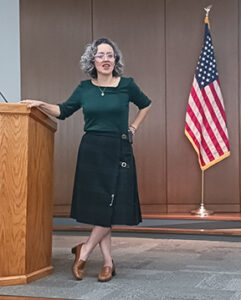
Lina-Maria Murillo, assistant professor of Gender, Women's, and Sexuality Studies, History, and Latina/o/x Studies at the University of Iowa, presented "1973: A History from the Margins."
"This was a very fascinating, interesting year," she said.
Murillo told the crowd of roughly 40 people her presentation could be rounded out with intersectionality.
"How might their stories, triumphs and tribulations explain our current historical moment?" Murillo asked. "How do we understand these histories from an intersectional framework?"
She said she uses intersectionality analysis and thinking to understand the history of people who come from different classes, races, genders. Murillo said it can fit them together in an understandable narrative, which has been done during the better part of the twentieth century.
"What does that mean?" she said. "They were saying 'What does it look like if we ask questions about people at the intersection of various identities?' What does it look like to ask questions about people going through, for instance, immigration issues? If we think about this person as a woman, as an indigenous woman, as a Mexican indigenous woman, as being poor, what do we understand about people's experiences as we begin to fully flesh out who they are as human beings."
One of the foundations for 1973, according to Murillo, is the multi-decade Civil Rights Movement, which began in the 1950s and 1960s as people trying to dismantle racist structures. In that year, Murillo said some of that effort came to fruition even as the country seemed to be spinning out of control.
She focused on three 1973 stories -- Reproductive Justice, Movement for Decolonization and Music and Revolution.
In January 1973, Murillo said Roe v. Wade went to the United States Supreme Court and provided a brief history of the historical lawsuit. She said it protected abortion care for white women, who fought for the right. She said in Iowa, people supported abortion because they felt it was critical to dealing with overpopulation.
"There was a great fear in the 1960s the world was becoming overpopulated," Murillo said. "People were very fearful. Leading up to 1970, there's a lot of discussion in the state of Iowa about this anxiety, that there were too many people on the planet."
However, while that was going on, women of color were fighting for the right to give birth. Murillo said there was a spike of forced sterilization cases of women of color -- mostly Latin, indigenous and Black -- across America.
"For many of these women in different states, they had been in the grip of public health institutions, that under the guise of free medical care, had been forcibly sterilized," she said.
Murillo said in 1973, women began to talk about this and the federal class action case of Madrigal v. Quilligan began. In that case, 10 women, including Dolores Madrigal, said California obstetrician James Quilligan at the Los Angeles County Hospital forcibly sterilized them. Madrigal said it occurred during labor of her second child. She was told she would receive pain medication, but only if she signed some paperwork.
Murillo said such action as described in Madrigal v. Quilligan, stems from eugenics. She said people wanted to socially engineer better human beings, to excise traits such as illiteracy, alcoholism, promiscuity and more. The way eugenics believers did that was to curtail the reproduction of people who were deemed 'problematic.'
"In a deeply racist society like the United States, who do you think are the people with the bad traits," Murillo asked. "It's mostly going to be poor people and people of color."
In Iowa, she said there was a eugenics board at the time and the amount of people who were sterilized increased in the 1960s and 1970s. Since Iowa primarily consisted of Caucasian people, Murillo said the sterilized people were poor white people, or those who were disabled.
Another case she spoke of was of an indigenous woman in California in 1972. The woman went to the Indian Health Service and requested a womb transplant. Six years prior, the woman struggled with alcoholism and a doctor removed her uterus, assuring her it could be replaced later.
According to Murillo, 75 percent of indigenous women in the 1970s were sterilized, which led to the growth of the American Indian Movement (AIM) and the 1973 occupation of Wounded Knee, S.D.
"This is a critical movement for radical militant youth in the United States, one that in many ways undergirded the fear of overpopulation by certain factions," she said. "Imagine hearing on the news there are sieges of indigenous populations and indigenous people are rising up, that queer and gay people in New York City and San Francisco are rising up, that you have Black Power militants in Chicago and Los Angeles and New York rising up, that you have a movement for Puerto Rican liberation. Imagine people calling for Chicano power in the southwest, the American Indian Movement taking up space. People were, of a certain generation, very much shaken by this radical activism. This desire to control and clamp down these voices of dissent shaped this generation."
Amidst all of the activism and movements in 1973, Murillo said hip hop, a production of art and beauty, was born. It was a mixing of beats and a way for people of color to speak to one another about what was happening in their communities. She said it was a culmination of activism by communities of color in the United States, filled with rage and frustration.
Murillo asked what the culmination of the three stories could tell us about today.
"What do you think this particular history could tell us about the loss of Roe v. Wade, about a tax against our education system, the move to ban books from our libraries, the fight for land and access to land?" she asked.
Contact Lana Bradstream at 641-753-6611 ext. 210 or lbradstream@timesrepublican.com.