
‘She’s my hero’ — Marshalltown woman donates kidney to her father
Trending
Organ donation does not always occur after someone has died. Sometimes it can come from a living donor, such as Allison Capalla, 46, of Marshalltown.
Earlier this year, Capalla's family was faced with a tough reality -- her father Don Meyer, 72, also of Marshalltown, was ill, and he needed a kidney. Capalla said she would give him hers.
"He's my daddy," she said.
Capalla's mother Vicki Meyer said the experience inspired Capalla to promote the living organ donation program. While this family went through the University of Iowa, they received information about other programs, such as paired kidney exchange in which a donor is found to not be compatible with a recipient. So, the donor offers to give a kidney to a different recipient in exchange for a new donor for the original intended recipient.
"It's a pretty streamlined process," Capalla said. "For a healthy person, it's not a huge recovery."
Vicki said people might have a fear of the idea, but encouraged them to investigate. She hopes they keep an open mind because other people might need a donation down the road.
Inspired by the steps Capalla was taking as a living donor, family members encouraged her and told her if she happened to need a kidney in the future, they would step up to the plate.
The beginning of Capalla's journey to becoming a living donor started four years ago when Don's health struggle began. It was discovered his kidneys were not functioning well due to a health condition. The following four years consisted of regular care at McFarland Clinic and adopting a restrictive diet -- no sodium or potassium. Vicki took care of Don, and Capalla said her mother was perfect at it -- making sure his medications were taken, appointments were met and his diet was followed. The latter was tricky at times.
"If you have low sodium in something, chances are the potassium is high," Vicki said. "And if it's low potassium, chances are the sodium is high. So we had a limit of 1,500 milligrams of sodium and no potassium. It was difficult to shop and plan a meal that was not totally boring."
Unfortunately, Capalla said the Thanksgiving meal was fairly boring for Don.
"I couldn't have the green bean salad. I couldn't have potatoes," Don said.
Following the transplant, Capalla is very happy Don is now able to ease up on the dietary restrictions and travel more.
"Now he can eat the things he couldn't before," Capalla said. "He went to Okoboji over the summer. They are back to season ticket Hawkeye football holders. He can have his life back."
Vicki was afraid Don would have to maintain his restrictive diet. However, a urologist told her since Don had a working kidney again, he could eat it all and enjoy French fries once again.
Starting the process
Vicki said last winter it was determined Don would need a kidney, and it had to come from a living donor. The wait time for a deceased donor -- an average of five to seven years -- was too long. Capalla wanted to prevent her father from going on dialysis. The fact dialysis was avoided was huge, Don said.
"I went and saw him and said, 'I have a spare,'" Capalla said. "They both were like, 'No. No. We don't want you to do that.' I said, 'No, I have a spare and you can have it' and I never looked back."
Vicki said they were opposed to the idea because they did not want their daughter to take the risk.
"It's pretty humbling when the only thing available is your daughter and she's willing to make that gift," she said.
Numerous testing was conducted to find out if Capalla's tissue and blood matched Don's, and it was found she was perfect. Upon learning of their daughter's approval for the procedure, Vicki said they were reassured by the physicians.
"They said, 'Look at it this way, only the healthiest people are allowed to donate an organ,'" she said. "So, my fears subsided at that time. It made me nervous but she was so gung-ho about it. It means she's healthier than most people walking around. That helped a lot."
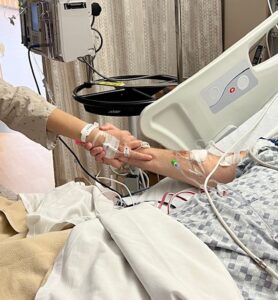
CONTRIBUTED PHOTO -- Allison Capalla and Don Meyer hold hands and comfort one another before undergoing surgery at the University of Iowa Organ Transplant Center. The entire procedure went very smoothly and was described by the doctors as being "textbook."
Before the four-hour procedure at the University of Iowa Organ Transplant Center in Iowa City, Capalla said she and Don, dressed in the standard patient gowns, took pictures and spent time with one another. The removal of Capalla's kidney occurred first. Don was taken into the operating room afterward.
"I have three kidneys now, but only one of them works," he said. "They don't take out the kidneys. They just add one. It's right here in my abdomen."
Vicki waited while her husband and daughter were being operated on.
"Someone asked me how I felt when they both left and I said that's when faith took over," she said. "I just had the calmest day. They kept us informed."
After Capalla woke up, she saw Don being wheeled by her room to the recovery area.
"I was aware enough to say, 'Is that my dad?'" Capalla said. "He got back to his room probably an hour and a half later. I got up and walked with my IV pole to see him."
Immediately, she said Don looked awesome.
"I was shocked," Capalla said. "It's not that he didn't before, but I could tell a difference for sure. They said my kidney started functioning right away."
The entire process was described as textbook, and Capalla was even able to leave the hospital the next day. Because of how smoothly everything went, she believes the experience was meant to be.
"I'm happy I threw my name in the hat, and it all worked out," she said.
"She's my hero," Don added.
About living donation
According to the Health Resources & Services Administration, roughly 6,500 living donations take place yearly throughout the country. Most occur between family members or close friends.
Organs that living people can donate include one of their kidneys, a segment of their liver, a lung lobe or parts of their pancreas or intestines. For tissue, living donors can provide skin, blood, bone or cells.
Most of the time, living donors do not have to pay for the testing or procedure. The recipient's insurance will cover the costs.
------
Contact Lana Bradstream at (641) 753-6611 ext. 210 or lbradstream@timesrepublican.com.