
Council formally approves contracts with Chamber, MCBD
Trending
After discussing the proposals at length during a pair of previous meetings, the Marshalltown city council formally approved agreements with the Marshalltown Central Business District (MCBD) and the Marshalltown Area Chamber of Commerce on Monday night.
Per the terms of the contracts, the city will pay the Chamber $100,000 annually for economic development services over a five-year period -- previously, they had received $50,000 a year -- and $50,000 annually to the MCBD for the first year of the contract before bumping it up to $60,000 in year two and $70,000 in years three through five utilizing Tax Increment Financing (TIF) dollars. Additionally, the MCBD will receive $50,000 to be put toward code enforcement and facade improvements.
As the floor was opened for public comments on each matter, Mark Eaton said he did not believe the Chamber needed taxpayer money with its current assets and reiterated his calls for the board meetings of the organization related to economic development to be open to the public -- along with budgets, agendas and minutes.
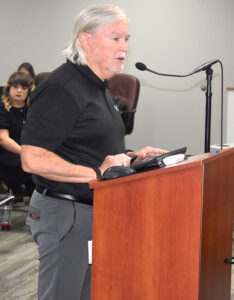
Chamber CEO/President John Hall came forward next and provided a recap of the work his organization performs as well as the history of the operational agreement between the city and the Chamber. Hall remarked that the economic development has changed substantially and "radicalized" in the last few years since the pandemic.
"We know that folks now move where they want to and then find a job later. It is less about moving where there is a direct job, and so a lot of our efforts have had to shift based on what the business community feedback looks like," Hall said. "Work on retail and restaurant, entertainment business development. Work on housing development. Those are items that we need to be at the table on in a more robust way than we ever have been, and that's what the private dollars that we've got coming in indicate that they are looking for from us."
He highlighted some recent successes including the Karl's expansion on the north side of town, Scooter's, Real Deals and Nied's Pharmacy, and Hall said there were more single family homes built last year than there had been in the previous five. He also alluded to the current Marshalltown Mall situation and noted that the Chamber often has to be involved in negative situations as well.
Hall concluded by telling the board he felt confident in the contract provided before the floor was reopened for public comments. Linda Clark echoed Eaton's calls for greater transparency before Jim Bowman, the senior economic development manager at Alliant Energy, praised the Chamber for its aggressive and proactive efforts to bring businesses to town.
Like Hall, Bowman reflected on the change from people following jobs to jobs following people, and he was complimentary of the way meetings run in Marshalltown.
"We support the Chamber. We just increased our investment in the Chamber because of their leadership and their desire to really grow the economic development services that will have an impact on Marshalltown," he said. "We, as a business, have got to look at communities that want to be winners and decide where we put our investor dollars. And it's tough. We have to make tough decisions. Marshalltown's on that list that we talk about often about where Alliant Energy can invest more... We believe Marshalltown has all the right pieces."
He added that he believed more jobs could be created here, especially in manufacturing. Mayor Joel Greer complimented Alliant for its continued involvement and investment in Marshalltown, and City Administrator Joe Gaa said that if the Chamber didn't provide the service, the city would likely have to hire its own staff to do so at a higher cost.
After making similar comments about the Arts+Culture Alliance contract, which had been discussed earlier in the meeting, Councilor Gary Thompson indicated his desire to see a Request for Proposal (RFP) to be sent out to other agencies that could perform economic development services. A motion to approve the agreement with the Chamber then passed by a 5-2 vote with Thompson and Al Hoop opposed.
The conversation then moved to the MCBD, and Eaton again made the same request about the public being allowed to attend meetings and have access to agendas and minutes if taxpayer funding is provided to the organization.
Neil Dalal of the MCBD Board of Directors then detailed some of their efforts to revitalize the downtown and highlighted the recent "Treasures Tour" of historic buildings with opportunities for new businesses to open inside of them.
"It was really fun to see time spaces that are trapped in the 1920s all the way to the updated pharmacy to the new coffee shop coming, so that's all new retail business coming," Dalal said. "There was a comment earlier 'I wish there was more retail.' Times have changed. Economics have changed. We're working to get that back."
Marshalltown is currently one of just 54 accredited Main Street Iowa communities in the state, and Dalal reported that since 2019, $36 million in public and private funds have been invested in the downtown area. As a result of the accreditation, the city has received $3.4 million in grant funding.
Events like Haunt the Block and the upcoming Holiday Stroll attract large crowds and provide an opportunity for businesses to reach more customers, Dalal noted. He shared the basic details of a "Business Builder Academy" that has been utilized in Ottumwa to help aspiring entrepreneurs on the path to business ownership and hoped it could be replicated here.
Dalal credited the volunteers who have helped to make the MCBD's work possible -- Millizer is the only paid staff member -- citing over 68,000 volunteer hours since 2002 and the $82,000 in grants they distributed for COVID and derecho relief grants for businesses. Once he had finished, the floor was reopened for further public comments, with Jim Shaw asking for clarity on a population statistic shared and Serina Stabenow contending that while she has been pleased with some of the progress downtown, she'd like to keep her taxes "where they're at."
"I don't think taxpayers should be paying for businesses to be remodeled. Are they gonna make it?" Stabenow asked. "We don't know if those businesses are gonna make it or not, so I don't wanna be giving money to a business that may or not make it."
Millizer took the microphone and piggybacked off of Dalal's comments, expressing her excitement about the positive momentum downtown with projects like the pedestrian alleyway arch (also featured in today's Times-Republican) and the recent news that Oliver Beene Designs, a former tenant of the Marshalltown Mall, would be moving to Main Street. She was also quick to shout out the board members and volunteers, including Promotions Chair Alushia Fitzgerald, who help make events like Haunt the Block, Bee Ridiculous Day and the Holiday Stroll possible.
"We talk about grassroots. We talk about investing in our community, and these people have rolled up their sleeves and they have done it," Millizer said. "And we would appreciate that the city would continue to support our efforts, including our facade grants, which, when we improve upon these buildings, it also adds to our tax roll and they have a higher value."
MCBD Board President Cindy Parks thanked Millizer for her efforts and noted her own journey from thinking she would never want to live in Marshalltown to doing exactly that -- in a downtown apartment, to be sure. After Gaa shared the details of the agreement, Thompson asked why there was a jump in funding for the second year and then again for years three through five.
Dalal responded that the MCBD was "underfunded" compared to similar organizations in other communities, specifically citing Ottumwa, and he hoped this agreement would help to level the playing field. A motion to approve the operations agreement passed by a 6-1 vote with Hoop as the lone dissenter.
A brief third and final public hearing was then held on the allocation of $50,000 annually ($250,000 total) for five years to the MCBD for downtown facade and code improvements. Eaton argued that taxpayer money was "low hanging fruit," and he did not feel that it should be given to a private nonprofit organization. Dalal then opined that without grants like the ones being discussed, he did not believe that many of the redevelopment projects would have happened. Clark worried about how Main Street businesses would be affected by the upcoming road reconstruction, which is expected to begin sometime in late 2024 or early 2025.
A vote to approve the final resolution passed by a unanimous vote.
------
Contact Robert Maharry
at 641-753-6611 ext. 255 or
rmaharry@timesrepublican.com.