
Day recounts journey through two branches of military service
Trending
As a senior at Waterloo West High School in 1988, Rick Day, who now works as a probation and parole officer for the state based in Marshall County, signed up for the Marine Corps and did four years before he was discharged in 1993.
He may have thought his military journey had come to an end at that point, but as it turned out, it was only just beginning. Day scored highly on his Armed Services Vocational Aptitude Battery (ASVAB) test as a youngster, but when he joined the Marines, he wanted to serve in the infantry and enlisted as combat arms. He was selected as a tow gunner.
"If you have to be infantry, it's probably the best job to have because I wasn't walking anywhere. What a tow gunner is is an anti tank missileman, so the systems on top of a Humvee, so you're driving everywhere," he said.
He had also been asked about the potential for becoming a member of the Marine Corps Security Forces and ended up being posted in Sicily guarding a Navy air base with underwater nuclear weapons. Naples, England and Spain had been his top three choices, but at least he ended up in another part of Italy.
When Operation Desert Storm kicked off in 1990, Day was still stationed in Sicily, and, like most of his fellow service members, he spent his days wondering when he would be headed to Iraq or Kuwait.
"It was over by the time I was even close to getting out of Sicily," he said. "I completely missed that one. Part of it, you wonder if you would've had the mental (strength) to do what needed to be done."
After 18 months, he put in another "dream sheet" on where he'd like to go next, and this time, he put in a request for three bases in California. Unsurprisingly considering his past posting, he ended up on the other side of the country at Camp Lejeune in North Carolina.
"Honestly, it was kind of like a lot of my military career in general, kind of a comedy of errors, sort of. I went to where the Marine Corps wanted me to go, but it wasn't what I chose. But I loved North Carolina," he said.
Day reported to Camp Lejeune around Christmas of 1991 and stayed there until he was discharged on Aug. 1, 1993. From there, he returned to Iowa, enrolled at Kirkwood Community College while trying to figure out what his civilian life and career would look like. He didn't want to go back into uniform, so he opted to pursue community corrections, a field that he said was "blowing up" at the time as leaders sought new ways to reintegrate people convicted of crimes back into society and provide work opportunities for them.
His first experience in corrections came at Four Oaks in Cedar Rapids, and 2 ½ years later, Day finished his degree. Once he graduated, he gave himself a year to find a job before he would head back to the University of Iowa, but he was able to find a part-time job in Fort Dodge that paid more than his full-time job he already had.
With a year of part-time experience under his belt, he got a full-time job in Marshalltown in 1997 and has been here ever since -- with a few interruptions. Over the years, Day had kept in contact with a recruiter named David McGaughy who had taken over for the man that recruited him in Waterloo back in the late '80s.
A friendship blossomed between the two, and McGaughy, who passed away in 2022, did a stint in Fort Dodge as a recruiter before joining the Air National Guard and moving to Marshalltown. They continued to discuss the possibility of Day re-enlisting someday, but after 9/11, the conversations reached "a fever pitch," in Day's words.
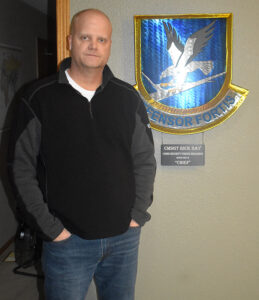
He finished even more education at Iowa State University, and by 2003, he was finally promoted to the title of probation and parole officer. Fifteen months later, he enlisted in the Air National Guard and, like he did before in the Marines, found a role as a military policeman helping with security.
The second enlistment lasted much longer than the first, as Day was ultimately promoted to Chief and stayed in until last year. He deployed four times -- three times to the Middle East and once to Puerto Rico as part of Hurricane Maria relief efforts. This time around, he did get his chance to enter Iraq serving as security on planes when they would transport prisoners of war from one location to another -- he traveled to many of the country's major cities including Baghdad, Mosul, Kirkuk and Basrah.
His final deployment was to Kuwait in 2018, and he noticed that "everything had changed." His unit guarded Army personnel training Saudis on how to use the equipment the U.S. had sold them.
"The bases were different, more built up. Things had calmed down quite a bit so there was a lot more freedom for people," he said.
Today, he still serves as a PO 3 working with intensive and high risk clients and has settled back into life in Marshalltown -- for good this time, he thinks -- but military service will always make up a huge part of Day's life and identity.
He sees plenty of correlations between the work he does now and what he did on a day-to-day basis in both the Marines and the Air National Guard, and he also remarked on how some of the time honored tactics for whipping young soldiers into shape have changed in the modern military.
"The dynamics have changed now because if you want to actually recruit or retain people, then you have to modify how you're going to address them or work with them," Day said. "So getting in individuals' faces and screaming and yelling and the whole knife hand type thing, that's going to the wayside... You can't get away with that now."
The experience also introduced him to a wide cross section of the American population, and he's grateful for all of the relationships he's managed to build along the way.
"You have to deal with, in my civilian job, a ton of different types of people and where they come from and what they've been through in life. So it mimics that in the military because the military is just a microcosm of our civilian lives," he said. "I got out for the right reasons, I think, the first time, and I got back in for the right reasons. And that's why when anything came down the pipe, I was like 'Hey, I'll go.'"
------
Contact Robert Maharry at 641-753-6611 ext. 255 or rmaharry@timesrepublican.com.