
Council opts to keep property tax levy rate at $16 during special meeting
Trending
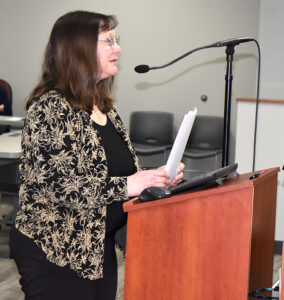
As part of the ongoing discussions surrounding the budget before the numbers are officially finalized, City of Marshalltown Finance Director Diana Steiner spent the last 15 minutes or so of Monday night's special council meeting reviewing the city's long-term debt obligation and asking for guidance on setting the property tax levy for the upcoming fiscal year.
After breaking down the debt by categories -- general obligation and sewer revenue bonds paid out of the enterprise funds -- and offsets that come from either Tax Increment Financing (TIF) debt or stormwater enterprise funds, Steiner explained the impact of Local Option Sales Tax (LOST). Currently, 78 percent ($3.12 million) goes to debt relief that in turns allows the city to reduce its overall property tax levy by that amount, and the remaining 22 percent, or $1 million, is allotted for council designated uses. If voters approve the reauthorization of LOST on March 5, the formula will slightly change to 75 percent debt relief, 25 percent council designated uses.
The current levy rate is $16 per $1,000 of valuation after the council voted to raise it from $15.36 last year, and Steiner said to maintain the $16 rate, they would need to kick in $1 million to the property tax relief fund, which would pull the balance down to about $280,000.
She also noted the possibility of taking $350,000 from the debt service fund. After a few clarifying questions and comments from Councilors Greg Nichols and Gary Thompson, Mayor Pro Tem Mike Ladehoff asked Steiner how the failure to renew LOST might affect the city's bond rating.
"For Local Option Sales Tax, when Moody's looks at our bond rating, they like to see cash. So they look at our cash reserve, they look at the Local Option Sales Tax balances. They look at the enterprise funds, and that feeds into the bond rating," Steiner said. "They don't give you their formula, so it's just Speer Financial who's telling us that."
Ladehoff commented that while it wasn't "a for sure," he worried that it would give the appearance of the city being less financially stable and declining. Steiner then pointed out that in addition to the property tax levy, there are other sources of revenue including the backfill for the business property tax credit (which could be reduced depending on state legislative action) and backfill for the commercial rollback, which could also change based on decisions at the statehouse.
"We want to leave a little bit of fund balance in that fund and not take it down to zero for those reasons," Steiner said.
From there, she shifted the conversation into the aforementioned property tax levy, a topic of great interest during every budget season. As she has during previous meetings, Steiner noted the changes as a result of House File 718 and its consolidation of levies eliminating special levies for the library, the emergency levy, the Marshalltown Arts and Civic Center (MACC) and the municipal band.
The regular levy of around $8.5 million is what goes into the general fund for city expenditures, and Steiner then discussed potential budget reductions including the ones Public Works Director Heather Thomas had suggested and received council direction on in the transit department paired with raising that levy from just shy of $0.30 to $0.40. One major expense increase the city can expect, according to Steiner, is in liability, property and self-insurance through the Iowa Communities Assurance Pool (ICAP) -- a likely 40 percent jump for this fiscal year and an additional 25 percent next year.
The city can also levy for benefits and retirement for general fund employees, while those funded through grants and enterprise funds are pulled from those sources. After breaking it all down, Steiner said the rate was still set at $16 and a fraction of a cent unless the council had a desire to change it.
Ladehoff said he didn't have any appetite to raise it with LOST being available to cover shortfalls in certain funds and asks.
"The council has been pretty miserly in holding on to the Local Option Sales Tax to be able to make the library whole, that type of thing, so myself, I think we oughta leave it at $16," he said.
Thompson asked for a recap of levy rates in recent years before the increase last April, and Councilor Barry Kell sought clarification on what was being bought down to get to that rate. Steiner said it had been at $15.36 for the last three or four years and $15.26 in the years before that, and last year, the city used $447,000 from the fund balance to get to its rate.
Citing Steiner's expertise on the topic, Thompson wondered if she was comfortable with the current rate or some "big dark lurking surprise" that would bite the city in FY25, but she responded that she wasn't currently expecting anything major to come out of the blue.
After a motion and a second were made to proceed with the $16 levy rate with the transit changes included, Thompson asked Steiner if such a vote was premature and could wait until a future meeting.
Steiner responded that she hoped to have it wrapped up by the next regular meeting, which is scheduled for Feb. 12, so the mass mailing of rates could go out to the public and when hearings will be held. The original motion ultimately passed by a 6-0 vote with Jeff Schneider absent.
Before the meeting adjourned, Ladehoff addressed what he felt was a misconception in the community that the city consistently fails to balance its budget.
"Our budget is balanced every year. Diana talks about deficit the way she does because of how she has to present it to us, but by state law, we have to balance our budget every year. And we do," he said. "It's somewhat like if you had $500 on a credit card and $50,000 in the bank. Your budget is balanced, so that's why we do it but we have to present a balanced budget every year to the state."
------
Contact Robert Maharry at 641-753-6611 ext. 255 or
rmaharry@timesrepublican.com.