
Council talks valuations, budget picture during special meeting
Trending
After discussing the city administrator situation and the Capital Improvement Plan, the Marshalltown city council moved on to assessed property valuations -- which have finally been received from the county -- and how they will affect the overall budget picture during Monday night's special meeting.
According to a memo prepared by City Finance Director Diana Steiner, valuations within Marshalltown increased by 16.71 percent -- $310,242,279 -- to a new total of $2,166,544,737 for fiscal year 2025, which begins on July 1.
"Normally, we would be jumping for joy with that big of valuations. However, due to the state making some restrictions on us, the rollback, for example, the residential rollback went from 56 percent in FY24 to 46 percent in FY25. So that was a big hit we took," Steiner said. "The backfill for commercial and industrial property continues to decrease every year by $46,000, and our TIF increase lowers our valuations as well."
She then explained the effects of House File 718, a bill removing special levies that, in Marshalltown, fund the public library, the municipal band, the Marshalltown Arts and Civic Center (MACC) and the emergency levy and replacing them with a consolidated rate. Steiner said under the previous law, the city would have generated $8.8 million. The consolidated rate is actually slightly higher, but the dollar amount coming in has been reduced by $248,000 off the bat.
"We knew we were gonna probably take a hit, which we did, on House File 718. In addition to other items for expenses, we saw wages are going up, our health insurance is going up, our property insurance is going up," she said.
Steiner added that the $100,000 for the MACC and $8,000 for the band have been put into the regular budget, accounting for "everything they would normally account for" other than increases in utilities and other products.
"When all is said and done, we have a deficit of $1.1 million," she said. "This isn't unusual. We come to you every year. We're always in a deficit when we put all the numbers together, so we want to walk through this and want you to help us with some items and at a future meeting, you can put it in ink rather than pencil."
She then presented some options for balancing the budget including $201,000 in unused American Rescue Plan Act (ARPA) funds, reducing the percentage of the hotel/motel tax disbursed to the Marshalltown Area Chamber of Commerce from 56 percent to 50 percent to put $36,000 back into the general fund, reallocating some or all of the $250,000 in Automated Traffic Enforcement (ATE) revenue currently earmarked for community beautification and nuisance abatement and using Local Option Sales Tax (LOST).
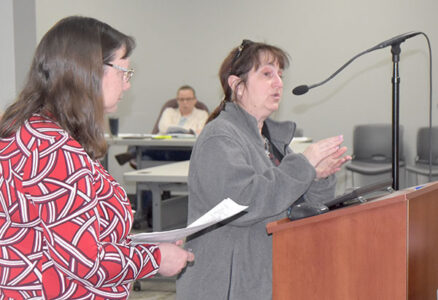
From there, the focus turned to potential spending cuts, and Steiner suggested closing the library on Sundays (currently, it is open for four hours) due to the loss of the special levy. Councilor Greg Nichols asked what the busiest and least busy days of operation are, and that brought Library Director Sarah Rosenblum to the podium.
"I'm afraid I don't have that information at hand, and I apologize. I should. I will tell you, when we first opened on Sundays, Sundays were the busiest hours per hour. We were only open (for) three hours," Rosenblum said. "When we were opened after COVID, actually we did look. We know now that Saturdays are actually busier than Sundays. We did take a look at that. I'd have to get the other information for you, but we can do that with our door count."
In Rosenblum's view, there wasn't necessarily a rhyme or reason for which days are busy and which aren't, and it can depend on weather or what's happening in the community. Currently, they're seeing an influx of visitors due to tax season.
Steiner said the volunteer coordinator position could also be eliminated to save $34,000 along with any other costs allocated from the original levy, which amounted to $251,000 annually. No longer operating the bookmobile, known as MOBI, would save $9,000, Steiner said, and book collection could also be moved to the CIP. Rosenblum noted that it was a common practice in libraries where she worked in California (and also utilized in Cedar Rapids and Marion) and could take some stress off of the general fund.
Steiner asked about finding another revenue source for the MACC and the municipal band and also mentioned two full time equivalent (FTE) vacancies, primarily for the police department, to save some money, delaying the implementation of the three percent cost of living adjustment (COLA) for non-union staff to save $97,500, leaving the currently vacant housing and community development director position open to save around $73,000 in the general fund because it is partly grant funded but also considering how it would affect other employees' workload and pay grade.
Other potential items included raising fees and changing hours for Summer Blast and the aquatic center or leaving other vacant positions unfilled. Those savings, in totality, would amount to over $500,000.
As Steiner asked for further direction, Councilor Jeff Schneider motioned to use ARPA and LOST and "make some adjustments" to move some items out of the general fund and use a different revenue source to cover them. After seconding the motion, Councilor Barry Kell, who was communicating remotely, said the council designated use portion of LOST seemed "very appropriate" for the situation.
"One, we're basically a month behind in starting the budgeting process. As council, we need to remember that the voters in Marshalltown approved those special levies, even if the state took them away. We need to recognize that the community showed support and conveyed to us that there's a need for it, so there's an opportunity to honor that," Kell said. "And then third, I know there's been a council composition change from when we approved it, but I would encourage (the) council to stay disciplined with the usage of ATE funds. It was presented and sold to the public that it was a public safety issue, not a budget backfill or a revenue source. And it appears, in a very short period of time, we're going back on that commitment to the city. For all those reasons, I support the motion Jeff Schneider put forth."
Councilor Mike Ladehoff agreed with Kell and Schneider and said it was "very appropriate" to use LOST to backfill the library and the MACC building, describing them as community services that are very much used and needed.
As City Clerk Alicia Hunter began to take a roll call vote on Schneider's motion, Nichols asked for clarification on whether they were locking themselves into anything specific by passing it. Mayor and Acting City Administrator Joel Greer said it was simply staff direction, and more changes would likely be made between now and the time the budget is formally voted on and finalized.
The roll call vote to proceed as indicated passed by a 4-3 tally with Kell, Ladehoff, Nichols and Schneider in favor and Al Hoop, Gary Thompson and Mark Mitchell opposed. The council agreed to schedule another special meeting for Monday, Feb. 5 at 5:30 p.m. to continue work on the budget.
Greer indicated he would be out of town for that meeting, and before adjournment, he advised the council to "be careful" about handling situations involving the daily operations of the city and city staff and indicating that he would be asking staff to consider revising the public comment policy for meetings going forward.
"In special meetings like this, we don't usually do it, but I want you to alert you that I will be asking staff to consider doing what other cities like Des Moines and some others have done in terms of having public comment," Greer said. "We moved it from the end to the beginning so people that just want to come and talk about something special to them didn't have to sit here until 6:20 to have their say. Because we have a bunch of agenda items then, I will be asking staff to consider that we switch our rules of procedure to allow comment at the beginning of the meeting on any items also on the agenda and maybe up the time from three minutes to five minutes. I think that will speed up our meetings, and we'll see if the council goes along with that. But as long as we have a pretty good full house tonight, I wanted to let you know that's what I've been considering doing."
------
Contact Robert Maharry
at 641-753-6611 ext. 255 or
rmaharry@timesrepublican.com.