
Public meeting addresses increase in accidents on Highway 30 through State Center
Trending
STATE CENTER -- The common denominator with all of the crashes at a State Center intersection on Highway 30 is driver error.
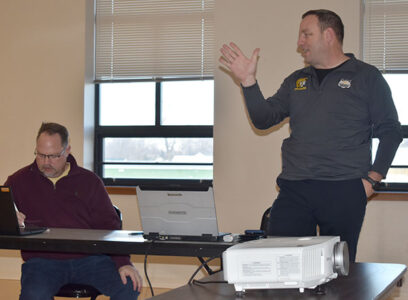
During a Thursday morning meeting with residents and Iowa Department of Transportation (DOT) officials, State Center Police Chief Jon Thomas said that in the previous four years, there have not been as many crashes as what have occurred in the last 18 months.
"In every crash I've covered out here, speed and impairment haven't been issues in any of them," he said. "We have a driver problem, primarily."
He showed a collection of vehicle crash videos taken at the intersection of Highway 30 and Durham Avenue, including one in which Thomas was responding to a crash on the westbound side of Highway 30. The Iowa State Patrol pulled over in the eastbound side to help, and a vehicle rear-ended the law enforcement vehicle.
"In almost all of our crashes, we're finding (that) it's eastbound traffic turning north into State Center," he said.
Resident Tracy Blink feels impatience is a big issue, along with drivers engaged with their smartphones. Thomas said distracted driving is huge -- even if the driver is not on the phone, their heads are not in the right place.
"I feel we have a lot of young drivers who go through drivers ed, follow the rules of drivers ed and when they're out on their own, rules do not apply to them," Blink said. "They're going to do whatever they can do, what they see their parents do, they're going to act the way their parents have acted."
Trucker Doug Lively agreed with Blink, saying everyone is in a hurry. He does not know if there is anything that can be done to slow drivers down.
Based on his observations of Marshalltown drivers, Marshall County Engineer Paul Geilenfeldt said it is amazing how many people do not know how to navigate a four-way stop. He also spoke about how common it is for people to go 50 miles per hour on Center Street.
"It's a raceway through there," Geilenfeldt said.
DOT
DOT Traffic Safety Engineer Willy Sorenson said he did notice the narrowness of the intersection median.
"It's narrower than our current standard," he said. "I think that plays into it. . . . When vehicles are coming eastbound and turning left into State Center, they're cutting it short. Holy cow, if that isn't evidence right there. In a way that shows . . . they're doing it freely. It's a natural, smooth motion, and works 99 out of 100. That one time when there is a vehicle coming at them is when we get a crash."
Lowering the speed in the area would not solve the problem and would only serve as a "feel good" solution, Sorenson said. People will continue to drive the speed they are comfortable with, or only slightly reduce it.
As a commercial driver, Lively said the first problem is a "Do Not Enter" sign blocking the view when a driver is heading south and looks east.
"It blocks the entire lane," he said. "I have to stop way back to be able to see, or almost get the front end of my truck out into the road where it doesn't belong."
Thomas asked the DOT if they could look at the "Do Not Enter" sign. Sorenson said they would, and it could either be relocated or removed.
Blink said there were not as many crashes when there was a double yellow line in the median. After the road was reconstructed, the line was removed, and turning lanes were added. Median pavement markings are hard to maintain, Sorenson told her.
"You drive over them all the time, (and) they get faded," he said. "What tends to happen is they don't get put in because they know it's only going to last a few months. If we do something, we would need more permanent paint. We'd love to do that at every single intersection we have in this state, don't get me wrong, but we can't."
Thomas suggested improving visibility. He asked about flashing lights that go off when a westbound car crosses an established threshold. A question was asked if the light would be flashing constantly due to a high volume of traffic.
"I think if you look at when our crashes are, you're not seeing the packs of eight or 10 [cars,]" he said. "It's one or two."
Sorenson said Thomas was inquiring about an ICWS (Intersection Conflict Warning System). He said one is placed north of Des Moines and is intended for two people. It only flashes when cars are incoming and when someone is in a turn lane.
"If you see them flashing, you will see a vehicle," Sorenson said. "The argument about [them always flashing], I hear that all the time, and I don't think that's a reason not to do it."
The DOT has installed seven ICWS systems throughout the state, and they would benefit traffic on Highway 30. Sorenson said there are also corresponding signs on the primary road, which only blink when a car is coming or is in the median.
"It's a heads up," he said. "There is an advantage to telling the mainline driver, who has no other reason in the world to worry, because their job is just to drive through. I'll tell you what. When they see a flashing light, they're more aware, they're scanning the horizon and looking around. Their foot comes off the accelerator."
Crashes occur when someone pulls out of the sideroad, Sorenson said. The mainline driver is the one who decides if the sideroad driver is going to live or die.
"The person who pulls out has lost their decision whether they're going to live or die," he said. "It's unfortunate, but their life is in the hands of the person in the approaching vehicle, hoping that they do something. In general, these signs help. Usually the crashes still happen. You're not seeing a huge crash reduction, but the severity of those crashes -- they're not usually as fatal or major."
Sorenson said another option is speed feedback signs. If a town has a population between 1,000 to 10,000, the DOT could place a sign in the most beneficial spot. He said it is not Automated Traffic Enforcement (ATE) but is intended to raise awareness.
No decisions were made during the meeting. It was just an exchange of ideas, Sorenson said.
------
Contact Lana Bradstream
at 641-753-6611 ext. 210 or
lbradstream@timesrepublican.com.