
Council talks railroad quiet zones, potential closure of 2nd Street crossing
Trending
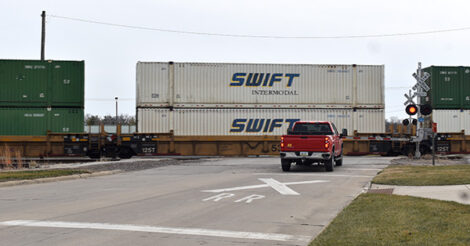
During Monday night's meeting, a long-gestating project came back up for a lengthy discussion as Marshalltown Public Works Director Heather Thomas asked the city council for guidance on railroad quiet zones as well as proposed improvements -- and one potential closure -- of the four crossings within city limits at 12th Street, 6th Street, 2nd Street and 12th Avenue.
As the conversation kicked off, Mayor and Acting City Administrator Joel Greer reframed the issue as "safety zones" because it encompasses more than simply restricting when and where conductors can sound their horns. According to Thomas, the city has been working on some form of the project since 2010, but discussions have "came and paused" several times in the years between then and now, hitting a major delay after the 2018 tornado.
In 2019, the council at the time gave staff direction to proceed "full forward," but there has not been a presentation or update to the council since January of 2022.
"There has been some progress, but there's been some stalled progress as well over the last two years as we've worked to continue this effort," Thomas said. "I do believe that we are in a position where if we continue, this is a potential. It still can come to fruition. We just want to make sure we are able to give you that update of where the project's at and concurrence on the direction that we're headed."
In explaining the quiet zone concept, Thomas said the train operators would not be able to blow their horns when they come up to an at-grade crossing unless something is blocking the tracks. She then broke down each of the aforementioned at-grade crossings, starting with 12th Street, which she said didn't necessitate any additional council guidance.
Union Pacific (UP) required some extended raised medians and the removal of a driveway at the northwest corner of the 12th Street crossing, so Thomas said the city is "sitting pretty good" with the plan provided. The 6th Street crossing, she said, has been "a little more challenging" as a semi-truck loading dock is in the area, and the railroad has requested that the driveway be modified in a way that would not allow for a semi to be backed in easily.
Thomas noted that there had been conversations with the property owner before he passed away, and the parcel then fell into a trust with some initial communication that has since dropped off in the last year. Recently, however, she did hear from one of the owners who said he plans to work with the city if the project moves forward.
"Realistically, what's gonna happen is that there's gonna probably be a payment from the city to this property owner to allow them to get rid of this loading dock, and then that would give them the opportunity to relocate this loading dock to another location on the building, more likely the north side," she said. "If we're able to come to terms with that, that's likely a $50,000 to $75,000 project to get that loading dock resolution."
She then asked for council direction and said she felt "a little bit better" than she had before on the prospect of negotiations with the landowner. In response to a question from Councilor Greg Nichols, Thomas went into further detail about how increased safety measures at crossings ultimately lend themselves to the quiet zone designation. The plans for 6th Street include extending the sidewalk across the tracks. Councilor Mark Mitchell wondered if the building in question was currently being used, and Thomas said it is being rented out by Hughes Properties to a tenant.
Councilor Gary Thompson expressed concern that with the dock not being used presently, the city would be paying the owners to put another dock on the north side of the building and said he had a problem with negotiating any further. Thompson lamented the cost of the entire project as "astronomical" and felt the biggest safety concern was kids crossing the 2nd Street tracks to get to the aquatic center, suggesting closing that crossing completely.
On the other end of the issue, Councilor Jeff Schneider called it a long term quality of life improvement and didn't feel the city should turn back on its progress, and fellow Councilor Barry Kell provided the examples of the cities of Clinton, Cedar Rapids and Hiawatha to the east implementing quiet zones as evidence that Marshalltown should push ahead with the project.
"I don't discount that this is a lot of work and a long timeline, but I think if we're honest with ourselves, the timeline we're experiencing is the reality of this type of project as demonstrated by recent communities that have just done this," Kell said.
Thomas echoed Kell's comments and cited the high level of turnover at UP as another driver of the delays. Councilor Al Hoop asked Finance Director Diana Steiner if the money bonded for the project was in the bank, and she said it had been bonded for in 2020. Steiner added that the money could be reallocated for other uses if necessary, and after Nichols asked when it would need to be spent by, she said it was usually three years but could be extended to five if progress would be made, though the city had been "stalling out" for a while.
Kell sought clarification on how to define progress, and Thomas said she felt there had been progress and would not consider the project stalled out. She then moved on and discussed the 2nd Street crossing, noting that a previous iteration of the council did not wish to proceed with closing it.
Since then, Thomas said, the UP has added another track and now has four total, which will result in a train being parked across the crossing more frequently than in the past. Several years ago, the company offered the city $100,000 to close the crossing, and Thomas said the number would be "much more than that" today. She also mentioned the possibility of a pedestrian bridge being constructed, and Schneider suggested having the company do the work at the other crossings at no charge to the city, it could be a mutually beneficial deal.
Thompson also sought clarification on the ownership of a nearby Manatt's driveway, and Thomas said it has since been closed off after conversations with representatives of that company.
The fourth and final crossing discussed was 12th Avenue, and Thomas indicated there was private property with a driveway coming in in the area where the railroad does not want a driveway. The initial plan was to close off the driveway in question and relocate one up directly across from East Madison Street, but the UP wants to keep its own driveway there.
There was also concern about giving way city access to its sanitary sewer easement, so Thomas said the UP was willing to work with them on a one-year Alternative Safety Measure (ASM) process.
Thompson wondered if the railroad placing a crossing gate at the driveway would be a "deal breaker," and Greg Broussard of Bolton and Menk responded that they wouldn't do any side crossing. If they did, the city would have to pay for it. Hoop then asked if the crossing wasn't already "basically done" and didn't know why it was in the conversation, and Broussard said there were still pieces to be adjusted.
"Of all the ones I've done, this is the easiest one to do because it's on the entry side. It's not on an exit side. They can't turn around there, so it's an easy thing to do but it is a time consuming process," Broussard said.
Mitchell asked Thomas if the UP uses their whistles to signal coupling and uncoupling of trains and felt there would still be noise regardless. Thompson pointed to an original study that said the quiet zones would only create 47 minutes of quiet per day and also wanted more data on whether there was a major safety issue at the other three crossings besides 2nd Street, which he felt should be closed.
"I am not aware of an accident tally saying there's a safety concern, but as you go through general engineering practices, we have a safety concern," Thomas said.
Currently, the total estimated project is $1.4 million. With the floor opened up to public comments, Mark Eaton recounted the history of the 2nd Street crossing being considered a utility corridor and former councilman Leon Lamer worrying about closing it as a result. He wished to know whether there would be a trail or a sidewalk running through the 6th Street crossing, instead urging the council to wait and figure it out later while spending the money on roads. Thomas and Broussard responded that a trail would likely be too expensive, so they were currently focused on a sidewalk. Broussard also said the 2nd Street crossing could still be closed with the easements maintained.
Neil Dalal expressed his support for closing the 2nd Street crossing and the quiet zone project more broadly, describing it as a quality of life issue for residents and those who are shopping downtown with the whistles reaching 110 decibels.
"How long do you (take to) get used to it? 20, 30, 40 years? I'm still not used to it," he said.
Jolene Ballard said she had "big questions" about the dock near the 6th Street crossing and felt the owners wanted the city to close it. Local REALTOR ® Kelli Thurston said she was very much in favor of the quiet zones for personal and professional reasons as she and her young children hear the trains at home and when they visit Mega-10 Park. In her work, she added, the noise is often a major concern for prospective homebuyers.
"There is nothing that dampens the experience when we are either entering or exiting the home like a loud train whistle, particularly if it is someone that is moving here not from our community," she said. "They come from larger communities that already have quiet zones, and it is very much a quality of life issue. So if we are talking about attracting and retaining talent, bridge the gap of the $1.4 million to new people living here, people working here, raising families here, owning homes here and paying taxes here."
Linda Clark said she supported the UP and appreciated all of the freight that travels through Marshalltown, arguing that people who don't like the trains must not like their contents either. She did feel that having a walking path across the 2nd Street crossing to the YMCA/YWCA would be beneficial, however. Thurston stepped back to the podium and, noting her home's proximity to the police/fire station, said the agencies have been more cognizant of blaring their sirens late at night and in turn improved quality of life.
Councilor Mike Ladehoff weighed in and said he didn't think the 2nd Street crossing should be closed until the Center Street Viaduct repairs are completed. After nearly 40 minutes of conversation, Thompson made a motion in favor of continuing negotiations to close the 2nd Street crossing, and it passed by a unanimous vote.
Thomas then indicated that she felt she had sufficient direction to move forward, and she also asked for guidance on the ASM process for the 12th Avenue crossing. Thompson had concerns about the dollar figure "skyrocketing" in the next year to year and a half. No motion was ultimately made, but Greer felt there was a general consensus to continue discussions.
Steiner plans to bring a resolution forward for the next meeting switching the bond funds from "general corporate purpose" to "essential corporate purpose" for the street improvement program and utilize bond funding for the quiet zone project to allow the city to get through them sooner. Kell, who was communicating remotely, said he felt Steiner and Thomas still had some homework to do and didn't feel an immediate decision on changing the designation of the bonds was necessary.
------
Contact Robert Maharry at 641-753-6611 ext. 255 or
rmaharry@timesrepublican.com.