More drama over ground solar installations at latest P&Z meeting
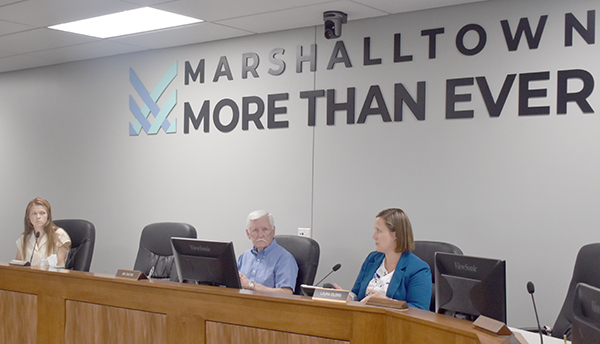
T-R PHOTO BY ROBERT MAHARRY From left to right, Planning and Zoning Commission Member Mahala Casady, Commission Chairman Jon Boston and fellow member Laura Eilers look on during Thursday night’s meeting.
The ongoing controversy over ground solar installations within the city of Marshalltown continued during a Planning and Zoning Commission hearing held Thursday night as a McFarland Clinic project sits in limbo due to confusion surrounding whether or not such arrays will be allowable on properties zoned public institutions.
Prior to that discussion, the Commission, which had a quorum of four for most of its sixth meeting of the year but lost it when Steve Valbracht’s telecommunication signal dropped off, had spent most of the evening considering rules regarding private drives and access roads, a proposed waiting period between submitting preliminary and final plats and setting public hearings on the final plat for the Freedom Hills 1st Addition, a rezoning request for several Creekside Estates properties and Chapter 157 subdivision regulations for June 26.
It was the second to last agenda item of the night, however, that sparked the most lively conversation as the commission engaged in further review of the rules regarding ground mounted solar arrays. Currently, a moratorium is in place on all new installations within Marshalltown after a unanimous vote by the city council, but City Planner Hector Hernandez reported that while McFarland missed the deadline to finalize its permit application before the moratorium, the clinic’s leaders are still interested in proceeding with the array. The city council has already passed two readings of an ordinance amendment that will ban ground arrays on all residential properties.
According to a memo attached to the meeting packet, city staff had recommended allowing ground arrays in land zoned as a Public Institution (PI), which would include the following properties: UnityPoint, Iowa Valley Community College, McFarland Clinic, Hoglan Elementary, Fisher Elementary, Marshalltown High School, St. Henry’s Church & School, Lenihan Intermediate, First Baptist, Marshalltown Christian School, Grandview Heights, Fellowship Baptist, Faith Assembly of God, Anson Elementary, Anson Park, Marshalltown Arts & Civic Center, Miller Middle School, Marshalltown Public Library, Woodbury Elementary, Rogers Elementary, Franklin Elementary, Iowa Veterans Home and the Water Pollution Control Plant.
Although he had been asked to schedule a public hearing on the change, P&Z Chairman Jon Boston did not feel comfortable doing so until the situation with “problem properties” at 511 W. State St. and 112 N. 3rd St. was resolved. He hoped the question on PI zoned land could be addressed during a later conversation on the rest of Chapter 156, which he anticipated would begin in July or August.
“I don’t want to cover it now because this is gonna get complicated for doing this. The same reason we didn’t include commercial (zoned properties) was that there’s so much residential around it, and this has got residential all over it. So we’re gonna get a whole bunch of neighbors upset if we try to go through this and aren’t very, very careful with it,” Boston said.
Valbracht said he agreed with Boston’s assessment before his signal was lost, and Commission member Laura Eilers felt that she would like to see more details and developments before official action is taken and recommendations are made. Boston indicated that he would push for “super restrictions” along with requiring special use permits on PI land, where ground solar is not allowed at all under current city code.
Marshalltown Area Chamber of Commerce President/CEO John Hall then stepped to the speaking podium and shared that he had advocated for the allowance of the arrays on PI land and shared ample information with Hernandez in hopes of speeding up the process. He felt McFarland had been unfairly swept up in the moratorium and should still be permitted to move forward.
The 75 foot setback rule from the nearest buildable lot Hall suggested was a “medium compromise” based on guidelines he had found in other communities, and in his view, it would eliminate potentially controversial arrays from being built in spots that are close to high density residential areas, especially around schools.
“This proposal was not put together haphazardly. This proposal was put together intentionally to try and move a development forward of somebody who, again, has been trying to navigate through these steps (and) have been swept up in a moratorium on this,” Hall said. “And I think it would be a disservice to development in our community to delay anything any further.”
Eilers told Hall she would work better when she could see the proposed code change language in front of her, and he commented that he had sent his suggestion to Hernandez a few weeks prior with the intention of getting it on the agenda and moving it forward quickly.
“(We) tried to be really thoughtful about how this was not going to negatively impact the same challenges the same challenges that brought this issue forward for you all in the first place but was going to provide an avenue for this continued development — again, one that had asked for the permit before the moratorium came in. They weren’t even aware that the moratorium was gonna be put in place, and when they showed back up, they were unable to move forward with their project,” Hall said. “And so we’re really trying to be thoughtful about how we continue to serve our development community and find avenues to move things forward.”
Boston responded that while it hadn’t been built yet, residential projects were proposed to the south of the new clinic at 421 E. Merle Hibbs Blvd., and Hall said that was the reason for the 75 foot setback rule. He then asked if there was any way the request could be considered at the special meeting set in two weeks, to which Boston responded “No way.”
“That feels counter to the city’s first mission, which is to strengthen development efforts in the community. I mean, the very first strategy in the city’s strategic plan is to expand and improve development in the community, and it feels like what you just said, Jon, is –” Hall said before he was interrupted.
“But this is rushing it,” Boston interjected. “I don’t want to rush this. I want to explore it in detail with Hector and when we do the rest of the changes… I don’t want to keep hitting the city council with one little piece and another little piece and another little change. I think they would be upset with us, but maybe not, I don’t know. I’m just not ready to discuss this yet, (but) maybe that’s just me. The rest of the commission can override me. I don’t have any problem with that.”
It was then noted that they couldn’t make any decision regardless because the quorum had been lost with Valbracht’s departure. Boston suggested making it a continued discussion item on June 26, but he doubted any recommendations would be ready after that meeting.
“Right now, I’ll go on the record and say personally, I won’t vote yes for this until the city fixes the two problems on 511 State Street and 112 N. 3rd St.,” Boston said.
“So, you’re impeding development based on?” Hall asked. “I just want to be clear. Thank you.”
Eilers then commented that she didn’t feel it was fair to hold one parcel up over a separate situation but told Boston it was ultimately his decision. The meeting was then adjourned.
——
Contact Robert Maharry at 641-753-6611 ext. 255 or rmaharry@timesrepublican.com
Todays News

Remembering Mary Beth Hurt’s time in Marshalltown
Progress 2026: Prop 12, tariffs and more challenge Iowa pork producers

Marshalltown veteran Steven Hyde details journey from enlistment to Vietnam in ‘Blood Sweat and Mothballs’

Progress 2026: Lifelong friends Lincoln Stover and Paul Murty launch MURST LLC with focus on drone spraying
Reserve Development confirms three tenants for Shops at Marshalltown