Marshall County households struggling to make ends meet
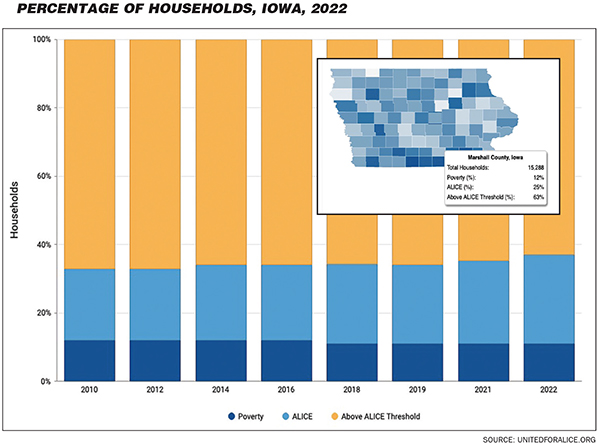
The need for help amongst residents in Marshall County has changed little in a year. The ALICE (Asset Limited, Income Constrained, Employed) Project has released the 2022 statistics and reveals that need has remained fairly steady, although the numbers have lessened.
Marshalltown Area United Way Executive Director Kendra Sorensen said the statistics are similar to the 2021 numbers revealing that 37 percent of the households in the county are below the ALICE threshold.
The 2022 ALICE numbers show 3,786 Marshall County households are considered to be in the ALICE category, and 1,800 are in poverty. In 2021, there were 3,854 ALICE households and 1,900 in poverty.
According to Sorensen, ALICE individuals typically end up having to make difficult sacrifices and must decide which items they will do without.
“ALICE are the working poor, households that are employed but whose income is still not sufficient to meet their basic needs of housing, child care, food, transportation, health care and technology,” she said. “ALICE households earn above the federal poverty level, but cannot afford the basic cost of living. Despite struggling to make ends meet, ALICE households often do not qualify for public assistance.”
The latest numbers display how inflation has impacted Marshall County households. Based on the number of calls people made to the United Way seeking help and city Homelessness Task Force meeting conversations, the majority of ALICE individuals are struggling with housing deposits, monthly rent and utilities.
“Ranking at the largest percentage of increase from 2007 to 2023 is housing at 76 percent, health care at 75 percent, transportation at 66 percent, child care at 57 percent, technology at 55 percent [from 2016 to 2023] and food at 37 percent,” Sorensen said.
Of the Marshall County ALICE households, she said 71 percent are headed by single females. The cost of child care remains one of the highest budget costs for family households, but the industry is still feeling the impact of the COVID-19 pandemic.
“Provider shortages and lack of affordable care present fewer options for parents,” Sorensen said. “According to the October 2023 Household Pulse Survey, when families in Iowa were asked what they did when child care was closed, unavailable, or unaffordable, [33 percent of] respondents below the ALICE threshold cut work hours [and 28 percent] take unpaid leave.”
According to the Center for American Progress Child Care Desert map, there are a large number of areas in Marshalltown with scarce child care available. A significant percentage of those areas are in the poverty-stricken portions of town, according to the map.
The other demographic affected the most are residents 65 years of age and older. Sorensen said that is because they are living on a fixed income, and the adjustment made each year, Cost of Living Adjustment (COLA), by Social Security and Supplemental Security Income, is not adequate.
“The costs of many of the essential goods and services purchased by typical households that receive these benefits increase faster than COLA,” she said. “Almost 50 percent of the individuals that are 65 years plus are below the ALICE threshold in Marshall County.”
Sorensen said the ALICE data gives United Way the ability to compare Marshall County statistics across Iowa. Now that the 2024 campaign has kicked off, the United Way will also utilize the ALICE data to ensure program funding aligns with community needs. The campaign has a goal to raise $900,000, which will be spread amongst 26 nonprofit agencies. She said people who are not in ALICE households, can help those who are by donating.
“We encourage everyone to donate to the Marshalltown Area United Way annual campaign,” Sorensen said. “Last year, over 13,000 people were positively impacted by the programs and services that our local partner agencies provide.”
Contact Lana Bradstream at 641-753-6611 ext. 210 or lbradstream@timesrepublican.com.
Todays News

Board gamer group rolls dice, launches in Marshalltown
Fundraiser for annual Red, White and Blue celebration features authentic Mexican cuisine
An event on Tuesday will be something to “taco” about. The Tacos & Tequila supper will feature a flight ...
Rural road names pt. 3: From a musician to Civil War soldiers

Gilman mayor, former city councilman both arrested over ongoing dispute

Debate over downtown sidewalk repair, alleyway plan continues