
Iowa Democratic lawmakers promise to focus on pocketbook issues during town hall at Marshalltown Public Library
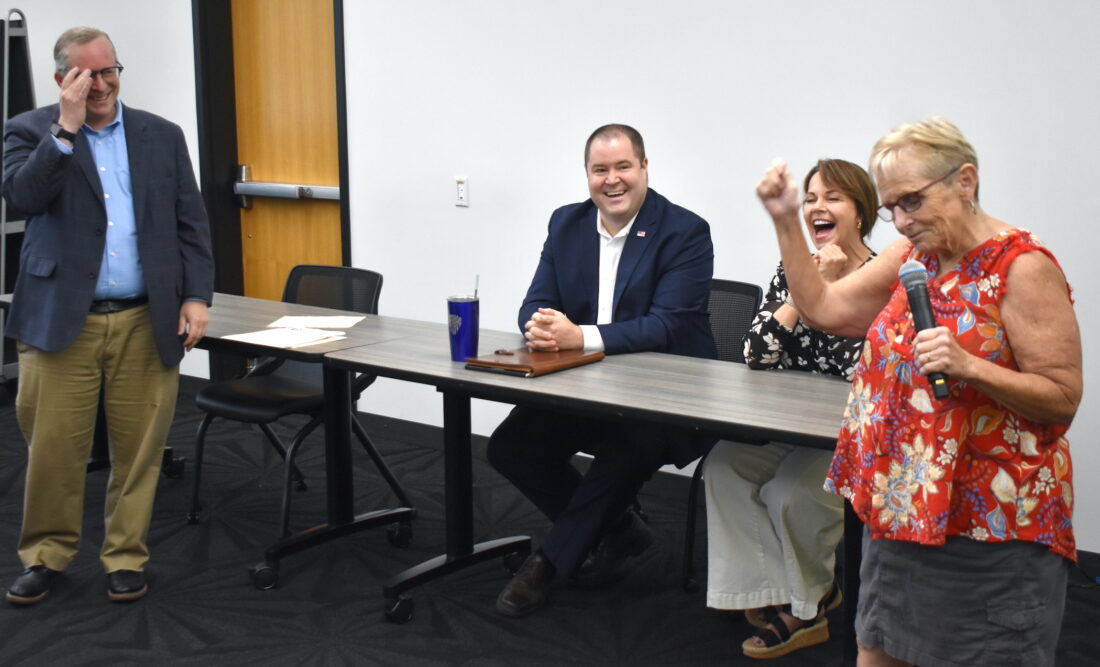
T-R PHOTOS BY ROBERT MAHARRY Former Iowa Rep. Sue Cahill, right, introduces Iowa House Minority Leader Rep. Brian Meyer (D-Des Moines), Minority Whip Rep. Sean Bagniewski (D-Des Moines) and Assistant Minority Leader Rep. Elizabeth Wilson (D-Marion) during a town hall meeting at the Marshalltown Public Library on Saturday afternoon.
With Republicans currently holding the “trifecta” of the Iowa House, Iowa Senate and the governor’s office heading into the 2026 election cycle, a trio of leaders from the opposition party — Iowa House Democratic Leader Rep. Brian Meyer of Des Moines, Democratic Whip Rep. Sean Bagniewski of Des Moines, and Assistant Democratic Leader Rep. Elizabeth Wilson of Marion — discussed their plans to change that and fielded questions from a crowd of over 50 people gathered for a town hall meeting at the Marshalltown Public Library on Saturday afternoon.
Former Iowa Rep. Sue Cahill (D-Marshalltown), who was narrowly defeated by Republican David Blom in the 2024 election, first introduced Meyer, and he praised her commitment to the community before criticizing Blom for voting “in lockstep” with his party’s leadership.
“To be frank with you, it’s damn disappointing, and we are here to have a conversation with you on many fronts. And one of those is that I want to talk a little bit about what’s going on at the Capitol, a little bit about what we see ’26 to look like and how we move forward and rebuild this party, the Democratic party, from the ground up. And that includes all of you, so thank you for coming,” Meyer said.
He took Republicans to task over education funding, arguing that they have given public schools “crumbs” while pushing Education Savings Accounts (ESAs), commonly referred to as vouchers, for families to send their children to private schools.
“There is going to be a reckoning in the next few years. There is no cap on these vouchers anymore — no caps, no caps — and the sad reality is they’ll spend and spend and spend, and they will deny public education,” Meyer said. “But they’ll allow millionaires in Des Moines, where I’m from, without any recourse whatsoever, they don’t ask questions. You send your kid to a private school, you get the money.”
Meyer added that they want to increase the annual amount for ESAs from its current figure of $7,500 per student to an even higher figure of $10,000. He also warned about a looming “budget cliff” as the GOP-controlled legislature dips into reserve funds and spent $900 million more than they took in last year.
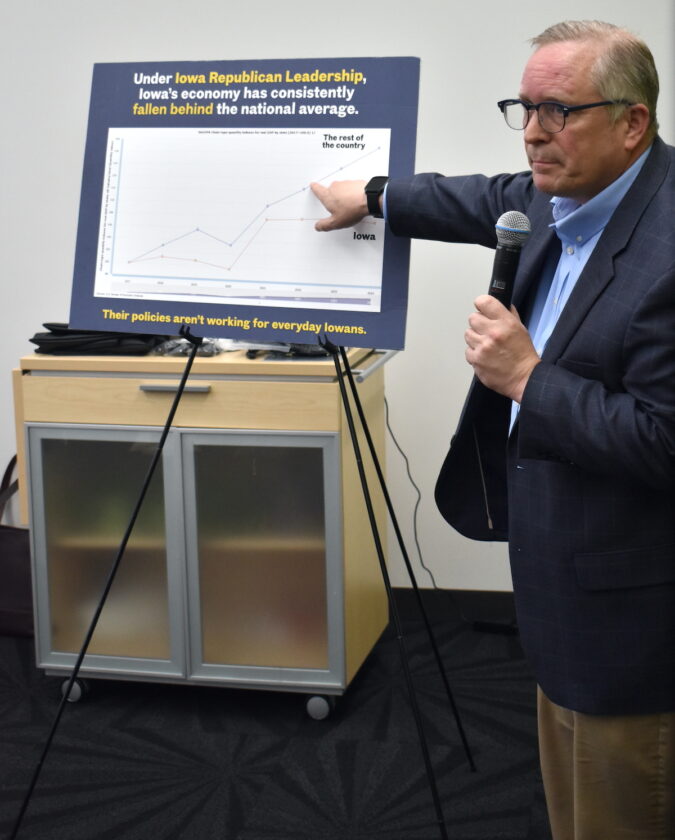
Meyer, who became the House minority leader earlier this year, points to a graphic showing Iowa’s economic outlook during the town hall meeting on Saturday afternoon.
To keep young people in the state, Meyer said, high-paying jobs must be created, and unions must be protected, calling the present situation “a crisis of low-paying jobs.” Finally, he blasted Republicans for failing to take action on property tax reform despite repeated promises to do so over the last decade and blamed tax increases on a lack of funding for services like education and public safety.
Meyer promised to “take back the state” and take back the House District 52 seat representing Marshalltown in the 2026 election before handing the microphone to Bagniewski, who joked that the event at the library had a much larger audience than one Blom had been involved in the day before. Bagniewski discussed efforts to traverse the state, have “hard conversations” in person and recruit Democratic candidates to run for office all over Iowa, and Meyer briefly retook the mic to point to a graphic highlighting stagnant economic growth and corporate tax cuts in the state.
Wilson called for more action on utilizing the opioid settlement funds to address addiction and mental health, addressed the Iowa DOGE task force’s controversial proposal to reduce Iowa Public Employee Retirement System (IPERS) benefits for new state hires and expressed concern about cuts to Medicaid.
“We are in a state of crisis, and I think a lot of people have felt like they didn’t know how to help. They don’t know what to do. This is what you do. You just start to get involved,” she said.
In conversations with younger Iowans, many have told Wilson they don’t vote because politicians don’t care about them, but she encouraged them to find issues they care about and exercise their right as their vote carries as much weight as the one cast by Bill Gates or Elon Musk.
The legislators then spent the next 50 or so minutes taking questions from the audience on a wide range of topics, and it didn’t take long for IPERS to come up when a man who works at the Iowa Veterans Home in foodservice suggested that cuts should be a “non-starter” in Des Moines. Meyer responded that Blom, his GOP colleagues and Gov. Kim Reynolds “100 percent” support eliminating IPERS because privately, they tell him they “hate” the program.
Bagniewski doubted that a proposal would come forward during the 2026 session but feared Republicans could start to chip away at IPERS now that the conversation has started.
The next commenter felt it was time to address Iowa’s water quality problems, and the next one raised the issue of the state’s cancer rate, which is the second highest in the nation, citing both loved ones and neighbors who have recently been afflicted by the disease. Wilson took Reynolds to task for only proposing $1 million toward cancer research during her “State of the State” address and called for adequate funding to track cases.
She also called for an increase in nursing home inspection funding, and Meyer predicted unequivocally that rural Iowa would lose hospitals in the years to come as a result of Medicaid cuts.
“But we’ll have a ballroom in the White House,” an attendee quipped from the crowd.
Another audience member suggested automatic voter registration and mail-in voting to increase participation in elections, and Meyer blamed the GOP for reducing the time window for requesting absentee ballots, making it harder to register and automatically unregistering voters who don’t participate in an election.
“That’s perfect for them. They love that. They want to see people not vote because when we don’t vote, they win,” he said.
Bagniewski recalled Republican Secretary of State Paul Pate sending an absentee ballot form to every eligible Iowan during the COVID-19 pandemic and the legislature subsequently passing a bill requiring voters to request the ballots themselves. He said 22,000 Iowa Democrats were inactivated as a result of the changes.
Another commenter raised concerns about homelessness increasing once the Medicaid cuts are enacted, and Meyer said Republicans hate Medicaid and “want it gone.”
“They hate government. They want to squeeze government,” he said.
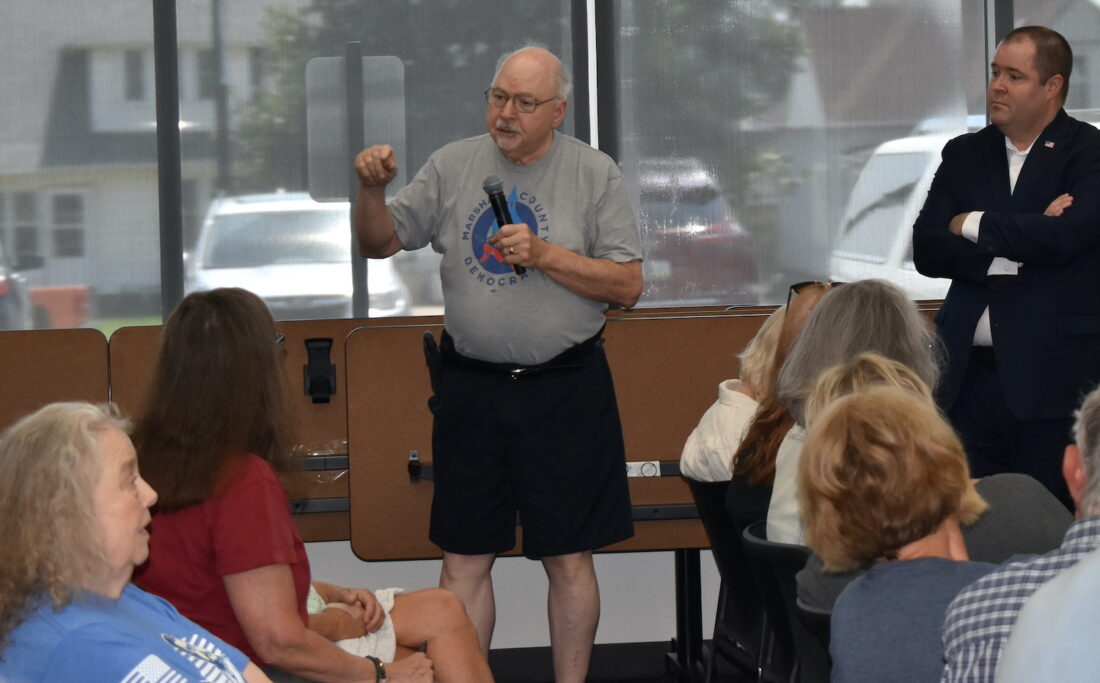
Retired Methodist Pastor Wally Paige addresses the crowd during a town hall meeting at the Marshalltown Public Library on Saturday afternoon while Rep. Sean Bagniewski (R-Des Moines) looks on.
Retired Pastor Wally Paige returned to the topic of nursing home inspections and cited Clark Kauffman’s work in Iowa Capital Dispatch covering the situation, and Bagniewski said Iowa is 49th in the nation per capita for nursing home inspectors.
Dr. Kelli Buresh of UnityPoint Health-Marshalltown said she was concerned about cuts to Medicare and its impact on rural healthcare. She also wondered how the legislators would get voters motivated to vote for Democrats.
“It is no secret that the Democratic Party has problems… and I’m here to tell you that we are the common sense party — 100 percent the common sense party,” Meyer said. “And I think that what gets lost sometimes in all the TV ads that go on in November because they have way more money than we do is just what they are doing at the Capitol and how do we emphasize and talk to folks about it? And that is a good point, and we’re gonna get people excited because we’re gonna have all new proposals coming up in the next year. By the summer election cycle, you’re gonna not even recognize what the Democratic party is here in Iowa.”
The last line drew a round of applause from the audience.
“We are gonna go back to common sense solutions. We’re gonna go back to pocketbook issues,” he said. “Here’s the bottom line. Most people don’t get up in the morning and they don’t think about things that are going on at the national level, they don’t think about what’s going on at the Capitol. You know what they do? Is my kid getting a good education? Can I afford to feed my kids? Can I afford to make my mortgage payment? How am I gonna get them to college, and if they go to college or trade school, will they have a decent job coming out of that? Can I keep my kids in the state of Iowa? That’s what people think about. They don’t think about this other mumbo jumbo.”
Bagniewski, who said he has been involved in Iowa Democratic politics for over 20 years, said he and others are working hard behind the scenes to rebuild the party and recruit candidates — the Sue Cahills of the world, as Meyer put it — which prompted her to respond to a question that she won’t be running for her old seat in 2026. Bagniewski added that he doesn’t want door-knocking candidates to arrive with a script but to engage in conversations with candidates on what issues are most important to them, and Meyer said they need to meet people where they are.
Terry Gray agreed with the pocketbook approach and, while hesitating to use the word, felt “wokeness” had hurt the Democrats in recent years. In response, Meyer said the Democrats would focus on increasing funding for public education, making college and trade schools more affordable and raising the minimum wage. That prompted another attendee to ask what they would say when Republicans come after them about drag queens.
“I’d say I’m not talking about it. I’m talking about what you want to hear about. I’m talking about what impacts you today. I want to know that you are being given a living wage, that you have health insurance, that you’ve got good public schools, that you have a hospital that you can go to,” Wilson said. “I don’t care. I mean, how I feel about any of those issues is immaterial to what we need to do for this country.”
Meyer compared debates over such social issues to “The Wizard of Oz” — “pay no attention to the man behind the curtain” — and called them a “nonsense” distraction from the economy, the state budget, property taxes and low wages.
The next questioner referenced President Trump’s commutations of individuals involved in Medicare fraud schemes, the school voucher bill and whether farmers, who lean heavily Republican, could be convinced to vote for Democrats again. Wilson responded that members of her party “need something new” and must move beyond paying consultants for messaging that doesn’t yield tangible results.
Another attendee called for taking money out of politics, and Meyer reiterated the importance of Democrats making their case to Iowa voters.
“Don’t blame the Democrats for this. We need to explain (that) this is what happened. This is why your income’s going down. We have not been in charge of the government for 10 years. Iowa is not getting better. The standard of living is not raising. The economy’s in the dumpster. It’s terrible. We’re in a bad condition here, and it’s only getting worse,” he said.
Wilson called for putting income limits on the voucher program, reversing Medicaid cuts and working to address drug costs, but she conceded that it wouldn’t be possible until the Democrats gained a majority. Meyer did note that if the Democrats could win a Senate seat in Sioux City, they could at least break the GOP supermajority.
The next concern raised during the final 20 minutes included a law allowing 18-year-olds to carry guns, which led Wilson to admit that there were some issues where she felt she had to decide how to prioritize her efforts. Harold Lanning thanked the three legislators for taking time out of their weekend to host the meeting and expressed frustration about a tour of Rinker Manufacturing Sen. Joni Ernst took in Marshalltown earlier in the week with a “select group” that was not open to the public.
“Why in the hell didn’t she announce that she was gonna be in town so John Q. Citizen like myself can come out and talk to her and ask her some blunt questions?” he asked.
“Because they’re afraid of you,” Meyer replied. “Because they know you have questions and they’re good questions, Like you said, we publicized this. We’re not running away. We’re coming at you.”
Bagniewski extended the invitation to Republicans and independents who wish to attend any of the town halls, citing the importance of open dialogue. A National Guard veteran shared disgust with his former branch of the military being deployed to assist Immigration and Customs Enforcement (ICE), and Meyer, a Guard veteran himself, said it “wasn’t their role” to get involved in that.
Another comment raised the issue of which hospitals were most likely to close due to the aforementioned cuts, and Bagniewski said Newton was currently at the highest risk. A woman in the audience described the no tax on tips and overtime provisions of Trump’s “Big, Beautiful Bill” as “bulls***,” and Meyer said frustrations like hers have been heard all over the state during the meetings they’ve held. Wilson, an accountant by trade, called the no tax on tips provision “a fallacy” as cash tips typically aren’t reported as taxable income anyway.
Former MCSD board member Jan McGinnis compared farm subsidies to funding cuts that could lead to the potential loss of schools, hospitals, pharmacies and nursing homes and its subsequent effect on the state economy.
“When you’re talking about rural Iowa, urban Iowa, we’re all in this together, and what you just talked about when you’re taking away the jobs at the school, you’re taking away the jobs at the nursing home, you’re taking away the jobs at the hospital, that’s the fiber of a community. That’s the thing that connects everything. And I’ll tell you, when a community dies is when they lose their school. That’s when a community dies,” Meyer said. “We are an agricultural state and I’m 100 percent behind farmers in this state, but I’ll tell you this. If we paid as much attention to that as we do to this, these communities are hurting, and you are corroding the fiber of the community when you take away money for schools, money for hospitals, things like that.”
Another commenter sought to distinguish between Democrats, Republicans and “MAGA Ts” — or hardcore Trump supporters — who she didn’t feel could be reasoned with or talked to about political issues. Meyer responded that a majority of GOP members of the caucus in Des Moines — “probably 55 of them” privately think Trump is “a complete and total moron” but are afraid to say so publicly for fear of reprisal.
“Why are they not here? Why don’t they do these things? Because they are scared,” he said. “They’re afraid of Donald Trump and being primaried, and they have no backbone whatsoever, including Rep. Blom.”
Meyer then sharpened his attack on Blom, describing him as an “ineffective” legislator and a “puppet” who does “virtually nothing” in Des Moines and defers to Republican leadership and Trump for guidance on how to vote. Bagniewski did, however, note that Democrats have praised GOP legislators who have taken stands against bills like vouchers and AEA reforms.
Cahill shared some of the work she has been undertaking with Center Associates to address mental health in the community and hoped Meyer, Bagniewski and Wilson could work across the aisle on the issue.
“You hear what she just said? That’s a real representative. Don’t you wish you had Sue Cahill?” Meyer asked.
The final comment of the day came from the same IVH employee who had spoken out against IPERS cuts earlier, and he wondered how Trump could be allowed to serve as president with 34 felony convictions.
“Good people have been fooled by the fools. What are we gonna do?” he asked. “We have to get together and make it make sense… Why are we allowing a felon to be in the White House with sensitive information? What is going on in our country? Make it make sense to me, representatives.”
Wilson concluded by making a call for donations and urged those in attendance to continue the conversations going forward. During a subsequent interview, Blom told the T-R he will advocate for a “long-term, safe and supportive” retirement plan for public employees and expressed his opposition to the DOGE task force’s proposed cuts for new hires.
“My mom is a public school teacher, and I’m pretty sure she would kill me if I did anything to mess with her IPERS. I know it’s the minority’s job to try to stir up fear and panic and try to build a campaign issue out of it, but I’ve already told people privately and publicly that I don’t support moving away from the IPERS system for our public employees,” he said. “And I want to make sure it’s the standard for the next generation.”
He also responded to Meyer’s criticism that he only votes in line with party leadership, countering that new Democrats usually look to Meyer for guidance on voting when they first come into office. Blom said he has broken with the GOP on certain issues such as being more welcoming to immigrants.
“(The criticism is) definitely a surprise to the people who tell ‘Oh, I recommend voting this way,’ and I go and vote the other way, but it’s what the minority leader has to do to drum up panic and support. So I understand,” he said.
While he hasn’t made it official yet, Blom said he will “probably” run for re-election and seek a second term in 2026 if voters in District 52, which covers the city of Marshalltown and the southeast quadrant of Marshall County, will have him.
——
Contact Robert Maharry at 641-753-6611 ext. 255 or rmaharry@timesrepublican.com.
Todays News

School board approves At-Risk plan, funding request
Alliant Energy receives approval for Bobcat Energy Center
Alliant Energy received approval to construct the 720-megawatt Bobcat Energy Center in Marshalltown. The natural ...

2025-2026 United Way campaign hits 90 percent of fundraising goal at year-end event

Trump will go to Delaware for the dignified transfer of the 2 National Guard members killed in Syria
Iowa farmers say the end of federal health care tax credits will hit their budgets
Iowa Farmers Union members said Monday that the federal decision to end enhanced tax credits related to the ...
Vanguard Appraisals president shares update on Marshall County project
The Marshall County reappraisal project has drawn much scrutiny and interest since it was announced and ...