No green light on Reduced Conflict Intersection in State Center — yet
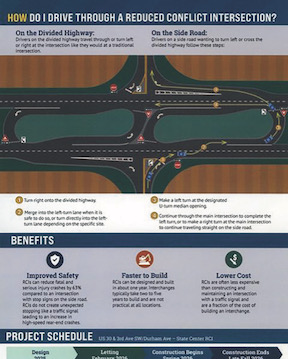
CONTRIBUTED GRAPHIC - A graphic provided by the Iowa Department of Transportation explains the proposed Reduced Conflict Intersection (RCI) at the intersection of Highway 30 and SW 3rd Ave./Durham Ave. in State Center and shows a concept of the reconstruction.
STATE CENTER – Will State Center become the second location in Iowa to implement a Reduced Conflict Intersection (RCI), commonly known as a J-turn? That remains to be seen. According to Iowa Department of Transportation (DOT) District Engineer Allison Smythe, the “green light has NOT been lit yet.”
On Thursday evening, approximately 80 residents gathered to hear from Iowa DOT representatives and engineering students from Iowa State University about the proposed RCI at U.S. Highway 30 and 3rd Avenue SW/Durham Avenue.
Smythe explained that the proposal stems from a collaborative effort between the State Center community and the DOT. Multiple meetings have been held to address a troubling number of crashes at the intersection.
Between Jan. 1, 2014, and March 17, 2025, there have been 28 reported crashes, including one fatality, three with major injuries, and three with minor injuries — with a total of 26 individuals involved. Smythe noted that 18 of the 28 crashes were attributed to failure to yield or failure to obey right-of-way laws.
An average of 7,000 vehicles travel through the intersection daily, with 15% being truck traffic.
What Is a Reduced Conflict Intersection?
To explain the reasoning behind the proposal, the DOT presented a brief video outlining the design and safety advantages of RCIs.
A traditional four-lane divided highway intersection has 42 potential conflict points–places where vehicles may collide. An RCI reduces that number to 24.
With an RCI, drivers on side roads no longer cross all lanes of traffic or make immediate left turns. Instead, they:
Turn right onto the highway,
Merge left when safe,
Use a designated median U-turn, and
Proceed in their intended direction.
The goal is to reduce severe right-angle (“T-bone”) crashes, improve safety, and maintain traffic flow.
Key benefits cited by the DOT included a 70% reduction in fatalities, 42% reduction in injury crashes and RCIs being faster and cheaper to build than overpasses or traffic signals. Construction time is estimated at about one year, and the cost is a fraction of a full interchange.
Community questions and concerns
The majority of the two-hour meeting was spent fielding questions from residents, with topics discussed including:
Intersection Collision System (flashing lights): Residents questioned why this safety feature hasn’t been completed. DOT officials responded that Tte system is still being installed. While it can help, it’s not a long-term solution. It will remain in place alongside the RCI.
Lowering the speed limit to 55 mph: Officials responded that speed limit changes are difficult to enforce without constant law enforcement. Lowering the limit may not significantly reduce crashes.
Why not a four-way stop? Officials responded that traffic volumes do not justify it. Similar installations, like one in Boone, have not been effective.
Shadowing effect (limited visibility from turning lanes): Officials responded that the design will be re-evaluated to reduce visual obstructions and improve safety.
Will drivers use Eastman Avenue to avoid the RCI? Officials responded that if traffic issues arise there, the DOT will respond. However, delays at RCIs are typically minor, so rerouting is unlikely.
Impact on truck traffic (especially during harvest and silage seasons): Officials responded that traffic and safety analyses account for truck volumes. The RCI is designed to accommodate heavy vehicles.
Experience with Iowa’s only current RCI (Highway 20 & Poplar Avenue near Fort Dodge): Officials reported that it was installed in 2022 and privately funded. Some attendees who have used it shared mixed feedback.
Could the intersection simply be widened instead? Officials responded that widening would be significantly more expensive and take years to design and complete.
Winter maintenance of RCIs: Officials said states like Minnesota (100 RCIs) and Wisconsin (30) maintain them successfully, and the Iowa DOT is confident in its winter road crews.
Adding acceleration lanes: Officials told the audience that the current design reflects extensive analysis, but alternative configurations will be reviewed.
What’s next?
Smythe emphasized that the project is still in the planning and feedback stage. No final design or contractor has been selected. A $500,000 Traffic Safety Improvement Program (TSIP) grant has already been awarded toward the project, which is estimated to cost $1.5 million.
Before concluding, Smythe thanked residents for their input and promised to bring concerns back to the design team. A follow-up public open house is planned within 45 to 90 days to share updates and gather more feedback.
“This is truly a conversation,” Smythe told attendees. “We are here to work with the community to find a solution.”
Public input still open
Residents can continue to provide feedback on the proposed RCI through the project’s official page: publicinput.com/d55271
The site currently reads as follows.
“Right now, we are working on our plan…The letting for the project will be in February 2026. Construction will begin shortly after, in March or April 2026, and continue through November 2026.”
More information, maps, and contact details are available at the aforementioned link.
Todays News
Tama County Supervisors no longer interested in old STC Middle School
TOLEDO - In stark contrast to last week’s meeting, only about seven people showed up for last Monday’s Tama ...
Haverhill farmer inducted into Iowa Hereford Breeders Association Hall of Fame
MCSD celebrates Public Schools Week, Feb. 23–27
The Marshalltown Community School District will celebrate Public Schools Week from Feb. 23-27, recognizing the ...
Marshalltown businesswoman among speakers at Iowa MMJ rally inside Capitol building
‘Wookiee’ what we have here: Fantasy meets sci-fi in Marshalltown Community Theater play