
Police, fire chiefs discuss upcoming budgets with council
Trending
As part of an effort to be more prepared for the important decisions to be made during budget season, the Marshalltown city council has opted to begin those discussions regarding various departments earlier in the process than in the past. For approximately the last half hour of Monday night's meeting, they heard from Police Chief Chris Jones, Fire Chief Christopher Cross and Housing and Community Development Director Deb Millizer on public safety items and their financial outlooks both for the current year and going into fiscal year 2027.
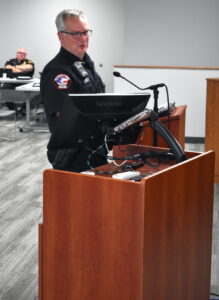
Jones approached the podium first and explained that the majority of his budget is consumed by salaries and benefits for police officers, and he noted that the MPD recently hired two new officers, Cory Critchlow and Steven Wonderlin. There are still three available openings with interviews ongoing and background investigations being conducted on candidates.
"This is as good as we've been at making a dent and becoming fully staffed, so that's very important," Jones said.
The costs of sending non-certified officers to the Iowa Law Enforcement Academy has increased, he added, along with the cost of equipment issued to new officers. The MPD is providing full equipment to new staff, and lately, Jones said they have also been training the executive staff and leadership team to get them up to speed by providing inservices whenever possible.
According to Jones, he has also looked for opportunities to work with other area law enforcement agencies such as the Marshall County Sheriff's Office, the State Center Police Department and the Meskwaki Nation Police Department to collaborate on trainings and cut costs. He then discussed lawn care costs, which are estimated at around $16,500 a year, and mentioned the possibility of exploring other options.
"We do want our building to look professional. We want it to look great. Milestone is doing a great job in what the building looks like, but it's something we could revisit," Jones said.
One of the biggest annual expenses for the department is overtime, which runs about $150,000 a year, and Jones said with two new officers still needing to go through the academy and another two currently deployed with the military, it may be early summer of next year before they see a reduction in overtime hours.
"We have field training officers that are working overtime right now. We're doing everything we can to hold on to those people that are agreeing to work for us, and we're doing everything that we can to hire the best possible people," he said. "So we're hiring them right away, we're getting them on the street, we're getting them acclimated to the city, and our agency will continue to do that until we're fully staffed."
Jones has also been reviewing fees for service and commented that the MPD has provided "complimentary" security for some city activities such as the 4th of July and Oktemberfest that may need to be revisited. He said they will additionally look into charging for officer and administrator time to honor Freedom of Information Act (FOIA) requests as they have increased in recent years, especially in regards to the Automated Traffic Enforcement (ATE) and Flock camera systems.
The chief has been encouraging officers to file city charges on simple misdemeanors like traffic control or other infractions involving city code because it keeps 90 percent of the fines within the city as opposed to filing a state charge. As he opened the floor up for questions, Councilor Mark Mitchell asked about the total number of officers, which Jones said was currently 39 with three vacancies.
Fellow Councilor Gary Thompson joked about having the officers mow the lawn while pushing 50 or 100 pound weights as part of the new employee wellness program. Jones said it takes about 6 1/2 hours for an individual to mow the lawn, while Milestone can get it done in a few hours.
During the public comment period, Tim Bradbury asked whether the MPD would be pursuing grass and gravel infractions as part of their focus on filing city charges, and Jones clarified that they weren't going after anything more aggressively but rather knowing when to file city or state charges. Bradbury explained that a neighbor of his had been cited for four cars in a driveway with some grass in it, and that upset him.
Fire department update
Once Jones wrapped up, Cross came forward next to provide an executive summary of the budget. Currently, there are 24 uniformed firefighters across three divisions, with eight per shift 24 hours a day, seven days a week and a minimum staffing level of six. The MFD provides service to the city of Marshalltown but also has 28E agreements with all of the surrounding communities in Marshall County and others closer to Des Moines. They also offer extrication services for all communities in Marshall County.
The MFD is responsible for fire suppression, fire code enforcement plan review for new construction and EMS response for all 911 calls to private residences, with a total of about 3,500 runs per year between fire and EMS and 30 to 40 legitimate structure fires.
For the current fiscal year that began July 1, the department's allocation is $4.1 million, and Cross said they had spent about 10 percent of it -- of course, that figure came before the large fire on North Center Street Friday evening. Like the MPD, the vast majority of the budget is spent on salaries and benefits for employees, and Cross said protective clothing is also replaced on a regular basis along with other necessary equipment.
The chief then discussed opportunities for cost reductions and efficiencies with free trainings, and he said they have followed the council's direction to stop outsourcing fire code inspections to a third-party vendor and complete them in-house instead.
"That's been going well, and all the revenue generated from inspections that we go out into the public to take care of for fire code things will remain in the city and flow back into the general fund," he said.
The MFD has an annual agreement for service in place with the Iowa Veterans Home and also charges for fire plan review fees and fire code violations with the caveat that education is typically the goal before the department has to be punitive. Councilor Gary Thompson commented that the fire inspections are now up to speed after previously being backlogged under the old system, and Cross called it an "all hands on deck" type of thing that's been "fantastic."
"We know that fire inspections are a big deal, and it has the tendency or the opportunity to be political. And we want to try to remove that and be as transparent as possible so that it doesn't have to be political," he said.
Building code inspections
The final presenter of the night was Millizer, who focused her remarks on building inspections but first praised City Administrator Carol Webb and Assistant Housing and Community Development Director Clayton Ender for assisting her while she was out of work for the birth of her first grandchild.
Historically, she said the building code budget ran a surplus in FY 23-24, a deficit in 24-25 and is on track for the current fiscal year, which primarily depends on building and trade permits. About 80 percent of the cost in the department comes from contracted services as the city primarily used Veenstra and Kimm.
In terms of potential efficiencies, she said the city could hire an in-house building official and inspector.
"I would say that that does slow us down a little bit because we have to reach out to somebody else and wait for that response instead of just having somebody on staff there that we can go to," she said. "Hiring a building official would approve governmental operation efficiency by allowing for city staff member to be available to complete reviews and to be available at city hall to address code questions as they arise."
It would also free up time spent by planning staff could be redirected toward code enforcement. Millizer clarified that the city wasn't dissatisfied with Veenstra and Kimm and noted that the addition of a new position would come with its own costs.
Webb asked the council for feedback on moving to in-house staffing as opposed to contracting and said she understood that the city once did have its own staff before switching to the current system. Ender recommended moving the functions in-house.
Councilor Mike Ladehoff said he would like to see a side-by-side comparison of in-house services compared to Veenstra and Kimm to allow him to make an informed decision on how it would affect the budget. Fellow Councilor Barry Kell asked for "a full picture" beyond just the dollars to determine what the city would be gain by moving the functions in-house.
Thompson said he has heard from tradespeople who don't like the contracted system because of the delays in service, and he felt it could result in a positive gain of better rapport with the public and those tradespeople. Mayor Joel Greer asked if anyone remembered why the council had previously made the switch, and City Clerk Alicia Hunter said two staff members retired, with Thompson adding that it was seen as a cost savings at the time.
Ladehoff noted that there was also "a huge backlog," and V&K jumped in to get the city back up to speed. Thompson then motioned to direct staff to bring back a plan for the council's review, and it passed by a unanimous 7-0 tally.