Council discusses future of public safety camera programs
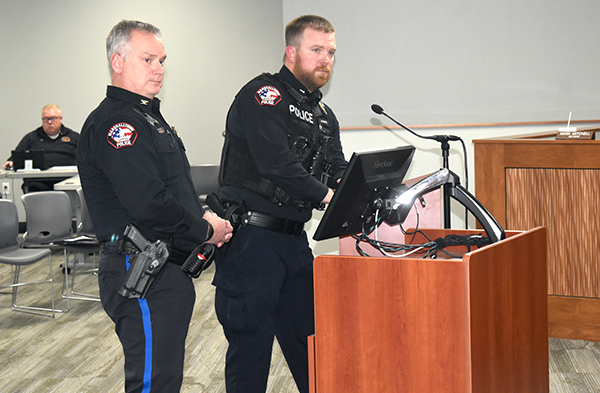
T-R PHOTO BY ROBERT MAHARRY — Marshalltown Police Chief Chris Jones and Capt. Kiel Stevenson discuss public safety cameras with the city council during Monday night’s meeting.
The Marshalltown city council spent approximately half of its 90 minute meeting on Monday night discussing the police department’s use of public safety cameras including Flock license plate readers and considering funding options to expand the programs in light of declining Automated Traffic Enforcement (ATE) revenues.
First, MPD Capt. Kiel Stevenson provided an update on the Flock cameras and shared a bit of history on the various public safety cameras used in the community, such as the live feed cameras purchased by Marshall County Crime Stoppers in public parking lots, around businesses and at busy intersections. The decision to work with Flock arose from rising maintenance costs on the older cameras as Flock owns and maintains their equipment while leasing it out, and Stevenson said the license plate readers have proven beneficial in criminal investigations.
In late 2023, the city council approved a contract with Flock, and the first 32 cameras were installed as of August 2024. In 15 months, Stevenson reported 270 uses of the cameras resulting in at least 160 arrests, but he added that he felt the numbers were actually too low.
“I can tell you that nearly every big case — the big cases you hear us report about — nearly every single one of those is coming down to Flock is used. And in some of those, Flock has been so instrumental that I’m not sure these cases don’t get solved without it, and I’m positive they don’t get solved as efficiently without it,” he said.
Some of the cases have included homicides both internally and for other agencies, a major robbery investigation, a theft of over $50,000 worth of equipment, missing persons, stolen vehicle recoveries, missing people, financial fraud and the credit card skimming scheme at local gas stations. Stevenson described the Flock technology as the most effective change he’s seen in his entire 20-year law enforcement career.
From there, he dove into what the future of the program would look like as part of the city’s strategic plan. One major goal, Stevenson said, is to fill the remaining gaps in covering the remaining entry and exit points in town as well as gaps in other widely traveled areas. Another aspect of the plan is to add live view traffic cameras to help with traffic accident investigations, and the last proposal is to add Pan, Tilt, Zoom (PTZ) cameras in the downtown area as well as replacing some that are already in place.
The plan would add 26 more license plate readers, four PTZ cameras downtown and then eight live view cameras at busy intersections, with Stevenson noting that Flock offers a discounted price on the live view cameras. The current contract costs the city $96,000 annually, and the expansion would add another $94,000 to that total.
As he opened the floor up for questions, Councilor Greg Nichols asked about a funding source for the project, and Police Chief Chris Jones replied that up to this point, it had largely been covered with ATE revenues. However, with the loss of the 12th Avenue camera due to a chance in state law, those numbers have declined, and the MPD was planning to cover the purchase of new body cameras through council-designated Local Option Sales Tax (LOST) for one year and then the ATE fund afterward. As a result, Jones does not believe there will be enough ATE funding to cover both projects.
“Both of them are critical projects for our operations. I think everybody would agree that our cameras and our body cameras are definitely a necessity, but from a staff standpoint, what we’ve been able to do with Flock and the results that we’ve had with Flock, like Kiel said, it’s absolutely changed law enforcement in this community,” Jones said. “This is by far the most useful tool that I’ve seen in my career here.”
Councilor Barry Kell asked Stevenson about an efficiency calculation regarding the cameras and how much time and money they have saved, and he replied that while he appreciated the sentiment, it was more of a two-way street because they allowed officers to solve cases they might otherwise stop investigating.
“It can create work for us to some degree, but it’s in a positive way,” he said.
Councilor Melisa Fonseca asked if the newer cameras would include more advanced technology, and Jones responded that while he didn’t know for sure, the lease agreement with Flock would allow for continual updates. He also praised the company for being responsive to requests for adjustments. Fonseca also wondered about the breakdown on the usage of Flock cameras between cases involving Marshalltown residents and outsiders, and Stevenson said he would have to review the data to give a clearer answer. Overall, however, he felt it was a mix of local and out of town cases.
Fonseca then asked about how much the cameras could catch in terms of surveillance, and Stevenson replied that it depended on which one — the license plate readers mostly focus on vehicles but could potentially catch individuals walking by, while the live views would capture the entire intersection. The PTZ cameras are also a live feed but can be moved and zoomed as desired.
Councilor Gary Thompson commented that ultimately, the MPD would need about $100,000 annually in LOST dollars to fund the long-term plan, and he felt the program had been “a great success” so far but also asked what future expansions might still be necessary.
Stevenson acknowledged that plans can always change, but he felt the current proposal would put the department in a strong long-term position.
“My feeling is this is a great investment for the safety of our city,” Thompson said.
Mayor Joel Greer remarked that Marshalltown is “way behind” other cities like Dubuque on camera technology, and Jones noted that they solved a recent traffic accident. During the public comment period, Tim Bradbury asked if other agencies like highway patrol and Immigration and Customs Enforcement (ICE) can use information the cameras gather, and he also wondered about how the use of the system is monitored for potential abuse.
Stevenson said the data is only accessed by law enforcement and shared “broadly” with other agencies — but not the federal government. Flock does not have any specific contract with the Department of Homeland Security, according to Stevenson, after a short pilot program that has since ended.
As for accountability, he said there’s a policy in place on how the cameras should be used, and Stevenson typically discourages officers from utilizing them for routine traffic violations such as driving without a license.
“Now, if you have no driver’s license and we suspect that you’re getting ready to sell drugs, maybe you’re gonna make it in the system, but we’re using this for more major stuff — warrants, things like that — we’re not gonna use it for minor stuff, and there’s significant punishment for officers who misuse this thing. And I would go as far as to say up to and including termination of employment,” Stevenson said.
He added that abuse of the system could end an individual’s career in law enforcement. First Ward City Councilor-elect Marco Yepez-Gomez started his remarks by noting that the cameras had been beneficial in solving crimes within the community, but cited concerns raised by the American Civil Liberties Union (ACLU) and other advocacy groups about ICE utilizing Flock data, women seeking abortions across state lines being tracked by the cameras and protesters being surveilled.
He ultimately hoped that the council would address the concerns and that the Flock program wouldn’t affect funding for the Marshalltown Police and Community Team (MPACT). Stevenson responded to the concerns and said the company has installed software to prevent searches related to immigration status or reproductive rights.
“We’re already taking this stuff seriously. We’re already looking into this, and we internally do reviews on our stuff and handle any complaints,” he said.
Lonnie Hogeland supported spending the money on the program and called it a “game changer” for the police, and he also asked for a more detailed explanation of how the cameras work. Stevenson said the license plate readers use AI to help identify vehicles, but there is no owner information tied to it other than active warrants.
Thompson then motioned to direct staff to come back with a resolution at the next meeting to utilize LOST as the funding source while leaving it up to Jones and City Administrator Carol Webb to determine the annual dollar amount. Webb noted that she had a budget meeting with Jones and Finance Director Diana Steiner the following day and hoped to explore any potential general fund options as well, and Thompson reiterated his desire to leave it outside the general fund in the first year. Nichols sought clarity on whether the contract needed to be renewed before May, and Thompson said he didn’t want the MPD to miss out on another need if extra money is available in the general fund.
Nichols and Councilor Mike Ladehoff both said they’d like to see a more comprehensive budget analysis before they make a decision. Kell suggested modifying Thompson’s motion to use LOST as the backup source while evaluating what the best course of action would be, but he kept his motion the same because LOST is typically used for special projects and he believed other routine costs would come up in the general fund.
“The general fund has enough stress on it every year. We don’t need to saddle the police department with a $100,000 overhead for something that I think is outside of the police department. It’s a community wide safety issue,” Thompson said.
Fonseca initially proposed an amendment to have staff explore funding options and present “a comprehensive idea” but ultimately withdrew it after Webb sought clarification on whether it would kill the motion on the floor. Ultimately, Thompson’s original motion passed by a 4-3 vote with Thompson, Mark Mitchell, Kell and Jeff Schneider in favor and Fonseca, Ladehoff and Nichols opposed.
In other business, the council:
• Approved the consent agenda as listed.
• Approved a low bid of $474,000 from Garling Construction for the library remodel project.
• Approved a resolution to amend the 28E agreement for the Marshall County Solid Waste Management Commission and add Roland and McCallsburg.
• Approved the Marshalltown Municipal Airport five-year capital improvement program.
• Approved a resolution assigning a development agreement and tax increment payments.
——
Contact Robert Maharry
at 641-753-6611 ext. 255 or
rmaharry@timesrepublican.com.
Todays News

Sammy Kershaw will headline at the 2026 Central Iowa Fair
MNPD investigating vandalism at Powwow Grounds
MESKWAKI SETTLEMENT — The Meskwaki Nation Police Department is investigating a recent incident of vandalism at ...

Extension office brings Mental Health First Aid certification course
Bill outlawing kratom as a Schedule I drug passes Iowa House
Kratom would be outlawed as a Schedule I substance under a bill passed Tuesday by the Iowa House. House File 2133 ...

National American Legion Vice Commander visits IVH Tuesday