Council OKs Flock camera expansion during final meeting of 2025
The Marshalltown city council gathered for the final time in 2025 on Monday night, swearing in two new councilors, one re-elected incumbent and a new mayor before approving the expansion of the current Flock public safety camera system through the use of Local Option Sales Tax (LOST) dollars.
According to a memo in the council packet, the agreement would expand on the current $96,000 annual contract with Flock for 32 Automatic License Plate Reader (ALPR) cameras by adding 26 more ALPRs within the community, four Pan, Tilt, Zoom (PTZ) cameras and eight live view cameras at heavy traffic intersections at an additional cost of $94,000 for one year.
As the conversation began, Councilor Greg Nichols, communicating remotely, raised questions about how the expansion would be paid for, citing numbers indicating that the LOST and Automated Traffic Enforcement (ATE) funds would be “in the red.” City Administrator Carol Webb responded, however, that the projected balance was around $1 million, and the city usually takes in about $1 million each year through LOST.
Police Chief Chris Jones explained that the city initially signed a two-year contract with Flock with an understanding that ATE would be available to cover it as well as new body cameras — before a new state law was enacted that resulted in the 12th Avenue cameras being deactivated and a substantial decline in ATE revenue. That change ultimately necessitated the request for LOST funding, and Nichols raised the question of whether or not it would ultimately be sustainable.
“I guess I can’t answer that question. That’s a difficult question. I can tell you, for year one, we have the dollars available. In future years, it’s hard to say because I don’t know how much LOST you would need to balance the general fund. I don’t know what other requests might come up, so it’s highly dependent on those variables,” Webb said.
Councilor Melisa Fonseca, also communicating remotely, wondered what would happen down the road with the cameras if the city did run out of money to fund them, and Jones said the two-year contract the council was considering entering into would cost $190,000 a year with the additional cameras plus the installation charges for the first year.
“If we were not able to continue, then we would terminate the contract with Flock. They would own the equipment. They would be responsible for taking the equipment,” Jones said.
During the public comment period, Penny Hartwell advocated for the Flock system and argued that taking the cameras away would cause more problems in town.
“At what point do you put the cost aside and keep people safe and keep our officers safe also?” she asked.
Linda Clark contended that the expanded system was a want and not a need.
“Everybody wants to be safe in this community, including myself, but there comes a time when we just don’t have enough money. And when I hear in the red and speculation as to where the money’s coming from, I have a very much problem with this issue,” she said.
Nichols then commented that he strongly supported keeping the current system in place but didn’t see how the expansion could be justified given the city’s financial outlook. Councilor Gary Thompson pointed to the Tax Increment Financing (TIF) agreement for the redevelopment of the Marshalltown Mall as a driver for an increase in LOST revenue, with a likely influx of at least $200,000 once the new stores open next spring.
“The mall alone will fund the Flock camera, the current system and the additional cameras forever, in perpetuity, so I think if we’re gonna start talking about what accounts have this and what accounts have that, let’s look at the big picture and let’s put the mall back into the equation also and the tax revenue that I’m being told it’s gonna add to the Local Option Sales Tax,” Thompson said. “One of the things I’ve been advocating for in my six years on the council is having the safest city, and again, the (recent) incident at the high school proved the Flock cameras work… We can say how much they cost for safety and it’s not worth it. Well, it’s worth it to the person that is wronged by someone committing the crime. So I have no problem with doing everything we can to help the police force in this town.”
Mayor Joel Greer, leading his final meeting, pointed to the arrest of a card skimmer from Canada being arrested due to Flock cameras along with their use in a murder case and the recent fatal hit-and-run near the intersection of Main Street and 3rd Avenue.
A motion to approve the use of council-designated LOST for one year of costs passed by a 6-1 vote with Nichols opposed. From there, the council moved on to a related motion authorizing the MPD to contract with Flock for public safety camera services.
Jones shared that he had been working with Flock representatives on a contract that would address concerns raised during the previous meeting. The goal with the expansion, he said, is to add cameras that will place them in areas of town they haven’t covered yet.
“As many of you know, and what we are generally finding out is that video evidence is imperative for us to work on both from an investigative standpoint but then also a prosecution standpoint,” Jones said, noting that County Attorney Jordan Gaffney had sent a letter of support for the program.
When he first started in law enforcement, Jones said an officer’s word was taken with “high regard,” but in the modern environment, juries often rely on tangible evidence including video in order to secure convictions. It can not only be used to track down suspects, he added, but also to contradict alibis and statements made by suspects.
Jones felt that Flock cameras are the future of law enforcement, and he also explained that the contract includes a termination strategy in case a law changes that would prohibit their use in the future. The company has never worked out such an arrangement with another community, but Jones said they were willing to do so with Marshalltown.
He reiterated that any abuses of the system would be taken “very seriously,” and any such allegations will be investigated to the best of the department’s ability. According to Jones, the PTZ cameras would be placed at 1st Avenue and Main Street, 1st Street and Main Street, North Center Street and behind the City Centre on Main Street, which would replace a Crimestoppers camera currently placed there.
The Live Feed cameras would be placed at the following intersections: Iowa Avenue and 6th Street (near Menard’s), Madison and 3rd Street, Center Street and Olive, Center and Merle Hibbs, Center and Iowa Avenue, Center and Anson, Anson and 3rd Avenue, and Main Street and Third Avenue. Councilor Mark Mitchell asked Jones if it would be possible to replace the current cameras and then reassess once a clearer picture of the new LOST revenue at the mall is established.
He responded that the goal was to provide equal coverage across the entire city, and a motion to approve entering the contract passed by a 5-2 vote with Mitchell and Nichols opposed.
In other business, the council:
Honored Geri Larson for 30 years of service in Housing and Community Development, Bob Ranson for 30 years at the Water Pollution Control Plant, Cody Schmidt for 10 years with the Marshalltown Fire Department, Wyatt Shelangoski for 10 years of service to the MPD, and Derick Garcia, Jonna Mayer and Andrew Weispfenning for five years of service to the MPD.
Recognized Greer and outgoing At-Large Councilor Barry Kell for their service to the city. Greer, who was previously a city councilor, served eight years as mayor, and Kell served four years on the council.
Approved the consent agenda as listed.
Heard a quarterly update on the MPACT program from David Hicks with YSS of Marshall County.
Approved a professional administrative services agreement with East Central Iowa Council of Governments for the Community Development Block Grant — Disaster Recovery Housing Program.
In other business, the council:
• Honored Geri Larson for 30 years of service in Housing and Community Development, Bob Ranson for 30 years at the Water Pollution Control Plant, Cody Schmidt for 10 years with the Marshalltown Fire Department, Wyatt Shelangoski for 10 years of service to the MPD, and Derick Garcia, Jonna Mayer and Andrew Weispfenning for five years of service to the MPD.
• Recognized Greer and outgoing At-Large Councilor Barry Kell for their service to the city. Greer, who was previously a city councilor, served eight years as mayor, and Kell served four years on the council.
• Approved the consent agenda as listed.
• Heard a quarterly update on the MPACT program from David Hicks with YSS of Marshall County.
• Approved a professional administrative services agreement with East Central Iowa Council of Governments for the Community Development Block Grant — Disaster Recovery Housing Program.
——
Contact Robert Maharry
at 641-753-6611 ext. 255 or
rmaharry@timesrepublican.com.
-

- T-R PHOTOS BY ROBERT MAHARRY — From left to right, incumbent At-Large Councilor Jeff Schneider, incoming Mayor Mike Ladehoff, incoming At-Large Councilor Sue Cahill and incoming First Ward Councilor Marco Yepez-Gomez took their oaths of office during Monday night’s Marshalltown city council meeting.
-

- Outgoing At-Large City Councilor Barry Kell, left, and retiring Mayor Joel Greer, right, were honored for their service during Monday night’s city council meeting.
-

- Jonna Mayer (five years, left), Wyatt Shelangoski (10 years, second from left) and Derick Garcia (five years, right) were honored for their years of service to the Marshalltown Police Department during Monday night’s council meeting. Also pictured is Police Chief Chris Jones, second from right.
-
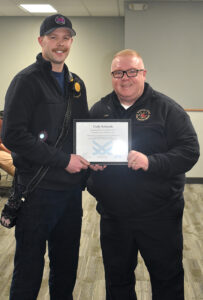
- Cody Schmidt, left, pictured with Fire Chief Christopher Cross, right, was honored for 10 years of service to the MFD during Monday night’s meeting.
-

- Water Pollution Control Plant (WPCP) Superintendent Bob Ranson, right, pictured with Public Works Director Heather Thomas, left, was honored for 30 years of service to the city during Monday night’s council meeting.
-

- Retiring Housing Administrator Geri Larson, right, pictured with Housing and Community Development Director Deb Millizer, left, was honored for 30 years of service to the city during Monday night’s council meeting.
Todays News

Riverside birds show no signs of avian flu
Iowa to scrap Healthy Kids Iowa in favor of federal, summer feeding program
Eligible Iowa households can receive a monthly allotment to spend on certain food items at the grocery store ...
Council OKs Flock camera expansion during final meeting of 2025

Traer native serves with Navy Medicine in Virginia

ARNP Smith joins McFarland Clinic Family Medicine