Local leaders gather for two-day Sequential Intercept Model conference at Vets Coliseum
Over the last several years, leaders in law enforcement and the local legal system have taken a proactive approach to criminal justice diversion through programs like the Marshalltown Police and Community Team (MPACT) and Enhanced Supervision Court (ESC), better known as drug court. On Wednesday and Thursday, community stakeholders gathered at the Veterans Memorial Coliseum for a Sequential Intercept Model (SIM) mapping workshop aimed at “identifying strategies to divert people with mental health and substance use disorders away from the justice system and into treatment.”
Staff from the National Center for State Courts (NCSC) led the workshop, which included about 50 participants ranging from judges and elected officials to nonprofit leaders and school administrators. Judge Sharon Greer of the Iowa Court of Appeals delivered the opening and closing remarks, and as the event wound down on Thursday morning, the stakeholders were tasked with devising a plan of action with implementation steps to follow.
“If we bolster those that are struggling in our community with all these efforts and systems and services, we elevate our community, and that’s what this is all about, getting a strong community,” Greer said during her closing remarks before reading a quote from James Baldwin.
Michelle O’Brien, a principal court management consultant with NCSC, explained that the key objectives are to keep people in their communities, coordinate resources and ensure the best possible outcomes.
“We know that most people enter the community again after involvement in the criminal justice system. There’s very few people that don’t come back, so that’s kind of what we talked about,” she said. “We identified all these intercepts. There’s five plus the community. We identified what resources are available, what opportunities or gaps there are, looking at the process of how people move through because sometimes (the) process kind of finds points that could be improved.”
While law enforcement, attorneys, prosecutors and judges play a key role in the process, O’Brien noted that community resources are equally important in assisting those who are working to rebuild their lives, citing Prairie Ridge Behavioral Healthcare (formerly SATUCI) as a prime example.
“Like any place, there are issues that are consistent across the country — lack of housing or lack of affordable safe housing, (the) competency process for someone who’s not competent to stand trial needs lots of improvement across the board. Transportation, a lot of times is an issue, so there’s some bigger issues,” she said. “I think one of the things that’s really important that comes out of a mapping workshop is understanding — not everybody understands what is in the community. They’re like ‘Oh, we have that?’ And so this is a great way to get all the right people sitting here to have these conversations. It’s about learning, knowledge, networking (and) starting to communicate better.”
From there, the group identified three top priorities and developed an action plan, which the NCSC staff will type up and finalize.
“This is a very knowledgeable, very cooperative (group). You have a really good atmosphere, and it was just very fun conversations,” O’Brien said.
During a subsequent interview, Greer and District Court Judge John Haney laid out the overarching objectives of keeping people from falling into the criminal justice system, out of jail and remaining productive members of society.
“It’s gonna be a collaboration of information and resources for people in our community,” Haney said.
Each subgroup will continue to meet in the future, and Greer said hers will be focused on providing systems to connect jail inmates with services once they get out, which Haney described as “warm handoffs” to the appropriate resources.
“Our group said ‘Listen, we need to come together again next year to have a summit to look at implementation’ because we talked about the goals of implementation, so we’ll constantly meet to revisit, see what’s working, see what’s not working, see if there are other stakeholders or people you need to bring into the loop that are gonna make it more effective for our citizens,” Haney said. “You’ve got such a broad group. I mean, we brought people in from the Chamber, from schools, social services, substance abuse/mental health treatment, law enforcement, the hospital, the legal community. There’s just this broad range of resources that we brought together. We may not have known about this opportunity or this resource if we hadn’t brought these people together, and so it gives them a steering mechanism for somebody when they come in to ask for help.”
For example, Judge Bethany Currie’s group is exploring adding a mental health liaison between the court system and treatment providers, which would require an ask of either the county board of supervisors or the state courts for funding.
“I think that (with) coordination of all these groups and services, now people know where to go and (who) to talk to, and it will be more coordination, I think. That’s the key,” Greer said.
The NCSC has run similar workshops in counties across the country, but the event in Marshalltown was one of the first in Iowa, according to Greer.
“One of my goals for the court system is to have this role continue on throughout our state,” she said.
Marshall County Attorney Jordan Gaffney, Sheriff Joel Phillips and Marshalltown Police Chief Chris Jones reiterated the theme of the abundance of services available and opportunities for collaboration with improved structure and more effective communication between community stakeholders.
“I think you have to realize that crime occurs because people are having issues in their own lives that put them in a situation where this is an option for them, and if we can reach out to them and provide them with services and break down some of those barriers, then we have people that are less likely to commit crime as part of their substance abuse concerns or mental health concerns,” Jones said. “And we can try to proactively decrease crime from the very core of the reason that it’s occurring… I think the biggest thing for us is to get to people early, to be able to build that robust resource guide and find trusted people that we can make sure that they’re getting in contact with (so) that we can try to make sure that there’s some level of follow up and get people to understand that we really care about the concerns that they have and trying to get them through those concerns and have them be productive members of our community.”
Phillips offered a similar assessment.
“It’s one of those situations where we won’t keep people in jail forever. They’re gonna be your neighbors. They’re gonna be part of your community. We want to make sure, with those resources, that they can be successful for the rest of their lives and make good decisions,” he said. “And with the resources that we have available to us that we did not realize going into this, I think it’s a great base moving forward.”
In addition to the mental health liaison, Gaffney said the other big goals are enhancing behavioral health services for incarcerated individuals and enhancing community awareness and education on substance abuse and behavioral health services that are available.
——
Contact Robert Maharry at 641-753-6611 ext. 255 or
rmaharry@timesrepublican.com.
-
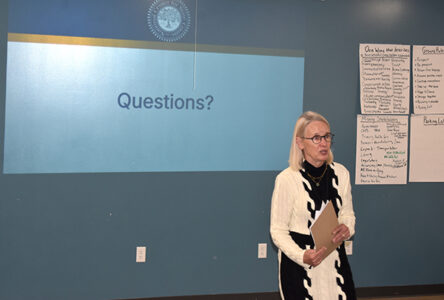
- T-R PHOTOS BY ROBERT MAHARRY — Judge Sharon Greer of the Iowa Court of Appeals delivers the closing remarks during a two-day Sequential Intercept Model (SIM) mapping workshop at the Veterans Memorial Coliseum on Thursday morning. The goal of the event, led by the National Center for State Courts (NCSC), was to “identify strategies to divert people with mental health and substance use disorders away from the justice system and into treatment.”
-

- NCSC Principal Court Management Consultant Michelle O’Brien helped to lead the SIM workshop and work with local stakeholders to develop strategies and action items for the future.
Todays News
Local leaders gather for two-day Sequential Intercept Model conference at Vets Coliseum

Animal intake temporarily suspended at ARL

‘Snow much fun’ abounds at Gladbrook’s annual tree lighting
Santa Claus is coming… to Pinnacle Bank
Old hospital foreclosure sale postponed, city seeks deed in court