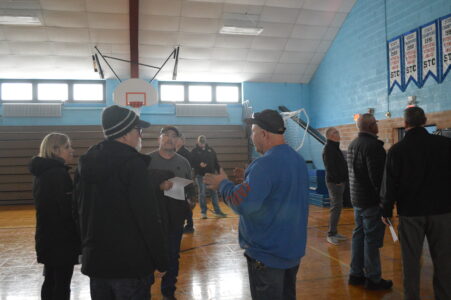
State Center police chief withdraws support for ‘J-turn’ proposal at Highway 30 intersection
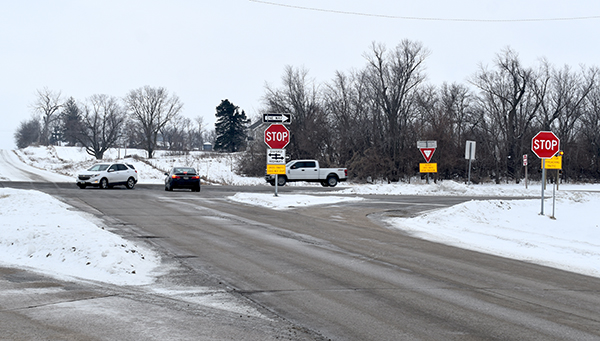
T-R PHOTO BY ROBERT MAHARRY A recent photo shows the intersection of Durham Avenue and Highway 30 in State Center facing south. After a community meeting on Nov. 24, State Center Police Chief Jon Thomas withdrew his support for the proposed “J-turn” Reduced Conflict Intersection (RCI) the Iowa Department of Transportation (IDOT) has been planning with construction tentatively slated to begin in the spring of 2026.
STATE CENTER — The long-discussed controversy over the Iowa Department of Transportation’s (IDOT’s) plans to modify the “dangerous” intersection of Highway 30 and Durham Avenue in State Center took another turn last week when Police Chief Jon Thomas announced that he had withdrawn his support for the proposed Reduced Conflict Intersection (RCI) or “J-turn” proposal due to community concerns about the project after a public meeting on Nov. 24.
“As Chief of Police, I will fully admit I am not a traffic engineer, but I am a subject matter expert regarding this stretch of Highway 30 and the contributing factors to the accidents within my jurisdiction. When evaluating both the documented accidents and several narrowly avoided collisions, a leading contributing factor to the danger at this intersection relates to the ‘shadowing’ effect which occurs from vehicles turning into State Center while other vehicles are attempting to enter Highway 30 leaving State Center. The community has inquired about several possibilities to address their concerns, and I believe that I understand the DOT’s position well as we have a lower vehicle count of north and southbound traffic than in other areas along Highway 30 in nearby communities resulting in many of these possibilities not being feasible for our community,” Thomas wrote in a letter to IDOT District 1 Engineer Allison Smyth. “Over the course of the past several months, I had evolved in my support for the RCI intersection, and while I understand why this type of intersection makes sense in this situation, without the reduction in speed limit in this area, I cannot support the RCI intersection due to my concerns regarding eastbound traffic approaching the turnaround point on the west side of the project. I acknowledge based on acceptable standards (that) the speed limit is not required to be lowered, but as stated earlier, as someone who works this stretch of road on a daily basis, I believe my firsthand knowledge and experience with drivers in this area have a greater value and represent a deeper understanding of drivers traveling this stretch of road, and I feel certain (that) without a reduction in speed limit as part of the RCI intersection, a two-vehicle collision with a commercial motor vehicle in the turnaround and an eastbound vehicle is only a matter of time.”
During a recent interview, Thomas told the T-R that he still felt the RCI would address some of the community concerns, but he worried that eastbound traffic would be topping the hill and encountering semi-trucks doing U-turns, which he called “a huge problem.”
“The Department of Transportation engineers have assured me that by their calculations and formulas, there’s enough sight distance that they’re comfortable with it. I’m not,” he said. “People are on their phones. They’re distracted. They’re eating their lunch. People are gonna pop that hill, and they’re gonna have problems. And so my frustration is that I was willing to go along with the intersection design if there was a reduction in speed to 55 (miles per hour) from basically the Rhodes corner out to the golf course, but the DOT has advised me that we don’t meet the criteria (and that) lowering the speed limit is not even being entertained. Well, then I don’t support the intersection because I have a lot of concerns about what that would look like.”
He also showed DOT officials myriad social comments outlining either skepticism or outright opposition to the plans, and although the state ultimately has jurisdiction and authority over the highway, Thomas doesn’t feel that the current proposal is a “done deal.”
“I really have been given feedback that they really do care what we think, and they are considering not doing the intersection. I just go back to the root of the problem, whether it’s the near misses that get reported or the actual accidents that we’ve covered. In almost every case, the speed wasn’t necessarily an issue, and in most cases it wasn’t people turning into town. It was people leaving town.”
He then referenced the “shadowing effect,” which means that cars turning into town are creating an unintentional blindness of other cars traveling on the road, so the turning traffic needs an offset turn lane like the one at the intersection of Highway 30 and Hart Avenue near State Center to allow cars leaving town to see around them. The public, Thomas said, feels strongly about both turning lanes and a reduction in speed, but he isn’t as concerned about the speed as long as drivers aren’t making the J-turns.
“I can’t attribute excessive speed as a contributing factor to any of the crashes we’ve had. It wasn’t like a car was going 100 and it came out of nowhere. In almost every case, a car pulled out from the stop sign and ran into another car going east or westbound on 30 because they didn’t see it,” he said. “The person leaving the stop sign or leaving town didn’t see it.”
There was one fatality crash where a driver turned left in front of a pickup truck, but Thomas described it as an outlier. Previously, construction on this project was set for the spring of 2026, but the chief wasn’t sure how rethinking the intersection would impact that.
He doesn’t anticipate another public meeting given the “abundant” feedback already received, but now, it’s just a matter of how the DOT will proceed. State Center Mayor Craig Pfantz called the J-turn proposal an “unintended consequence” of the concerns citizens had raised, but he did feel that the addition of flashing lights has helped to some degree.
“We have a problem with that intersection when people turn into State Center there. You kind of get caught in the middle when you’ve got traffic coming from the west turning in and you want to pull out and turn to Marshalltown. That is an issue that the speed limit reduction would not solve,” Pfantz said. “I just wish there was more of a median there because it’s so narrow that when you pull out in there and there’s car traffic coming from the west, somebody’s got to stop. That’s an issue that I just don’t know how we can solve. Now, the J-turn deal, it did solve that. We just could not figure out how semis could turn around on that J-turn if they were coming out of State Center and wanting to go back to Marshalltown because there’s just not a lot of room there to turn.”
Currently, there is only one other active J-turn RCI intersection in Iowa, which is located along Highway 20 near Fort Dodge, and Pfantz said the people he has spoken to who have used it weren’t happy with the design. His preference, like Thomas’s, is to reduce the speed limit from 65 to 55 through town, implement offset turning lanes and utilize the flashing lights.
“If that doesn’t help any, if we continue to have issues down there with accidents, then maybe the J-turn would be something down the road. It’s a last resort in my mind, and I’m sure the citizens feel the same way too,” he said.
At presstime, attempts to reach Smyth for comment had not been successful. According to information previously reported in the T-R, there were 28 reported crashes at the intersection between Jan. 1, 2014, and March 17, 2025, including one fatality, three with major injuries, and three with minor injuries — with a total of 26 individuals involved. Smythe noted that 18 of the 28 crashes were attributed to failure to yield or failure to obey right-of-way laws
——
Contact Robert Maharry
at 641-753-6611 ext. 255 or
rmaharry@timesrepublican.com.
Todays News
North Tama alumna set to cover Super Bowl LX as Fox 13 Seattle sports photographer
Stacy Kelley wins YSS of Marshall County’s Outstanding Service Award
T-R, Tama-Grundy publications recognized at annual INA awards banquet
Hart: ‘Trump’s tweet sends soybean market soaring’
Appointment committee interviews eight supervisor candidates
The appointment committee charged with selecting a new member to serve on the Marshall County Board of Supervisors ...