State launches new strategy on chronic wasting disease ahead of deer season
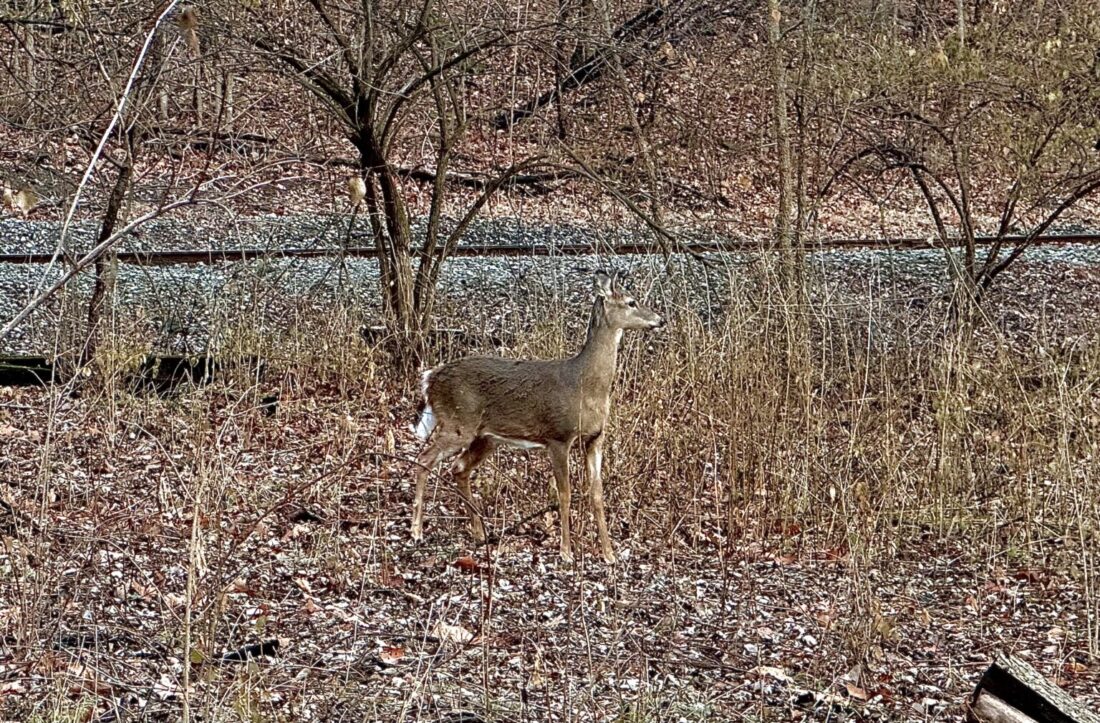
Photo by Cami Koons/Iowa Capital Dispatch A deer next to the Bill Riley Trail in Des Moines.
Since 2013, chronic wasting disease has been detected in more than 500 deer across 31 Iowa counties.
The Iowa Department of Natural Resources has launched an updated response plan to the disease that includes collaboration with the hunting community, researchers and landowners. The plan was introduced ahead of the start to Iowa’s gun season for deer hunting, which begins Saturday.
The plan, which is written for 2025 through 2030, said the state is shifting focus from eradicating the disease to instead “mitigating its spread and managing its impacts.”
Chronic wasting disease is a fatal neurological disease impacting cervids — elk, moose, caribou and most importantly to Iowa, white-tailed deer. It is spread through certain prion proteins in saliva, nasal drippings, urine and other secretions.
The stated goal in the response plan is to “document the spread of the disease while balancing deer herd health with quality hunting opportunities, for as long as possible, while preparing Iowans for our future with CWD.”
Jace Elliott, DNR’s state deer biologist, said the response plan is intended to serve as a “blueprint” for how state agencies are responding to the disease. Elliott said Iowa is still in a “relatively early stage” of the disease, as there are still a handful of hotspots.
“Our hope is the public sees it as a measured, moderate approach to managing an extremely difficult challenge,” Elliott said in a news release with DNR.
Monitoring CWD
The disease starts in low numbers but grows exponentially, according to a news release from DNR. Elliott said chronic wasting disease can take a couple of years before it starts to physically impact an infected deer, and it can take decades to impact a deer population.
As it has since the first Iowa detection, in Allamakee County, the department plans to continue sampling and testing harvested deer for the disease. The majority of surveillance in recent years has come from samples submitted by hunters.
DNR plans to continue to issue county-specific quotas for the number of deer samples collected and tested for chronic wasting disease. Deer hunters who want to participate in the program can find more information online about submitting and collecting samples from a harvested deer.
While the disease has not been shown to infect humans, the U.S. Centers for Disease Control and Prevention recommends that hunters test their deer meat for the disease before consuming. Samples, even after a county has reached its quota, can be sent to DNR for testing if a hunter wants the peace of mind before consuming his or her hunt.
Iowans can also access a dashboard online with chronic wasting disease data by county. Tyler Harms, a biometrician with DNR, said this data can help hunters decide if they want to get their deer tested, and where they want to hunt.
“Hunters care, they’re passionate, they want to do what they can to slow the spread of the disease,” Harms said in a news release with DNR.
DNR staff like Harms and some Iowa State University professionals have trained interested hunters on managing, testing and sharing information about the disease within their counties. These trained hunters become chronic wasting disease ambassadors for the state and are part of the department’s initiative to prioritize education and outreach about the disease.
Managing deer populations
In addition to testing, the DNR plan includes harvest-based management to help control the spread of the disease.
Deer hunting in the state helps to keep populations at a healthy level, which can also lower transmission of the disease.
“We’re trying to mitigate increased transmission and high prevalence rates by keeping deer numbers at a balanced level–in other words, avoiding overabundance,” Elliott with DNR said. “We’re not doing aggressive, targeted deer removals; all of our harvest and surveillance is voluntary.”
Counties with overabundance might have additional, special hunting weekends or tags to help curb the population. Hunters can find a map of DNR’s deer management zones online, as well as further licensing information.
“Hunting plays a huge role in slowing the spread of the disease,” Harms said in a news release. “We encourage hunters to continue hunting in Iowa and managing the herd for future generations.”
Saturday, Dec. 6, marks the start of gun season, which DNR said is Iowa’s busiest deer season. Hunters are expected to harvest between 55,000 and 60,000 deer during the Dec. 6-10 and Dec. 13-21 gun seasons this year.
Already, hunters have harvested more than 29,000 deer in 2025. Youth and bow hunting seasons began in September and October.
In the 2024-2025 season, hunters bagged 101,282 deer in Iowa, according to the state report.
Elliott said early season reports show “strong” deer harvest in eastern Iowa and low deer numbers in central and western Iowa, in part due to other disease pressures.
The department anticipated last year that epizootic hemorrhagic disease in deer would impact deer populations. Hunters can also report suspected cases of the hemorrhaging disease to DNR. Impacted deer are often found dead near bodies of water as the disease causes dehydration.
Public outreach
The chronic wasting disease response plan emphasizes that the department will enforce deer-related policies, like a ban on hunting over bait and interstate carcass transport.
The plan also calls for continued public outreach about the disease. DNR has partnered with ISU to lead the ambassador courses, seminars, chronic wasting disease sampling workshops, hunters education workshops and more.
The plan said outreach efforts focus on educating hunters, landowners and stewards about the disease so the department can be “actively involving” Iowans as the disease continues to spread to more counties.
“By leveraging a weighted surveillance protocol, engaging in proactive stakeholder collaboration, and utilizing validated diagnostic testing, the DNR strives to efficiently monitor and document CWD’s progression,” the plan said.
Todays News

Lines and Mud: Pottery, drawing exhibit opens at ACA building Thursday evening
Sanchez Vasquez found guilty of one of two election fraud counts
On Thursday, 12 Marshall County jurors came to a verdict in the voter fraud case. The jury found Jorge Oscar ...
State launches new strategy on chronic wasting disease ahead of deer season

Chamber event highlights ‘Fields of Opportunities’ in Marshall County

Supervisors approve MOU for opioid settlement funds to purchase medication locks