Supervisors approve MOU for opioid settlement funds to purchase medication locks
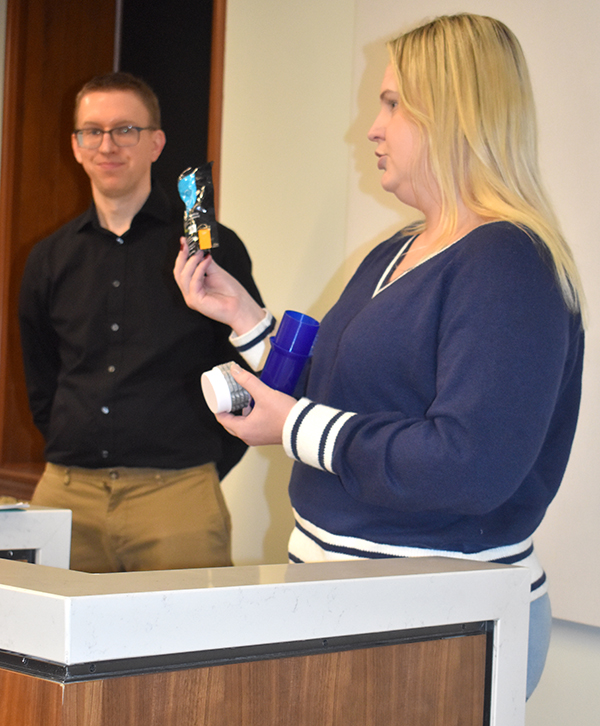
T-R PHOTO BY ROBERT MAHARRY — Marshall County Public Health Director Sydney Grewell, front, demonstrates the use of a medication locking device and Deterra neutralization pouch as Marshall County Attorney Jordan Gaffney, back, looks on during Wednesday morning’s Board of Supervisors meeting. The supervisors approved the allocation of $23,869 in opioid settlement funds to be put toward the purchase of 1,500 of the devices.
During a brief meeting that clocked in at around 20 minutes Wednesday morning, the Marshall County Board of Supervisors unanimously approved a Memorandum of Understanding (MOU) to utilize just under $24,000 in opioid settlement funds to be put toward the purchase of approximately 1,500 medication locking vials with Deterra neutralization pouches.
Marshall County Attorney Jordan Gaffney, who was flanked by Marshall County Public Health (MCPH) Director Sydney Grewell at the speaking podium, explained that a few months ago, the application window for opioid settlement grant funding opened, which are non-taxpayer dollars secured through civil litigation involving governing bodies all over the country including Marshall County. Earlier this year, the supervisors approved the allocation of grant funding to MCPH for Narcan distribution and the “What You Don’t See” experience trailer.
“This is the second request for Marshall County Public Health, and it’s a little different from the first but kind of an extension of the program,” Gaffney said.
The request for $23,869 would fund a program for MCPH to purchase locking prescription medication bottles to safeguard said medications for various reasons, including keeping them away from children in a home or secured during a vacation trip. It would also provide for Deterra disposal pouches that neutralize the effects of medications when mixed with them.
“It’s a little bit escape room, a little bit James Bond, so it’s pretty cool stuff,” he said. “Put simply, this is just a public health program that’s specifically geared toward reducing opioid exposure for young people, for community members and vulnerable persons in our community.”
The remainder of the funding as part of the current request will assist MCPH in public outreach efforts to distribute the information about the purpose of the devices and how they can help.
“Sometimes, when something happens in somebody’s family and family members discover ‘Oh, our loved one had all this medication in the medicine cabinet. What are we supposed to do?’ They may not bring it to a prescription drug drop-off location, but this will help them dispose of it safely,” Gaffney said. “So I think this is a good program. It’s right up the alley and the requirements of the national opioid litigation settlement. I’d be excited to get it started, and I think Sydney has the fun part because I think she can demonstrate for you what the canisters will do.”
Grewell brought one of the locking prescription vials with her to demonstrate how it works, and she said the latest round of funding would serve as an extension of the trailer and the outreach efforts already in place. The Deterra pouches, she noted, come inside each vial, and work on both pills and patches such as fentanyl.
“The cool thing about this, as well, is we’ll be able to set these locks ourselves when someone comes up,” she said. “So if you’re like, hey, I want to set my own code, that way you don’t forget it, we can do that as well as engaging with people. So it locks, then you just turn it and you can’t get in it.”
Board Chairwoman Carol Hibbs asked Grewell how the public will access the devices, and she replied that her goal is to hold public outreach events and share educational information during drug takeback days while giving them out for free to individuals who can come and get them.
Grewell explained the purchasing process and said pamphlets are included in both English and Spanish. In response to another question from Hibbs, Gaffney said the county has over $500,000 in its opioid settlement fund, with some money already allocated toward the first MCPH request and the expansion of the Marshalltown Police and Community Team (MPACT), with two other applications in the pipeline currently and agreements in the works.
A motion to approve the allocation to MCPH and a subsequent motion for a related internal transfer both passed by unanimous 3-0 votes.
During the public comment period at the end of the meeting, County Auditor/Recorder Nan Benson mentioned the Vanguard reappraisal project that recently commenced on the north side of Marshalltown, noting that information about the company’s representatives and their vehicles are available on the assessor’s website.
Hibbs reiterated that residents are not required to allow the appraisers inside of their homes, and even if residents decline to answer any questions, the appraisers will have to determine an assessment value based on the information available to them. Benson has fielded questions about why the project is being conducted, and she said it is supposed to happen every 10 years although Marshall County has never done one, to her knowledge.
“If we don’t have the proper assessments on the values, the state will come in and do this for us, and I don’t anticipate that they would be cheaper. So I think this is a better way to get a fair assessment,” Benson said.
Supervisor Jarret Heil noted that Marshall County has had three different assessors in the last decade, each with their own style, and he felt the re-evaluation would help to level things out. Benson commented that not allowing the appraisers into one’s home may result in overvaluation, and Hibbs added that the information on the assessor’s website was helpful in promoting transparency.
Heil understood the concerns that have been raised as assessments can ultimately impact property taxes, but he added that they are following “the letter of the law” and decisions on tax rates are decided by governing bodies such as the city, county, school district and community college.
“It makes sense that people are thinking that way, and there’s nothing wrong with thinking that way. But knowing that the whole point of this process is to get accuracy on our records, the whole point is to get accuracy,” Heil said.
Marshall County 911 Communications Director Rhonda Braudis shared that she has had productive conversations with Assessor Blaze Wurr and hoped to minimize 911 calls as a result of unknown individuals arriving on properties across the county.
In other business,
the board:
• Approved the EIWA CEO shared liability 28E agreement and authorized the chair to sign.
• Approved the consent agenda and personnel changes as listed.
——
Contact Robert Maharry at 641-753-6611 ext. 255 or
rmaharry@timesrepublican.com.
Todays News
Marshall County Supervisor Carol Hibbs announces run for re-election

Students display artwork at MACC Saturday

Trees to Table features Grammer Grove harvested maple syrup
MACC Foundation names Borton as inaugural chief operating officer
MCC professor wins Dan Marburger Mentors in Violence Prevention Advocacy Award