A Q&A with the commander of the Kosovo Security Force, Lt. Gen. Bashkim Jashari
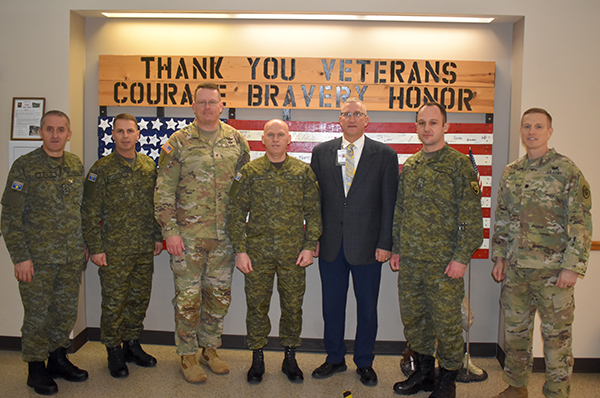
T-R PHOTO BY ROBERT MAHARRY Last Tuesday morning, a delegation from the Kosovo Security Force that included the European country’s top military general, Lt. Gen. Bashkim Jashari, visited and toured the Iowa Veterans Home in Marshalltown. Pictured, from left to right, are Colonel Sylejman Cakaj, Command Sergeant Major Bedri Zuka, U.S. Army Brigadier General Mark Kappelman, Jashari, IVH and Iowa Department of Veterans Affairs Commandant Todd Jacobus, Major Shpend Hajdini and U.S. Army Lieutenant General Jonathan Shaw.
Last Tuesday, a delegation of members of the Kosovo Security Force led by Lt. Gen. Bashkim Jashari visited the Iowa Veterans Home to meet with IVH leadership including Commandant Todd Jacobus, a veteran of the U.S. Army and Iowa Army National Guard who served in Kosovo himself, and toured the facility that houses approximately 400 Iowa veterans and their spouses. Jacobus was granted honorary citizenship in the Kosovan city of Decan last summer, according to the Kosova Press.
“What a tremendous honor (it was) for us to host the commanding general of the Kosovo Security Forces here in Marshalltown at the Iowa Veterans Home. This year we celebrate 250 years of independence. Next month, Kosovo will celebrate 18 years of independence,” he said. “Freedom in both of our countries was not given to us – it was secured through sweat, blood, and lives. No family understands that sacrifice more than the family of Lieutenant General Bashkim Jashari, who lost 58 members in Prekaz, Kosovo, on March 5-7, 1998. It was truly an honor to have this delegation see how our nation serves and supports veterans of the United States Armed Forces.”
Through a translator, Jashari answered a series of emailed questions from the T-R about his military experience, the relatively young country’s alliance with the United States and the state of Iowa specifically, his impressions of IVH and his hopes and dreams for the future of Kosovo.
T-R: First, tell me about yourself and your background, and how you managed to enlist in the Kosovo Liberation Army.
Lt. Gen Bashkim Jashari: I was born in the year 1977 in Prekaz of the municipality of Skenderaj, of Republic of Kosovo. I come from a patriotic family from the Drenica region, which has contributed for the freedom of Kosovo throughout the history. I am married and I have four children.
During my free time, I enjoy sports activities such as swimming, football, and hiking. Like the majority of young people in Kosovo, I attended my education within the country’s educational institutions during a period marked by violent measures and repressive policies executed by the Serbian authorities. I continued my academic development by completing academic studies at the Faculty of Law in the Pristina University. At the same time, I carried out military education and training in various NATO countries.
My military experience dates back to the early years of my youth, a period during which our family was continuously exposed to attacks by Serbian paramilitary, police, and regular military forces. As a family, we were exposed to persecution by the Serbian regime of that time as a result of our national cause for freedom and independence, aimed at the establishment of a free, democratic state governed by the rule of law. With the establishment of the Kosovo Liberation Army and our rightful war, we achieved the goal of liberating the country and gaining freedom for our occupied people. I continued my engagement as a member of the Kosovo Liberation Army until freedom, serving in various staff and command positions, a period that concluded with my appointment as Deputy Commander of the Drenica Operational Zone.
The reputation as a distinguished military officer and the contribution during the war, were key and highly significant factors in the development of my military career. After the liberation of the country, I continued my military career in positions of varying responsibility, and since 2021 I have been serving as the Chief of Defense of the Republic.
T-R: What were the origins of the war with Serbia and what was your experience in it?
Jashari: The people of Kosovo have endured injustice, persecution, and systematic violence throughout their history. As a consequence of the conditions that emerged and the hardships faced by the Albanian population of Kosovo during the 1990s, our family was forced to prepare and organize a form of armed resistance against the Serbian occupying forces. As a result of our family’s involvement in this resistance, we were subjected to several attacks by Serbian police and military forces between 1991 and 1998.
The fighting that took place on March 5-7, 1998, now acknowledged as the ‘Epopeja e UCK-së/The Epic of the Kosovo Liberation Army (KLA),’ constitutes one of the hardest moments for our family. This battle was unequal, both in terms of manpower and weapon systems (which according to the media and journalist reporters of that time it is considered to be approximately 15,000 military and police troops). As a result of this inequality, the Commander of the Kosovo Liberation Army, Adem Jashari, who was my uncle and 55 members of the Jashari neighborhood were killed. Of them, 21 were children.
Furthermore, from 55 members that were killed, 20 of them were from my close family, among them children, women, and the elderly (encompassing a total of three generations of my family). During this battle, on the third day of fighting, I managed to break through the encirclement established by Serbian police and military forces, while my cousin (uncle’s daughter), Besarta Jashari, who was only 11 years old at the time, was captured alive by Serbian forces.
Therefore, I can state that the battle of 5, 6, and 7 March 1998 represents a turning point in the history of Kosovo, as the people of Kosovo on a voluntary basis were massively mobilized to join the Kosovo Liberation Army.
T-R: How did the U.S. help Kosovo in its quest for independence, and how has the country’s relationship with the U.S. military evolved over time?
Jashari: I always emphasize that the United States of America is part of our freedom, having played an essential role in supporting Kosovo on its path toward independence. The United States has been Kosovo’s main ally, initially through diplomacy and later by supporting the KLA during the war. Furthermore, the United States led NATO’s 1999 military intervention in Kosovo, decisively helping to halt ethnic cleansing and laying the groundwork for the establishment of the Kosovo state.
Furthermore, during the post-war period, the United States has provided continuous support in the state building and political processes that culminated with the declaration of Kosovo’s independence on February 17, 2008. In addition to the contribution of the American military within the KFOR, the United States has been a key partner in the development and strengthening of the Kosovo Security Force. Cooperation between the armed forces has gradually evolved into a long-term strategic partnership, marked by a range of bilateral activities such as training, exercises, and educational programs.
T-R: What did Kosovo’s independence mean to you and the other individuals who fought for that freedom?
Jashari: Kosovo’s independence represents the culmination of profound and painful sacrifice, both personally and for the entire people of Kosovo. It stands as a testament that the suffering, resilience, and countless efforts were ultimately rewarded, transforming into dignity and hope for future generations. For the people of Kosovo, independence was not merely a political act, but the realization of a deeply held ideal for which everything was given. For the Jashari family, it carries an even deeper meaning, given the sacrifice and martyrdom of many members of our family.
T-R: Iowa, specifically, has been a state partner with Kosovo for over a decade. What have you learned through the partnerships, and what are your impressions of Iowa and the Iowa Veterans Home after today’s visit?
Jashari: The state partnership program between the Republic of Kosovo and the State of Iowa began in 2011. This partnership has had an impact across multiple areas, including the military, education, economic exchange, and city twinning initiatives. For the Kosovo Security Force, this partnership holds particular significance due to its support in developing military skills and capacities. The cooperation between the Kosovo Security Force (KSF) and the Iowa National Guard is considered a success story and is highly regarded by many other states participating in the State Partnership Program (SPP).
Through this collaboration, the Iowa National Guard and the KSF have successfully signed a three-year cooperation plan encompassing five lines of effort. Therefore, my impressions of the State of Iowa are extremely positive. Due to the excellent cooperation between our two states and armed forces, I consider Iowa as a second home.
Furthermore, my visit to the Veterans’ Home was particularly meaningful, as it reflects the United States’ outstanding commitment to honoring and caring for its war veterans. It highlights the importance and highest regard for those who have fought to protect peace and democracy around the world. During this visit, I had the opportunity to meet a World War II veteran who, even at the age of 102, receives highly respect and outstanding care from the United States of America and this makes him feel good.
T-R: What are your hopes for Kosovo’s future, and what challenges does your country face going forward?
Jashari: Global conflicts continue to influence security and stability across Europe and our region. In particular, Russia’s aggression in Ukraine has had a profound impact on the security environment in Europe, including in Kosovo. Kosovo continues to face challenges from Serbian interference through various conventional and unconventional means, supported by Russia. However, Kosovo’s professional security institutions, with the support of the United States, are effectively countering these challenges. Kosovo’s hopes for the future are tied to the building of a stable, democratic, and economically developed state, fully integrated into Euro-Atlantic structures.
What message do you have for Americans as we celebrate the 250th anniversary of our own independence?
Jashari: On the occasion of the 250th anniversary of the Independence of the United States of America, the citizens of Kosovo express their profound gratitude and respect to the American people for their unwavering support for freedom, peace, and democracy. The United States has been and continues to be, a crucial ally of Kosovo during the most pivotal moments of its history. This anniversary also stands as a testament to the enduring friendship and shared values that unite our two countries.
With sincere congratulations, the people of Kosovo express their hope that this special relationship will continue to strengthen and further develop for the benefit of future generations.
Todays News
Naig tours water-quality conservation projects in Tama, Grundy counties
Gov. Kim Reynolds supports U.S. war in Iran, mourns deaths of Iowans killed in strike
Iowa man charged with aggravated murder in the deaths of 3 women found in Utah
Local panelists speak of challenges faced on International Women’s Day

Ovens set to roar once again at Traer Pizza Palace