Average area land values dropped slightly in 2025 despite statewide increase
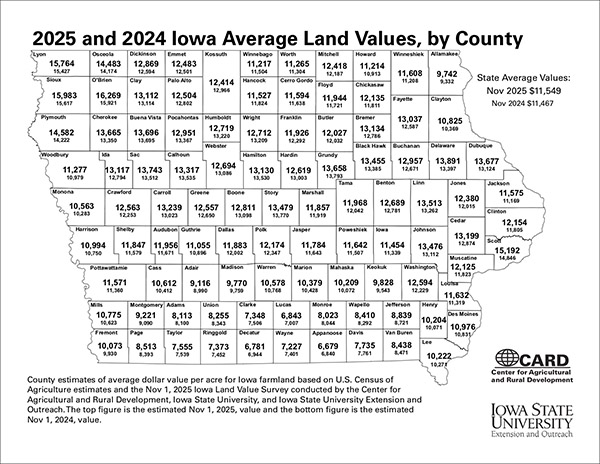
CONTRIBUTED GRAPHIC — A graphic from the Iowa State University Center for Agricultural and Rural Development (CARD) shows average land values by county in the state in 2025 compared to 2024. Average values dropped slightly in Marshall, Tama and Grundy counties.
Despite a slight overall increase across the state, average land values in Marshall, Tama and Grundy counties all dropped slightly in 2025 compared to 2024 according to information released by the Iowa State University (ISU) Center for Agricultural and Rural Development (CARD) last month.
The average value of an acre in Marshall County declined by 0.5 percent from $11,919 in 2024 to $11,857 in 2025, and in Tama County, the number dropped by 0.6 percent from $12,042 per acre to $11,968. Grundy County, which typically registers among the highest average land values in the state, went from $13,793 in 2024 to $13,658 in 2025, a one percent decrease.
A press release accompanying the survey reported a 0.7% increase in average farmland values across the state, bringing the statewide average to $11,549 per acre. The biggest increases were seen in northwest and far northeast Iowa.
“The inflation-adjusted value, $8,475 per acre in 2015 dollars, represents a 1.8% decline, driven by continued pressure from lower commodity prices, rising input costs, and the lingering effects of elevated interest rates,” it reads. “Although strong yields, limited land supply, and steady demand from farmers and investors alike helped support the market, these positive factors were not enough to produce broad-based growth.” O’Brien County in northwest Iowa stayed on top with an average land value of $16,269 per acre (an increase from $15,921 in 2024), while the lowest average value was reported in Appanoose County in far southern Iowa at $6,679 an acre (down from $6,679 in 2024).
Patrick Hatting, a farm management specialist with the ISU Extension who serves 12 central Iowa counties including Marshall, Tama and Grundy, said commodity prices are the biggest driving factor behind land values.

Hatting
“Commodity prices are low, so we wouldn’t anticipate that there would be an increase in land values,” he said. “However, there is a limited supply, and there still is competition to own acres, especially when, if you don’t make the decision to purchase the land that might be next to you, it may never come up again in your lifetime or your successor’s lifetime… That creates competition, and the competition drives up the price.”
Central Iowa land values, he added, are mostly following statewide trends and selling at market prices unless a competition for a specific parcel drives up those rates. According to Hatting, Iowa has fairly strict rules on who can purchase land, limiting acquisitions by foreign investors.
“We’re not a state that’s gonna be in the headlines for the Chinese buying land or something. We’re very stringent on that,” he said. “If you went and looked at foreign ownership, Canada would be number one.”
The biggest out-of-state land investor, he said, is the Church of Jesus Christ of Latter-Day Saints (LDS).
——
Contact Robert Maharry
at 641-753-6611 ext. 255 or rmaharry@timesrepublican.com.
Todays News

Bill to prohibit smoking in Iowa casinos fails to advance

New antique/thrift store Grandma’s Attic opens on S. 3rd Ave.
Average area land values dropped slightly in 2025 despite statewide increase
Council OKs engineering agreement for Highway 14 project, Center Street viaduct contract
Rural Gladbrook couple robbed; trio of teens charged with burglary, theft
GLADBROOK – An elderly, rural Gladbrook couple was robbed while asleep last November, leading to the arrest of ...