Bill to prohibit smoking in Iowa casinos fails to advance
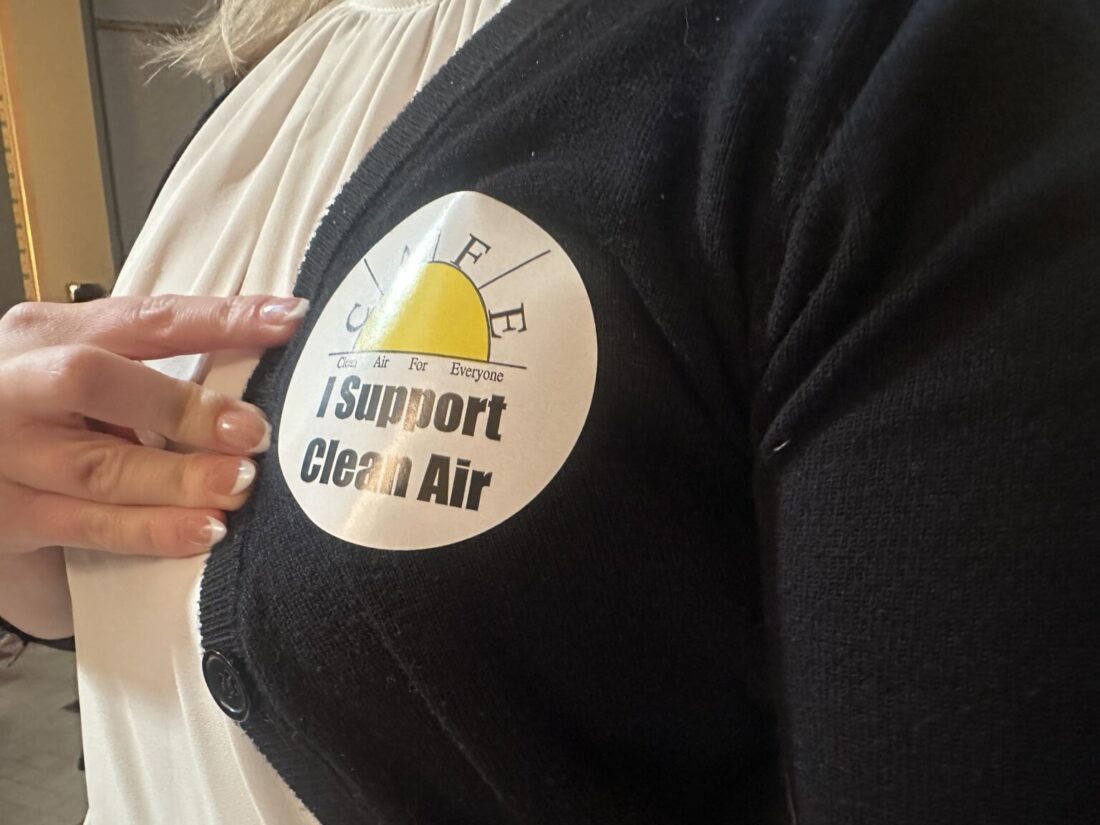
Photo by Cami Koons/Iowa Capital Dispatch — Supporters of a bill that would have prohibited smoking on casino floors wore stickers that read “I support clean air” at a Senate subcommittee Jan. 26, 2025.
Senators in a subcommittee Monday rejected a bill that would have enforced clean air act protections on casino floors.
Sen. Tony Bisignano, D-Des Moines, did not vote in favor of the bill, but made a “promise” that a reversal of the exemption would happen “relatively soon.”
Senate File 2051 would have eliminated an exemption in the Iowa Smokefree Air Act that allows smoking in gambling structures, excursion gambling boats, and racetracks.
Bisignano, who said he “participates” in casino activities and also serves on the board of directors for Prairie Meadows casino in Des Moines, said “smoking is bad” and that it was an “absurdity” to leave casinos out of the original clean air act.
“Casinos need to take the responsibility … and I think their business plan better start to change, and change quickly, because I will be the one pushing this,” Bisignano said.
Advocates for the bill, including representatives from the American Cancer Society Cancer Action Network, American Lung Association and American Heart Association, said the bill would protect gambling establishment employees who, under current law, are subject to secondhand smoke during their shifts.
Lobbyists on behalf of casinos in Iowa argued the bill would put them at a competitive disadvantage with casinos that do allow smoking.
According to the American Cancer Society Cancer Action Network, exposure to secondhand smoke for nonsmokers increases the risk of lung cancer by about 20% and the majority of lung cancer is caused by tobacco use and exposure.
“I want to stress that there is no safe level of secondhand smoke exposure, making this an occupational hazard for casino workers,” Jackie Cale said on behalf of the American Cancer Society Cancer Action Network in the subcommittee meeting.
Cale and other speakers representing health organizations noted that Iowa has some of the highest cancer rates in the nation.
Data gathered by the American Nonsmokers’ Rights Foundation show that as of July 2025, 21 U.S. states had laws in place to prohibit smoking in gambling establishments. States with these laws include Iowa’s neighbors, Nebraska, Minnesota, Wisconsin and Illinois, but not Missouri.
Mary Earnhardt, on behalf of the Iowa Gaming Association, opposed the bill and noted that casinos on tribal lands do not have to adhere to smoking laws. She said the bill would “therefore create an uneven regulatory treatment among competitors operating in the same markets, both within and across state lines.”
Earnhardt also pointed to revenue declines at casinos in Delaware and Shreveport, Louisiana, following local smoking bans.
Traci Kennedy with Americans for Nonsmokers’ Rights opposed these claims, arguing there were additional economic factors that impacted the declines at those casinos.
“The business model built on smoking in the year 2026 does not make sense,” Kennedy said. “Nearly 90% of the U.S. population are non-smokers, and so we’re catering to a smaller demographic.”
A study conducted by C3 Gaming, a casino consulting firm, found that the COVID-19 pandemic caused “a radical change in consumer attitudes towards smoking in casinos” and that since the pandemic, casinos that implemented smoking prohibitions have not experienced a drop in revenue.
Jake Highfill, speaking on behalf of Penn Entertainment and Ameristar, which is expanding a casino in Council Bluffs Iowa, said going to the casino is an “adult decision.”
“Nobody’s making you go to the casino, it is 100% adults,” Highfill said. “Nobody’s dragging kids across the floor, let adults make adult decisions.”
Joe Hafley, a former casino employee and representative for Casino Employees Against Smoking Effects, said secondhand smoke was “unavoidable” when he worked at a casino and caused him and other employees to develop persistent coughs and shortness of breath.
“For casino workers, exposure is not optional,” Hafley said. “We cannot step away from it, we breathe it in for the entirety of our shifts …There is no neutral position here. Every delay means more exposure, every delay increases the risk of serious illness.”
Tony Phillips, also with Penn Entertainment and Ameristar, said if the bill were enacted, it would put his company in “a direct competitive disadvantage” with nearby Prairie Flower Casino, operated by the Ponca Tribe of Nebraska.
Bisignano said “greed” is the force pushing back on this bill.
“I believe in this industry, but whether it’s Wall Street, or any street, greed isn’t good to me, because people get hurt by greed,” Bisignano said.
Bisignano, who was joined by Sen. Dawn Driscoll, R-Williamsburg, in voting against the bill, said the bill “wasn’t going to go anywhere” and he didn’t want to give “false hope” by passing it out of the subcommittee.
Sen. Dennis Guth, R-Klemme, who sponsored the bill and chaired the subcommittee, said he was “grieved” that the government was unable to play “its proper role.”
“The role of government is to protect its citizens, to protect its freedoms, and it’s not about economic development,” Guth said.
Todays News
Bill to prohibit smoking in Iowa casinos fails to advance

New antique/thrift store Grandma’s Attic opens on S. 3rd Ave.
Average area land values dropped slightly in 2025 despite statewide increase
Council OKs engineering agreement for Highway 14 project, Center Street viaduct contract
Rural Gladbrook couple robbed; trio of teens charged with burglary, theft
GLADBROOK – An elderly, rural Gladbrook couple was robbed while asleep last November, leading to the arrest of ...