Fire chief shares 124-year history of MFD at HSMC event
From organized firefighting techniques created in the Middle Ages to those in colonial America to Marshalltown, Fire Chief Christopher Cross detailed all and more during a presentation Tuesday night at the Historical Society of Marshall County’s (HSMC) iconic Mowry-Irvine Mansion.
It was part of the organization’s regular “History on Second Tuesday” public service event before a number of attentive and engaged attendees.
They asked compelling questions ranging from a recent fire on South Third Avenue to those in the 1800s and 1900s to current MFD staffing and equipment. He responded with detailed answers to every question in an informal, but extremely informative presentation.
Cross described how the lack of water and other fire suppression techniques required those in the Middle Ages to block fires from spreading by tearing down walls and destroying roofs to create fire breaks.
“Their objective was to keep the fire contained and not spread and threaten lives and property,” he said. “We follow those same principles now.”
Over the centuries, villages, towns and cities developed firefighting techniques from bucket brigades to horse-drawn fire carriages to the modern motorized equipment available today – supplemented by a system of fire hydrants. Cross said Marshalltown’s distinctive yellow fire trucks are unique in Iowa.
Marshalltown, originally known as Marshall, was incorporated as a village in 1853 according to Times-Republican archives. Residents were required to keep two leather buckets outside of their house to aid in firefighting, Cross said.
The June 10, 1953 T-R reported that on May 2, 1872, a fire which destroyed much of the town started at about noon in Stanley’s Elevator near South Fifth Avenue and the Chicago & North Western Railway (C&NW) tracks. Many causes for the fire’s start were given but could not be verified.
The fire was rapidly pushed northwest by a strong wind. From there, the fire spread to the E.G. Straight elevator on the east. A sheet of flame crossed Market Street setting fire to the Aultwein House – a large four-story brick structure.
Soon, Cunningham’s lumberyard and the large stone wooden factory burned with the fire spreading to the west of Station Street (now Fourth Avenue) Binford’s Elevator, and more were consumed by the flames.
A whole block of brick business buildings, owned by a “Mr. Watson,” caught fire, and the Williams House, one of the town’s largest hotels, soon was on fire. By this time, calls for aid were being sent to Cedar Rapids, Des Moines, Grinnell and elsewhere.
Grinnell’s fire department arrived via train. The Cedar Rapids department readied but was not sent.
Going north, the flames crossed Nevada Street. There, it burned Craigue and Johnson’s Grocery Store, Leonard’s Billiard Hall, Henry’s Shoe Shop, Deitrich and Son Large Dry Goods store, a livery stable, the carriage factory and the Thomas Cole residence.
The fire was so severe that Main Street merchants were alarmed, and they hurriedly removed valuable items from their properties.
While the tide of fire seemed to be sweeping directly to the courthouse, County Recorder Thomas (only name reported) took the records and carried them to safety. Cinders from the fire landed in Albion nearly six miles northwest.
The list of men who helped to fight the flames was extensive, but there was no loss of life or report of any serious injuries. The loss totaled $308,700 with insurance coverage of $105,800.
A second severe fire in 1876 and a less severe fire in 1880 led to the purchase of more sophisticated firefighting equipment. Cross, a West Burlington native, is a 33-year veteran of the firefighting profession in several Iowa communities.
“I was inspired to be an EMS/firefighter by watching the television show “Emergency!” he said. “I wanted to be like (fictional character) John Gage.”
The NBC television show debuted in 1972 and featured the challenging and dramatic work of EMS/firefighters, doctors and nurses in the Los Angeles area. Cross was appointed chief by the Marshalltown city council in November of 2024.
He previously served as the department’s interim chief and deputy chief.
The latter was under former Chief David Rierson – who retired after almost 10 years of service to Marshalltown in February of 2024. Cross was Clive’s fire chief before joining the MFD in 2016.
“The MFD is a destination fire department,” he said. “I was humbled to be appointed and plan to retire here. My wife Mindy and our son Jack have settled here. We purchased a home here and love Marshalltown. Mindy previously served as an EMS and a nurse for the local hospital. She now works from home. Jack, 13, is a student at a local school.”
Cross said he is proud to work with a dedicated team of 27 male and one female firefighter and fellow administrators. He also complimented local 911 dispatchers, past and current mayors, city councilors, fellow department heads, local residents and civic organizations for their strong support.
“Jack asked me about being a firefighter someday,” he said. “His question almost brought me to tears. I told him we could talk more about that in time.”
For more information about the MFD, contact 641-754-5723 or visit www.marshalltown-ia.gov. For more information about HSMC, contact 641-752-6664 or info@hsmcia.org.
-
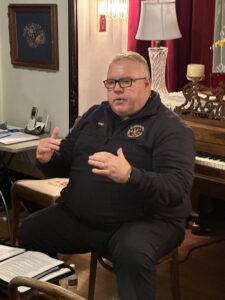
- T-R PHOTOS BY MIKE DONAHEY MFD Chief Christopher Cross is pictured answering a question about department operations from an attendee at Tuesday night’s public service event hosted by the Historical Society of Marshall County in Marshalltown.
-
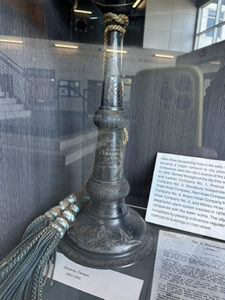
- Pictured is a “Speaking Trumpet” used by the MFD from 1882-88. It is on display at the joint MFD/MPD facility in the 900 block of South Second St.
-

- Local resident and retired businessman Ken Lamb directs a question to MFD Chief Christopher Cross during Cross’s presentation at a Historical Society of Marshall County event Tuesday evening in Marshalltown.
Todays News
Naig tours water-quality conservation projects in Tama, Grundy counties

Gov. Kim Reynolds supports U.S. war in Iran, mourns deaths of Iowans killed in strike

Iowa man charged with aggravated murder in the deaths of 3 women found in Utah

Local panelists speak of challenges faced on International Women’s Day

Ovens set to roar once again at Traer Pizza Palace