
Iowa House Democrats propose property tax rebates, limiting growth
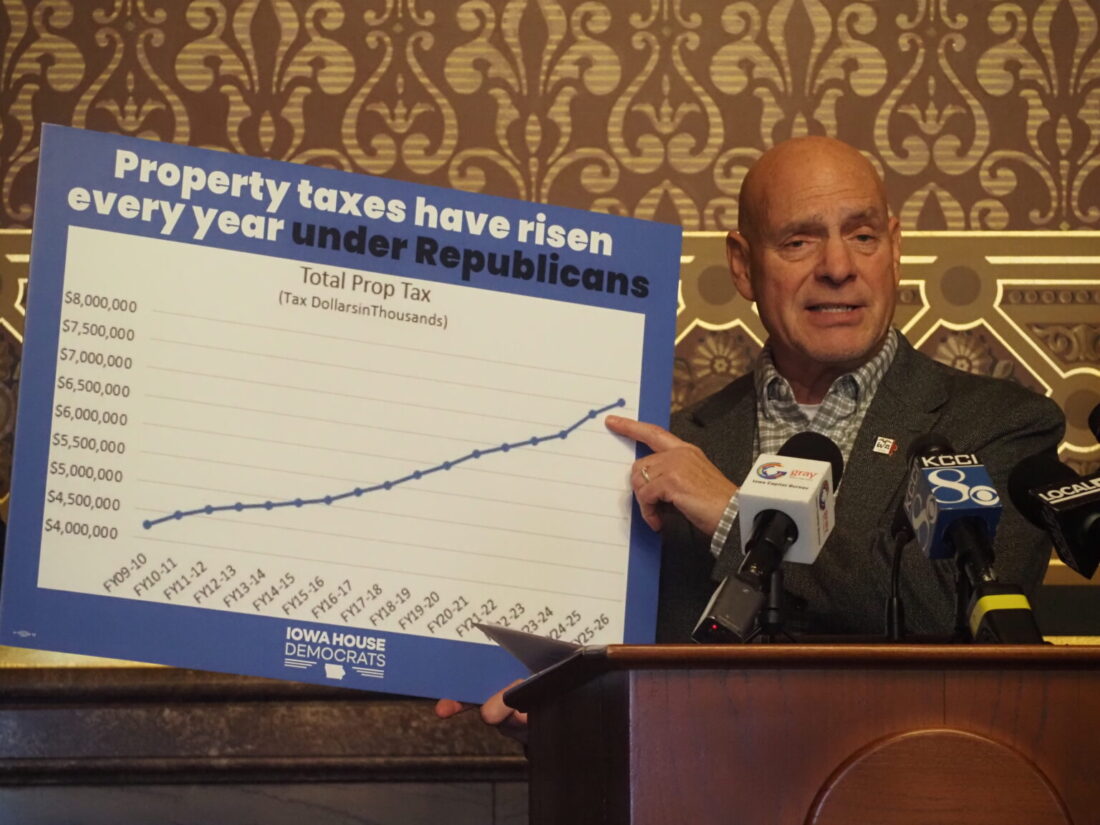
Photo by Robin Opsahl/Iowa Capital Dispatch Rep. Dave Jacoby, D-Coralville, the ranking member of the House Ways and Means Committee, showed a sign depicting state property tax costs rising at a news conference Monday about House Democrats’ property tax proposal.
With the 2026 legislative session set to start in a week, Iowa House Democrats introduced their plan Monday to tackle one of the biggest issues heading into the year — how to lower Iowans’ property taxes.
Republican leaders, including Gov. Kim Reynolds, have said changes to Iowa’s property tax system are at the top of the list for issues lawmakers will consider as they reconvene next week. Reynolds and members of the Republican trifecta at the state Capitol have spent the past few months meeting with local government officials and community leaders as they work through ways to lower property tax burdens for Iowans.
While there is not a clear consensus from Republicans on what property tax legislation they will introduce, House Democratic leaders unveiled their proposal at a news conference Monday.
Rep. Dave Jacoby, D-Coralville, ranking member of the House Ways and Means Committee, said the proposal involves four components: freezing property taxes for people age 65 and older, tripling the Homestead Tax Credit, limiting property tax growth to 4% annually and providing state support for public safety workers’ retirement funds. Jacoby said while transitioning to this new system, the measure would provide two years of “immediate relief” through rebates of $1,000 for homeowners and $500 for renters.
By limiting property tax growth each year, the Democrats’ plan would provide “certainty” to both taxpayers and the local government entities that rely on these taxes, like schools, cities and counties.
“Our plan offers effectiveness — a word that you’ll hear often this year from House Democrats,” Jacoby said. “And, hopefully in a bipartisan way with Republicans, we want a policy that’s effective. Our plan will work, and Iowans will feel the effects immediately.”
In addition to the rebates, Jacoby said the proposal would offer immediate savings for Iowans through an increased Homestead Tax Credit. The credit for qualified homeowners is based on a portion of the homestead’s actual value. The plan would increase the tax credit from an average of $200 to $300 per household to $500 to $600 per household.
Other parts of the plan, he said, like limiting property tax growth, will provide more long-term cost savings for Iowans by ensuring that each year, costs can only rise a certain amount. Under the 4% growth cap, each $1,000 of property tax costs could grow to a maximum of $1,040 the next year, he said.
Freezing property taxes for seniors — “not by means, not by formula, simply by age,” Jacoby said — will also give older Iowans more assurance that they can afford to remain in their homes.
“Many seniors would like to stay in their home,” Jacoby said. “Many people would like to move, but they can’t afford the property tax liability if they move up. This way, it offers certainty that we will also open up the housing stock in Iowa.”
Jacoby said the exact costs of some parts of the plan, such as the rebates and senior tax freeze, were still being discussed with requests out to the Legislative Services Agency, Iowa League of Cities and the state Association of Counties for estimates. However, he said he expected some funding for the rebates to come from the Iowa Taxpayer Relief Fund.
Some components of this proposal were also introduced by House Democrats as legislation in the 2025 session, which did not receive a subcommittee hearing.
The property tax measure discussed most last year was Republican leaders’ plan to eliminate Iowa’s “rollback” system of calculating property taxes and make other changes to limit tax growth. Jacoby said he believes Republicans’ proposal is to “eliminate rollback and somehow make up for it — but that is economically impossible.” He also criticized the idea of limiting property valuations, which he said was a “dangerous path” to start on.
Jacoby said he has spoken with Republicans, including the new House Majority Leader Bobby Kaufmann, about how to approach the subject of property taxes from a bipartisan perspective.
“We’ve seen over the years that the things that have been done from the Statehouse have been totally ineffective, and in fact, they’ve hurt more,” he said. “I will say this, we do have positive relationships with people across the aisle … that are very interested in an effective plan.”
Todays News
Retired Marshalltown police chief announces campaign for Iowa House
Iowa House Democrats propose property tax rebates, limiting growth
Downtown hospital no longer up for auction

GQ Gentlemen’s Quartet to perform Live On Stage
Looking back on 2025, looking forward to 2026 pt. 3
Respiratory viruses on the rise, subclade K flu variant now dominates U.S.
Influenza remains a health concern going into the new year, both in Marshall County and internationally. A mutated ...