
Supervisors OK two more opioid settlement fund grant agreements
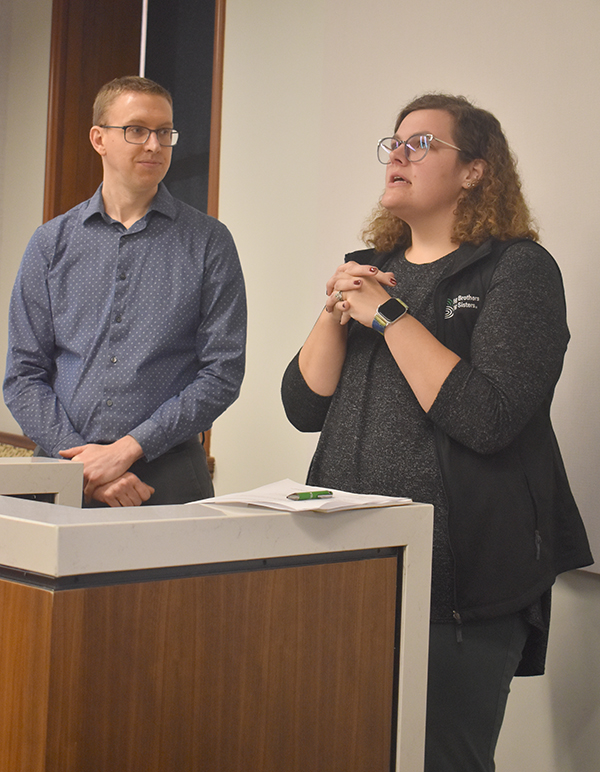
T-R PHOTO BY ROBERT MAHARRY Marshall County Attorney Jordan Gaffney, left, and Heart of Iowa Big Brothers Big Sisters Executive Director Brookelyn Schlawin, right, address the Board of Supervisors during Wednesday morning’s meeting. The board approved a $34,375 grant application utilizing opioid settlement funds to expand the organization’s mentorship program and specifically target children of parents who have been impacted by opioid use disorder.
The Marshall County Board of Supervisors officially finalized two more grant agreements with local agencies for programs utilizing settlement funding from the national opioid lawsuit during Wednesday morning’s regular meeting — one for $34,375 with Heart of Iowa Big Brothers Big Sisters (HOI BBBS) and Prairie Ridge Integrated Behavioral Healthcare, formerly known as SATUCI.
Marshall County Attorney Jordan Gaffney explained that grant applications opened last year, and the BBBS application received approval from the grant committee. The nonprofit organization plans to expand mentorship programs for boys and girls within Marshall County — specifically, those with parents or guardians who have been impacted by opioid use disorder.
The stated goal is that early prevention for those children who would be most at risk could benefit from a volunteer “Big.”
“This opioid funding project is a little outside the box, but when you think about it and you think about prevention, it’s really important to start young. And connecting somebody, a young person who’s at risk, with a big who can be a really valuable mentor and a guide for that person can be all the difference and have the opportunity to change the trajectory of a child’s life. So I hope you’ll support this project,” Gaffney said.
HOI BBBS Executive Director Brookelyn Schlawin stepped forward to answer a question from Supervisor Carol Hibbs on how children will be identified for the program, and she responded that they are mostly self-reported through parent applications and disclosure through that process.
Auditor/Recorder Nan Benson then asked the supervisors to approve the Memorandum of Understanding (MOU) and attachments and adopt the resolution in a two-step format, and the board voted unanimously to do so by a 2-0 tally.
From there, the board moved on to the second agreement with Prairie Ridge, and Gaffney described the organization as a longtime trusted community partner. The application would provide for the hiring of two part-time peer support specialists who are in recovery themselves and would work hand in hand with a substance abuse counselor to “bolster and enhance” the treatment services Prairie Ridge provides.
“What their presence and their involvement and their activity helps to do is it gives them a certain amount of base knowledge for what somebody with a substance use disorder who’s going through treatment. They know what they’re going through because they’ve walked that walk,” Gaffney said. “They have a certain level of credibility that you might not have if you’re a defense attorney or a prosecutor or a judge or a probation officer or a family member saying ‘Hey, you need to get clean and sober. It’s time to address this and you need to get better.’ That person, their words and their advice and their insight carries that different credibility and different weight that would really enhance those services.”
The funding application includes gas cards for the peer support specialists to attend groups and other activities for people involved in treatment such as picnics and other social activities for those in recovery. It can also serve as a preventive measure for someone engaging in treatment who hasn’t developed an opioid use disorder but is at risk, and it can conversely help with those who have already developed them.
The application also includes a Naloxone (Narcan) vending machine that helps to reverse the effects of a drug overdose with a small number of doses — which could mean the difference between life and death without enabling abuse. Board Chairman Jarret Heil asked Gaffney to remind the public how much funding the county has received from the settlement with opioid manufacturers and distributors thus far, and he replied that since 2022, the county has taken in over $600,000.
The settlement funds must be used to support opioid abatement activities, prevention, addressing opioid use disorder and combatting overdoses. The supervisors have already approved an expansion of the Marshalltown Police and Community Team (MPACT) co-responder program throughout the county in partnership with YSS, and once Wednesday’s two motions were approved, the total allocations totaled just under $300,000 for programs designed to combat opioid use disorder.
“These are programs that not only are saving lives and will save lives but help people live full and rich lives and keep families together, quite honestly,” Gaffney said.
Hibbs also inquired about a timeline on spending the funds and the remaining balance after these allocations, to which he replied that the county will still have about $300,000 on hand and will continue receiving funds for the next 15 or 16 years. There is currently no deadline on the spending as outlined by the state, but as previously mentioned, there are defined parameters on how the money can be spent.
“I’m really thankful for our committee and the work our committee has put into it and our community partners who have expressed interest and really brought a diversity of projects to us and opportunities to put these funds to work right here,” Gaffney said. “Because I’d rather see the money going to work right here and making a difference here than maybe kicking it to the state, because that’s an option too. But I’d much rather see it get used right here.”
Benson passed a message along from Assistant Auditor/Recorder that the monies are committed and then billed for reimbursement when expenses are submitted. Prairie Ridge CEO Kelly Grunhovd, communicating via Zoom, briefly addressed the board and noted that as they hire the two peer support specialists, they will be full-time employees. She added that staff will only be funded by the settlement dollars when there is no other payer such as Medicaid.
Grunhovd also explained that training will be available for Naloxone through Prairie Ridge staff in order to ensure that the doses are properly administered in an emergency situation. With no questions from the board, the second MOU was approved, and the resolution was adopted unanimously.
——
Contact Robert Maharry at 641-753-6611 ext. 255 or
rmaharry@timesrepublican.com.
Todays News

Identity of man killed in Sunday morning shooting released
Suspect arrested in connection with Sunday morning shooting
MCSD board awards bids for Miller Middle School project

Marshall County Treasurer Deann Tomlinson announces reelection bid

‘Iowa Skilled Workforce Act’ bill advances from House subcommittee