Water Works, MFD open to ‘working together’ after recent fire hydrant failures
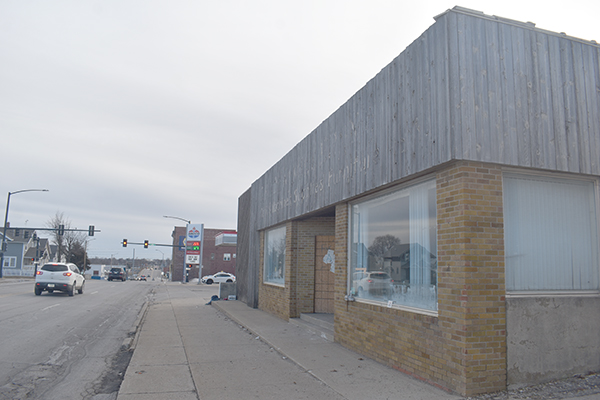
T-R PHOTO BY ROBERT MAHARRY The Marshalltown Fire Department (MFD) responded to a blaze at the vacant commercial building pictured on 3rd Avenue last Thursday, and firefighters unsuccessfully attempted to hook up to two inoperable hydrants nearby before finding a reliable water source near the scene.
The condition of Marshalltown’s fire hydrants came into the spotlight last week after a press release from the Marshalltown Fire Department (MFD) noted that the response to a blaze at a vacant commercial structure was delayed due to two separate hydrant failures last Thursday evening.
Marshalltown Water Works (MWW) General Manager Zach Maxfield, whose organization owns and maintains over 1,000 hydrants within city limits, told the T-R that Fire Chief Christopher Cross notified him about the failures the day after the fire, and Maxfield was a bit surprised when he saw that they were “all over the news” the same day. According to Maxfield, MWW staff performs annual flushing operations and uses that process to find non-functional hydrants.
“Typically, we assume that they work until they don’t,” he said. “We have hydrants in town that are probably 40, 50 years old, and they work just fine. We don’t typically replace them unless we can’t find parts or couldn’t do a repair on it or we find one that’s broken and then it’s unfixable. Then we’ll just dig it up and fully replace it.”
Because they only do that once a year, he added, MWW staff sometimes have to rely on the public, situations like the recent fire to know or reports of a hydrant being hit by a vehicle to learn that a hydrant doesn’t work.
“When a hydrant’s just sitting there and looks normal, you don’t know that it got hit by a snowplow or a car could’ve potentially run into it, and I think that was the situation with this one. Our guys went and checked it out afterwards, and you can move it with your hands,” Maxfield said. “I know the one must’ve gotten hit by something. You can’t typically walk up to one and shake it, and that’s how it was. But if you drive by, you’d have no idea that it didn’t work. It didn’t look damaged. And we went and looked at the other one, and no water’s coming out of it.”
Before the fire last week, Maxfield said neither of the two nearby hydrants had been flagged or identified as non-functional.
“We try to get on them as soon as we can when we find out that they don’t work. We try not to do very much construction work in the wintertime. We’re gonna fix these because it’s a priority,” he said. “We’re gonna have to rip out some street, and if we rip out the street, we may not be able to get it poured back. And then all of a sudden, we’re dealing with potholes. It’s hard to balance making everybody happy, but obviously fire protection is the number one priority. I mean, that’s kind of why water departments are around.”
One of the two hydrants in question was scheduled to be dug up on Wednesday, and Maxfield said that the current warmer temperatures will make the process easier. When asked if the recent situation would prompt any sort of review by the MWW Board of Trustees or policy changes, he responded that the goal will remain to keep up with yearly testing because the flushing process takes months to complete.
“I don’t want to say that’s an excuse, but when you have seven guys and there’s 1,000 fire hydrants, you can’t just open and close them and go around checking them every day,” he said.
MWW has 10 utility workers, and typically, four go out in the springtime in two groups of two and flush every hydrant, with one group starting on the east side of town and the other on the west.
“We’re constantly looking at trying to make things better and trying to come up with solutions to fix things because fire protection is the number one priority. Unfortunately, fire protections are finicky but they’re also gentle. They get broken easily,” Maxfield said.
The annual MWW budget for the replacement of fire hydrants and valves is around $100,000, but to dig up and replace a single hydrant can cost upwards of $10,000 — around $5,200 for the new hydrant itself before the parts and pieces to put it back together, concrete and rock.
“We take it seriously, but you have to be smart about it,” he said. “Unfortunately, occasionally these things happen, and we just go out as soon as we can and get them fixed and we hope that it doesn’t happen again… We could go through town in the spring and flush every hydrant and then nobody touched it for a year, go back there the next year and it doesn’t work. And it’s like, ‘Well nobody’s touched it in a year, why doesn’t this work now when it worked before?’ And then we address it, and we fix it. It’s why we have jobs.”
Cross also spoke to the T-R earlier this week and explained that in the simplest terms, the faster firefighters can hook up to a sustainable water supply, the faster a blaze can be contained and the situation at hand stabilized.
“We don’t arrive to the incidents empty handed. We carry 1,000 gallons of water with us wherever we go, so we can start to do fire operations off of tank water. It’s a finite supply, but on residential stuff, it’s important because it takes less water to put out less square feet,” he said. “In this particular incident downtown, we were about 97 percent sure that the building was empty and it wasn’t super time sensitive. It was just a big building, and we weren’t going to be able to commit firefighters to the inside in a sustained manner until we had a reliable supply of water. And the lag between the time that we started attempting to hook up to stuff and the time that we achieved a water supply, it wasn’t maybe five minutes or something like that. While it’s frustrating when we encounter these situations, it’s not necessarily unheard of, and we train for that and we also bring water with us wherever we go. I guess in the grand scheme of things, I don’t want to say that it’s not a huge deal, it’s a huge deal, but we mitigated it. We understand that that’s a risk, and we’ve taken steps to mitigate that risk ahead of time.”
The chief added that he is open to partnering with MWW, which is technically an independent entity from the city with its own budget and a board appointed by the mayor, going forward, and he said the men and women of the MFD are always quick to let MWW staff know when a hydrant fails.
“I’d encourage the back and forth communication between the two departments, 100 percent,” Cross said. “I understand budget dollars being finite, and I know that they have to prioritize all kinds of operational wants and needs within their organization, but we would appreciate anything that they can do to help get some of these hydrants that are offline back online.”
According to Cross, comments frequently come in via phone calls, emails and social media about hydrants that have been knocked over and not replaced, which makes him feel “helpless” knowing he can’t immediately doing anything about them, but he understands that Water Works is doing the best it can to “plug the holes.”
“We don’t have any operational control over anything that Water Works does. I think the only time that we overlap, at least to my knowledge, is on things like this or when Water Works needs to do a project in our right-of-way, then we help them with the permitting process and give them exclusive access to things,” Cross said. “I don’t know what the cost is for them to get into our right-of-way, but we try to grease the skids as much as possible for them so that they can do their work because we know that their work is crazy important to the entire city.”
An exact cause of the fire has not yet been determined, but Cross said there have been squatters in and out of the vacant building just north of the Amoco gas station along 3rd Avenue.
During the public comment period of Monday night’s Marshalltown city council meeting, resident Lyle Hineman pushed for a stronger emphasis on fire hydrants as part of efforts to improve public safety in the community.
“Why should it take three times to find a hydrant that works? How many hydrants in this town don’t work, and is the water department really trying to keep them working?” he asked. “The real number of hydrants that don’t work, is it nine, 20, 80? I know of a hydrant that was hit by a vehicle at Center and Madison over a year ago. That hydrant has not been replaced yet, so did the hydrants get pushed back on the to-do list to the someday list? I also went to the Water Works website today to do some investigation, and it says ‘Quality, affordable, reliable.’ You decide.”
——
Contact Robert Maharry at 641-753-6611 ext. 255 or rmaharry@timesrepublican.com.
Todays News

MCBD takes on Live After Five
Supervisors OK two more opioid settlement fund grant agreements

North Tama high school students begin classes in new addition
Water Works, MFD open to ‘working together’ after recent fire hydrant failures
Council opts against pursuing uniform parking configuration ordinance