Alleyway projects reignite debate over street repairs at council meeting
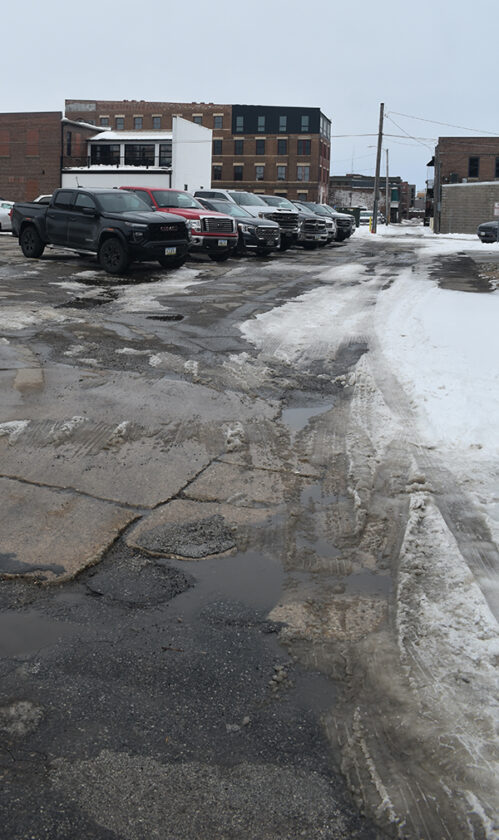
T-R PHOTO BY ROBERT MAHARRY — A discussion about proposed improvements to two alleyways in Marshalltown, including this one east of the Marshall County Courthouse, prompted debate over the city council’s lack of action on street repairs during Monday night’s meeting.
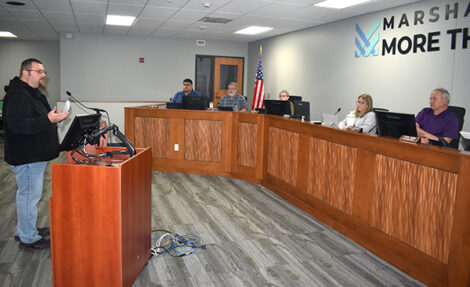
Emotions ran high during Monday night’s city council meeting as a conversation about a proposed alleyway project brought another familiar topic — the condition of Marshalltown’s residential streets and perceived inaction on improving them — back to the forefront of the discussion.
Public Works Director Heather Thomas explained that the council was being asked to consider improvements to a pair of alleyways — one near the county’s parking lot across the street from the courthouse to the east and another that is being conceptualized as a pedestrian alleyway along East Main Street near the 7 Rayos Liquor Store. Speaking on the former, Thomas said county officials reached out to the city about improving its alley near theirs to address drainage issues, with the county recommending a two-inch overlay to raise the height of their pavement.
“The reason for that is because they’re concerned the thickness of their existing asphalt wouldn’t support them milling it down and bringing it back to the current grade, so they’ve asked the city if we would participate,” she said.
Thomas added that the project wasn’t “imminent” from the city’s perspective as the sanitary sewer has been working for decades, but she felt comfortable proceeding with service work. One challenge would be the private utilities in the area, and she asked councilors if they would be OK taking contingency funds from the East Main Street project in the amount of about $13,000.
Councilor Gary Thompson commented that the project was a “publicity nightmare” because it sent the message that the alley was more important than residential street improvements, and he asked if there were other eligible funding sources beyond bonds originally allocated for street projects. She replied that Road Use Tax Fund (RUTF) dollars would also be eligible, and she would follow the council’s direction on whether the city should participate in the project.
Fellow Councilor Jeff Schneider quickly motioned to direct staff to use bond funds to fix the alley, and after it was seconded by Councilor Melisa Fonseca, Councilor Mark Mitchell shared his thoughts.
“We’re gonna have people really upset with the decision if that’s the way we go because everybody you talk to says ‘We need the roads fixed.’ So I think we should put the money towards our roads and let this ride. If the county wants to do it, let the county do it,” he said.
During the public comment period, Joleen Ballard began her remarks with “Really?” before criticizing the council’s priorities.
“You’re gonna add more on and not fix our streets? When does it stop?” she asked.
Councilor Greg Nichols then motioned for an amendment to use RUTF dollars instead, but it died for lack of a second. The original motion passed by a 5-2 vote with Thompson and Mitchell opposed.
From there, Thomas moved on to the future pedestrian alley that will be known as “The Lane” as the Arts + Culture Alliance is working with an artist to develop conceptual plans, and she noted that it is currently in “pretty rough shape.” During that discussion, Councilor Sue Cahill opined that downtown alleys are used at a much higher rate than those in residential areas and are part of the larger infrastructure improvement efforts.
“I understand where we’re thinking about what we’re spending our money on, but I view these alleys, especially these two, as part of our downtown infrastructure that we got the bonding for. So I would be in favor of doing this project as well,” she said.
Thomas estimated a cost of around $7,000, and Schneider agreed with Cahill that it was part of a larger project to improve the downtown area before making a motion to proceed using bond funds. That vote passed by a 4-3 tally with Thompson, Nichols and Mitchell opposed, and before casting his vote, Mitchell remarked “Obviously, your money tree is bigger than the one I have in my backpack,” which drew a reprimand from Mayor Mike Ladehoff when he told Mitchell that councilors should only answer “yes” or “no” on roll call votes.
City Finance Director Diana Steiner then provided a brief summary of special revenue funds as part of ongoing budget discussions before City Administrator Carol Webb moved on to the Capital Improvement Plan, which generated more conversation on how much money will be put toward street improvements. Fonseca asked Webb to specifically address those plans so the public will know what to expect.
“Just from the other comments that were made by other council members, I just wanted to let the public know that there are funds going towards the streets and towards the roads, and that’s not being left out at all in this Capital Improvement Plan,” Fonseca said.
Steiner added that the goal is to use the oldest bonds first and highlighted projects like the aquatic center improvements for $221,000, Kiwanis Park improvements for $13,000 and library parking lot and garbage enclosure for about $33,000. With the oldest bond now nearing five years old, Thompson asked her what the public was originally told it would be used for, and she replied that it was street improvements and patching.
“It’s still being used for that. We’re just trying to get rid of the old stuff first. We’re just shifting it to another bond for those street projects, so we can get it spent,” she said.
Thompson took issue with the idea that the bond was presented as being spent on streets and was now shifting to another use. Cahill sought further clarification on the timeline for specific street improvements and communication of the plan to community members, and Thomas returned to the podium to discuss it in more detail.
According to Thomas, some pavement improvement work can be expected this year, and Cahill said councilors like her who were elected in 2025 promised the people transparency on how such projects would be handled. In response to a question from Mitchell, Thomas told the council the city has a Pavement Condition Index (PCI) report that rates the state of existing streets but does not prioritize which ones should be repaired or resurfaced.
Thomas then said city staff hoped to have an outlined plan by August or September, and during public comments, Leigh Bauder suggested a plan that would allow councilors and city staff to let residents know when their street was up for repair with some sort of an interactive map.
“If we can get the T-R to support that and get that information out to the public, I think you’re gonna have some happier people, and you’re gonna also have more utilization of the city website,” she said. “I’m just trying to think of ways to drive traffic there but also help these councilors up here on when does this happen? When are we looking at our streets getting done?”
As Steiner asked for direction on the aquatic center and library projects, Thompson motioned to use the money for street improvements as they were the original purpose of the bond. It passed by a unanimous 7-0 tally.
——
Contact Robert Maharry at 641-753-6611 ext. 255 or rmaharry@timesrepublican.com.
Todays News
Meet ‘Anastasia’
Colleagues praise Sorensen’s leadership as she departs
In preparation for the publication of this story, community members who have been involved with the MAUW in various ...
Alleyway projects reignite debate over street repairs at council meeting
Sanchez Vasquez placed on probation for election misconduct
Jorge Oscar Sanchez Vasquez was granted a deferred adjudication last Friday by Judge Kathryn Austin. In December, ...
Judge: City’s arrest of critic is ‘quintessential viewpoint discrimination’